


Roland Berger’s Future of Health 7 study reveals how equity, coordination, digitalization, prevention, resources, governance and innovation shape resilient healthcare systems worldwide.

Pharma & Healthcare
We support life science companies and health insurers in mastering the challenges of tomorrow
In a world where healthcare is the most indispensable industry of all, Roland Berger advises companies that care about our health.
Healthcare companies are facing a changing environment: new, disruptive technologies are entering the market, new levels of treatment individualization are being achieved by means of stratified medicine, digital technologies allow the creation of new opportunities to demonstrate the practical effects of pharmaceutical treatment methods and medical technology companies are being challenged by increased regulatory and market access requirements. At the same time, manufacturers and suppliers are under great cost pressure. Digitization enables health insurance companies to take advantage of new opportunities to design care pathways and strengthen their customer relationships.
At Roland Berger, we help navigate the industry through these problems and move it forward. We focus on innovative market strategies and international expansion as well as careful management of the supply chain and production sites, enabling the transition to individualized medical care with the patient at the center.
Pharma
Further reading


Contact to our Global Pharma experts


MedTech
Continuous cost pressure in the healthcare system is making it increasingly difficult for MedTech companies to achieve the traditionally high growth and profitability figures. At the same time, the increasing challenges that hospitals are facing and the digitalization offer vast opportunities for MedTech companies. These are just some of the reasons why MedTech companies have to constantly question their business models and take on the role of healthcare providers, for example by extending their value chain towards the patient. At the same time, these trends mean that the performance of all corporate divisions, from development to production and sales, is becoming increasingly important.
Roland Berger regularly assists MedTech companies with our comprehensive functional know-how and our deep understanding of customer needs to meet the following challenges, among others.
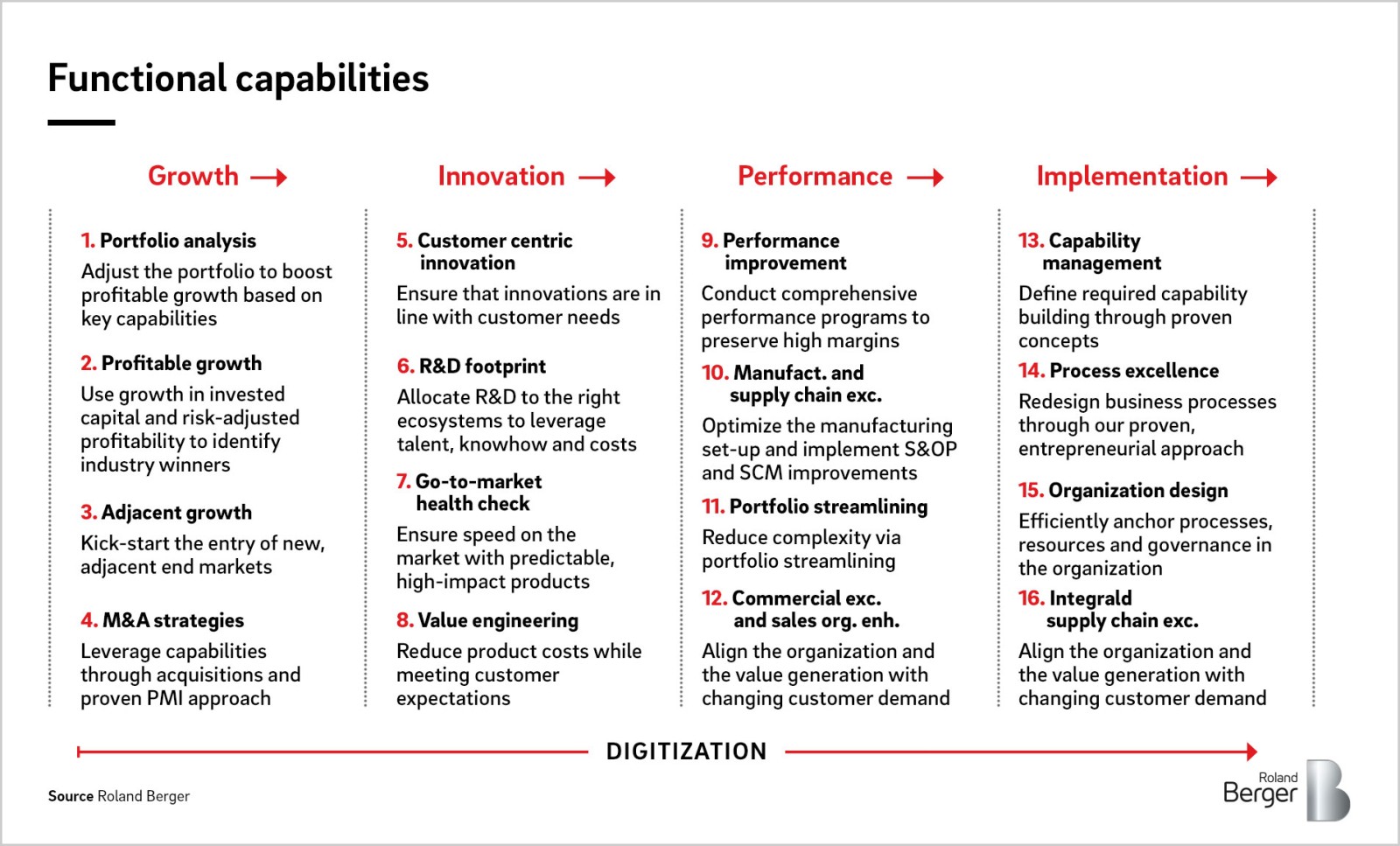
Contact to our MedTech experts


Healthcare and Hospitals
The landscape of service providers in the health care sector is subject to increasing dynamics, especially considering the constantly changing regulation. Market conditions for healthcare providers are generally considered favorable. The healthcare market is growing steadily due to increasing patient numbers and higher per-patient expenses. But in many countries, we have been seeing sustained economic pressure on hospitals and a high investment backlog for years. This economic and financial pressure is further intensified by increasing outpatient care and a multimorbid patient structure. This patient structure also affects nursing home operators, who must ensure the care of people in need of nursing care while being challenged by staff shortages and increasingly strict minimum legal requirements.
Roland Berger has many years of experience in healthcare consulting to help your company navigate through this complex landscape. We offer a comprehensive range of services and support you in various areas.
Strategy development
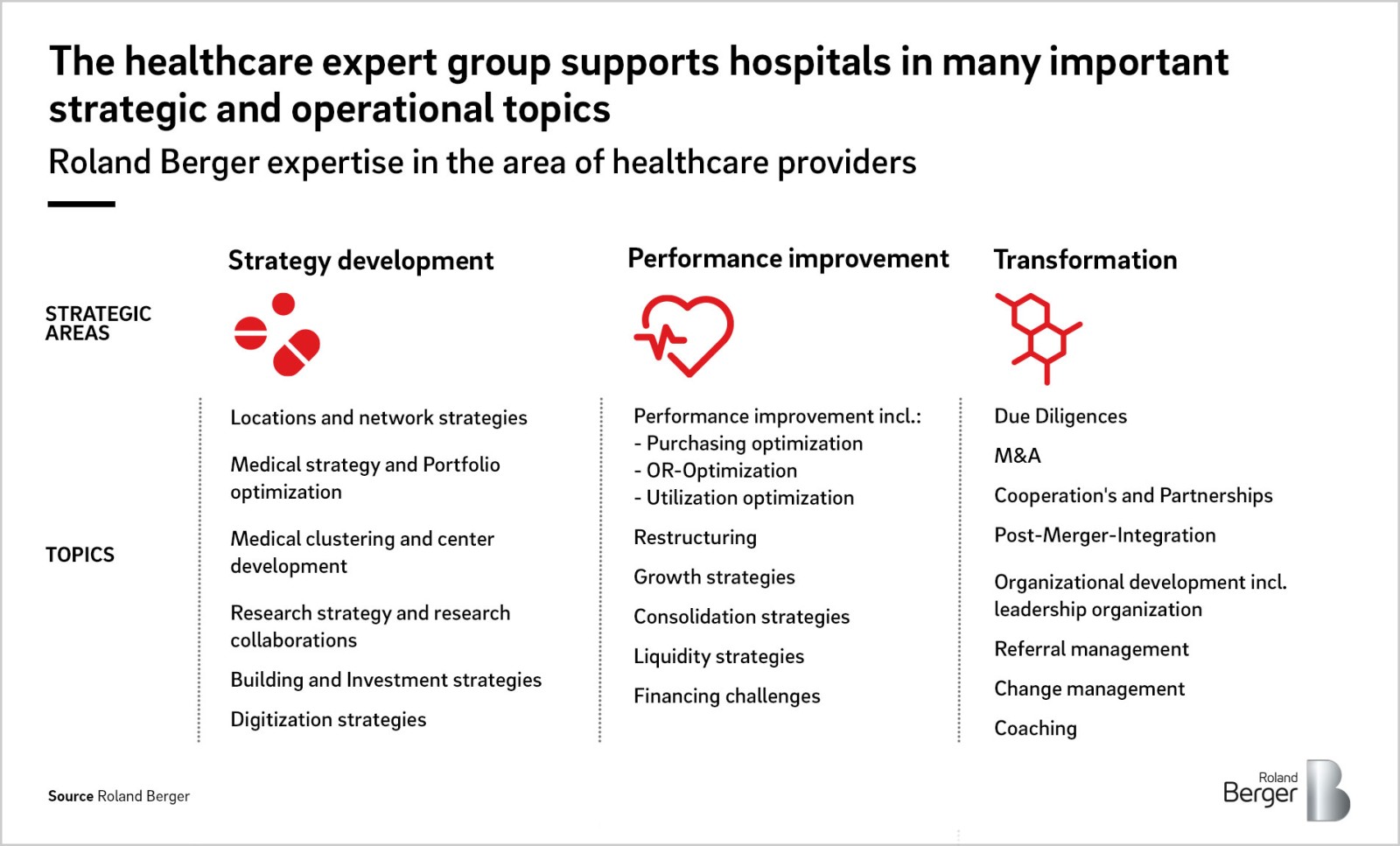
We help service providers to solve the most diverse strategic problems. Against the background of a changing regulatory environment, which also creates new competition, we advise service providers in questions of medical strategy. Within the environment of location, network strategies and structural assessments, we analyze to what extent a consolidation of locations or the establishment of centers with selected medical specializations can be beneficial. In this process, the challenge of a very high investment requirement often arises. In this case, we also advise together with our partners in the areas of construction and investment strategy. We also advise university hospitals in particular on the development of a targeted research strategy. Digitalization is also becoming increasingly important for healthcare companies. With our digital experts, we are on the forefront of digitization and advise on various issues across the entire value chain.
Performance improvement
In hospitals, personnel and material costs increase often faster than the fees generated by patients. Hence, many healthcare providers are under an increased cost pressure. Roland Berger therefore supports healthcare providers in profit improvement programs. To achieve sustainable effects, we take a holistic view of hospitals in a contribution margin logic and optimize everything from medical services (e.g. optimizing length of stay), medical services (e.g. optimizing operating rooms) and non-medical services (e.g. cleaning and catering) to administration.
In the event of acute liquidity crises, we also carry out restructurings as well as reorganization reports. Within the scope of this we consider liquidity optimization measures as well as economic and financial restructuring measures.
Transformation
The healthcare market offers attractive investment opportunities even as consolidation increases. Here we bring transparency to the upcoming transaction in the context of vendor commercial due diligences and commercial due diligences or support the purchase or sale process in a leading role. After a successful M&A transaction, we help healthcare companies to smoothly integrate the acquisition in the sense of a post-merger integration (PMI), so that after successful integration not only the economic result is right, but also the new corporate culture wins over employees.
In addition, we help service providers to adapt their organization to the new environment even after a transaction, growth or consolidation phase. Both on the operational and on the management level.
With sustainable change management and coaching, we also ensure that our work is sustainable and that knowledge is transferred into the organization.
Interim management
Interim management is a key driver of successful change in hospitals, providing leadership at short notice during critical transitions. Our experienced interim managers—serving as CROs, CFOs, or CEOs—bring deep industry expertise and an unbiased perspective to guide hospitals through restructurings and transformations. Working closely with internal teams and external stakeholders, they develop and implement effective solutions that ensure stability and long-term value.
By combining IMPEX’s interim management expertise with our specialized healthcare consulting, we offer a powerful blend of strategic insight and hands-on execution. This partnership helps hospitals adapt to market shifts, enhance profitability, and achieve sustainable success.


Contact to our Global Healthcare experts


Health insurance
With digitization, health insurance companies can accelerate their transition from payor to player and intervene even more actively in care: In the course of innovations, such as electronic patient files or apps for care and service, ecosystems are created at the interface between insurance and the insured, in which classic and digital care interact.
All functions of health insurance are changing, from digital contact in sales to invoice verification with Artificial Intelligence or the digital coaching of chronically ill patients. A large number of digital services, optimized patient pathways and other care offers need to be developed and implemented. At the same time, and for this to be successful, internal development processes must be modernized and organizations made fit for digital forms of work.
Roland Berger advises and accompanies health insurers in the development of digital strategies, in the implementation of projects such as patient files or the introduction of apps and digital services, as well as in internal cultural and structural changes. We draw on decades of project experience and constantly adapt our methods to new trends and developments. We develop our measures in constant dialog with our customers. The team combines a wide variety of skills and focuses: doctors, economists, experts in the field of digitization and IT, and data scientists.
Contact our health insurance experts

_person_320.png?v=1687234)
Experts


_person_144.png?v=1687234)


_person_144.png?v=1687234)


Middle East


Get in touch