eSIMs set for major growth by 2030
Initially launched in consumer wearables just over five years ago, eSIM technology is now becoming increasingly popular. This growth is predominantly driven by manufacturer innovation: all new smartphone models from Apple and Samsung, for instance, now have eSIM capability.
In the smartphone segment, 10% of connections made in 2023 were eSIMs. This is expected to show a CAGR of around 40% over the rest of the decade, reaching approximately 75% of all smartphone connections in 2030.
The continued expansion of IoT technologies means eSIMs are also set for greater adoption in a variety of industries, including manufacturing, automotive, logistics, and utilities.
But what do these changes mean for operators? In late 2023, we spoke with 11 top managers from primary telecoms operators across North America, Europe, Africa, the Middle East, Asia (excluding China), and Oceania. This article outlines the key findings.
Key survey results
eSIMs a major factor but not a short-term priority in the consumer segment
All the operators we surveyed said eSIMs are factored into their strategies, offering the option to adopt eSIM at least for some customer segments (typically business customers).
However, less than 20% of interviewees said eSIMs were currently a top priority due to the low adoption rates of eSIM-enabled devices among their customer bases.
The most promising segments appear to be IoT (30% of respondents) and enterprise (20%), albeit with different respective rationales and limitations.
For IoT devices, including wearables, the possibility of remotely configuring an eSIM with different connectivity plans enables greater flexibility, especially for devices like smartwatches that are shipped to multiple countries. However, some respondents noted the modest adoption of cellular IoT networks as a limitation.
Among mobile SIM customers, the enterprise segment appears more attractive than the consumer one in the short term. One key factor is the lower price sensitivity for both service subscriptions and eSIM-enabled device adoption. There is also a higher concentration of international travelers who could benefit more from eSIM adoption to reduce roaming charges.
Mid-term adoption shows potential upsides
There is a consensus among respondents that eSIMs are likely to be widely adopted in the mid-term. This is expected to mostly be enabled by more affordable eSIM-equipped devices and the natural handset replacement cycle.
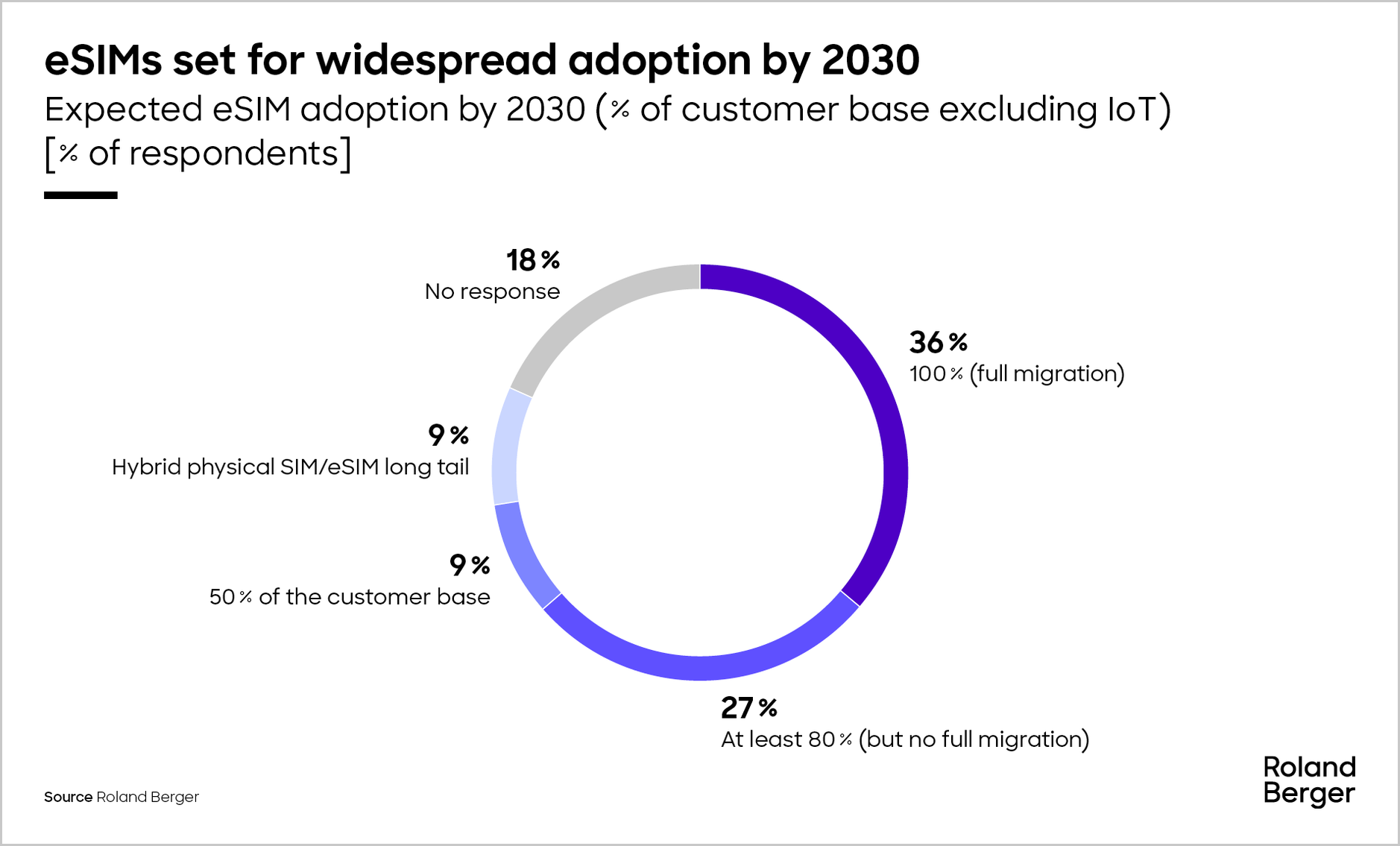
More than half of participants expect at least 80% of the entire subscriber base to have eSIMs by 2030. Just over a third of respondents anticipate a complete migration, with less than 10% foreseeing a hybrid ‘physical SIM/eSIM’ long-tail scenario.