Pros and cons
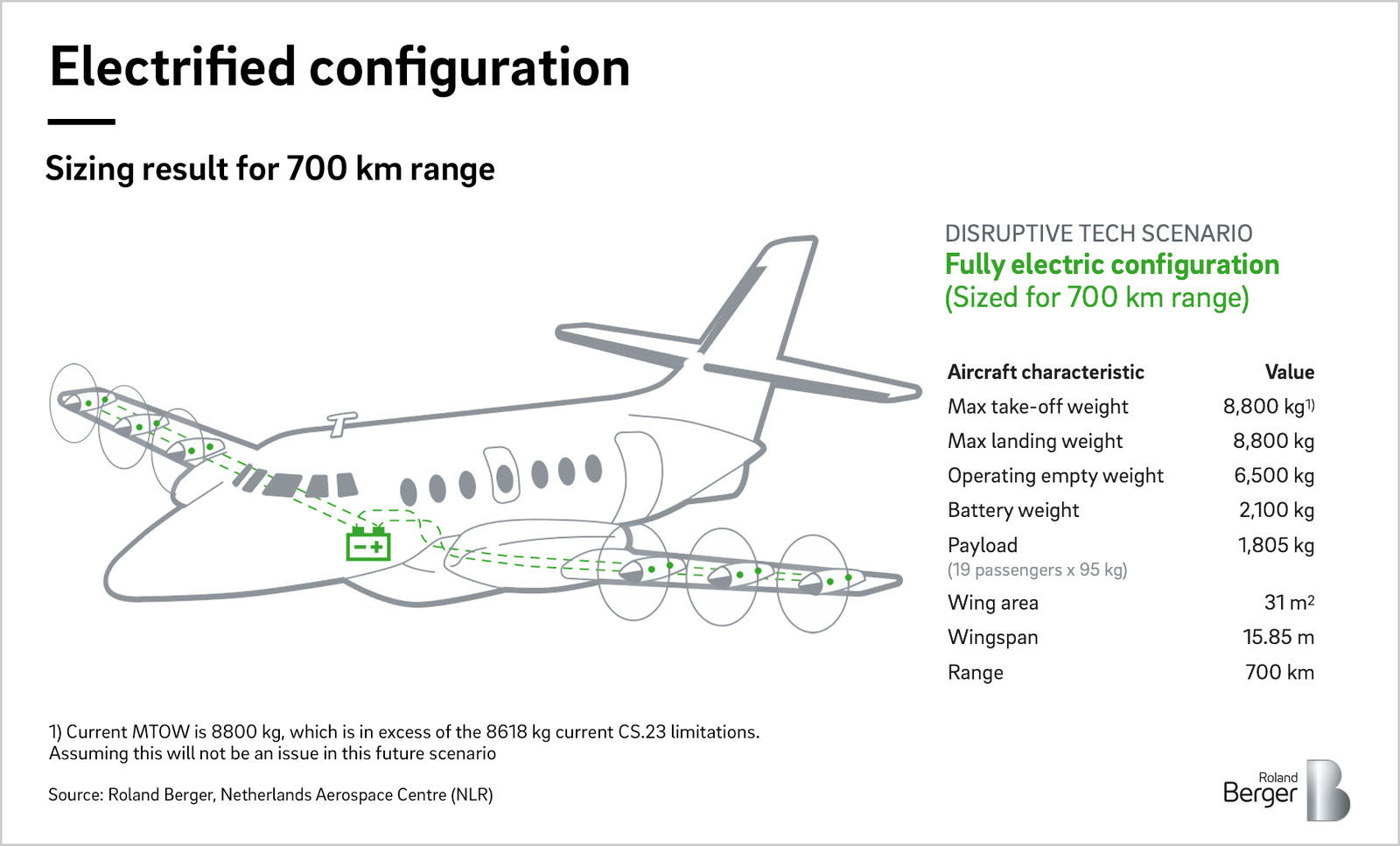
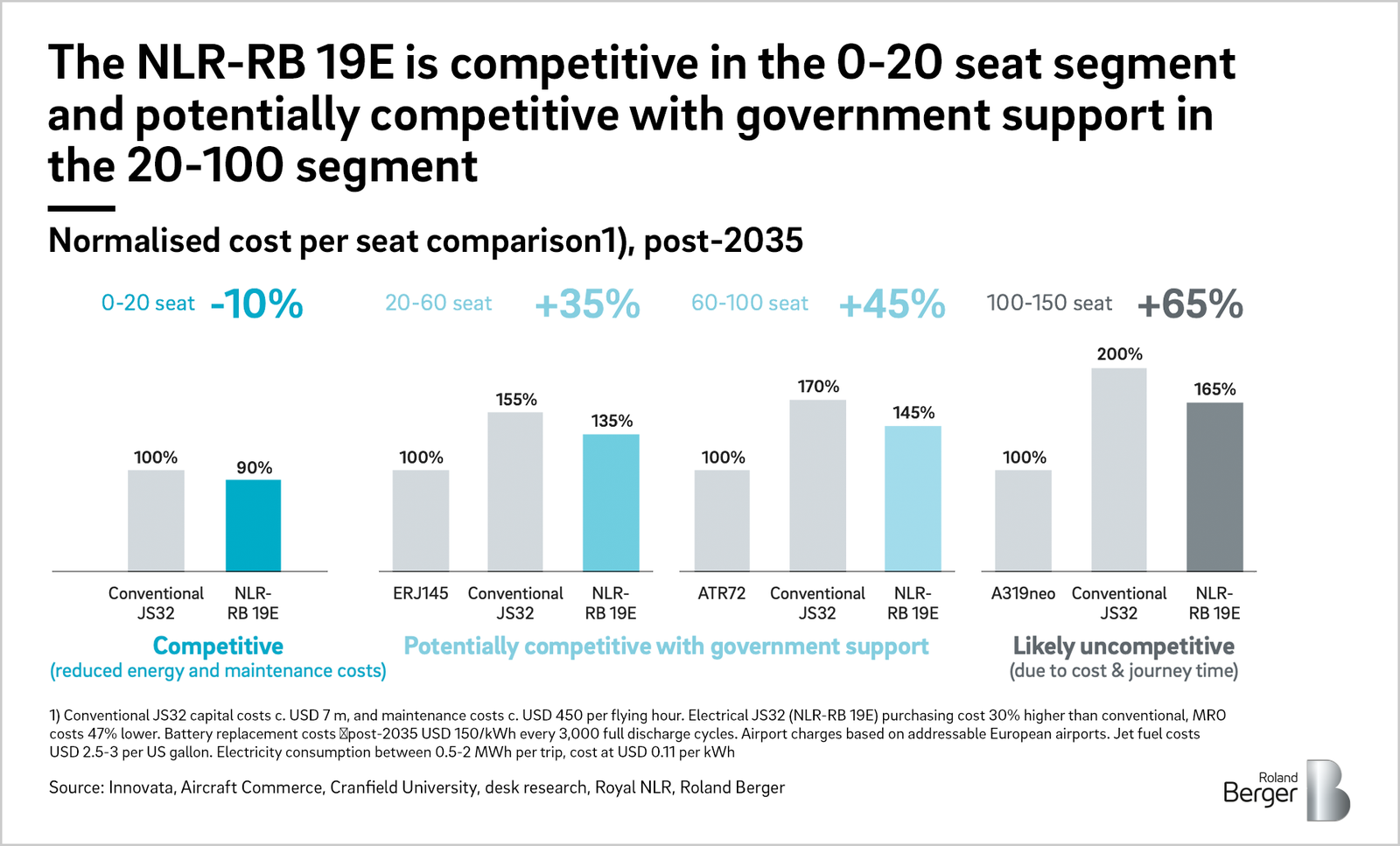
Having tackled the all-important question of cost, we must also consider more qualitative factors: this scale of electric aircraft could be advantageous in many other areas. Being quieter and smaller, it could open up access to smaller airports, enabling distributed propulsion, where small regional aircraft connect regional airports en masse, taking the point-to-point philosophy a step further. For travelers currently forced to take interconnecting flights, the NLR-RB 19E could enable more direct flights, and thus greater convenience, reduced total travel time and potentially lower cost. At scale, distributed propulsion might even allow larger aircraft to focus entirely on longer-distance journeys, improving their own CO2/RPK and leaving shorter sectors as the province of these small, electric sub-regional aircraft.
However, realistically, we believe that this would be difficult to achieve. The key learning from our investigation is that larger options, such as A320-type aircraft, which do not suffer the multi-for-one problem and are more efficient with regard to airport charges, would have greater potential. We are therefore now planning to turn our attention to the narrowbody scale, looking beyond pure-electric aircraft (which would not be feasible on this scale) and considering new designs. By computing their commercial, real-world impact we can gain practical insights into future sustainability in the industry. Let us know what architectures we should look at next!
We would like to thank Siyi Hao for his analysis and contribution to this article.
We invite you to subscribe below, contact us at EP@rolandberger.com, or connect with
Nikhil Sachdeva or
Siyi Hao via LinkedIn to discuss your thoughts.