AGM outcomes are only a reflection of major upheavals
Companies are well advised not to simply get on with the business of the day in the face of the cumulative AGM criticism and the negative press coverage. If Bayer's Board of Management can't get their actions ratified at the AGM in spite of the company's decent business figures, or if RWE is challenged over the damage to its reputation for digging up Hambach Forest, then these are not singular events, but a reflection of revolutionary movements on the investor side.
Driven among other things by societal expectations like Fridays for Future and regulatory pressure (SRD II), institutional investors have extended their view of performance even further to take in long-term and non-financial aspects. Sustainability risks, involvement in controversial issues or even a need for improvement in corporate purpose and culture are just as much grounds for criticism today as the classic issues of dividends, earnings and remuneration ever were. The fact that more and more investors are using the escalation tactics of activists in order to voice this criticism or organize voting majorities is also an element of the
new normal .
From tactical voting to reasoned voting
The scope for attack has thus increased accordingly. Any conceivable aspect of a company's performance that might elicit some finger pointing increases the firm's vulnerability to attack from activist investors. Nevertheless, there are still more opportunities than threats here: the requirements of SRD II mean that investors have to base their voting behavior on a reasoned investment strategy that is geared towards a sustainable value contribution. Simply nodding through management motions is therefore just as inexpedient as supporting activist counterproposals or the recommendations of proxy holders for purely tactical reasons. "Comply or explain" brings increased transparency and a higher level of distinctiveness at the same time. Companies that address all investor-relevant aspects through active shareholder engagement and systematically work on their weaknesses have the opportunity to build a strong line of defense against short-term oriented shareholders who have the potential to be disruptive.
New benchmark index makes shareholder engagement comparable
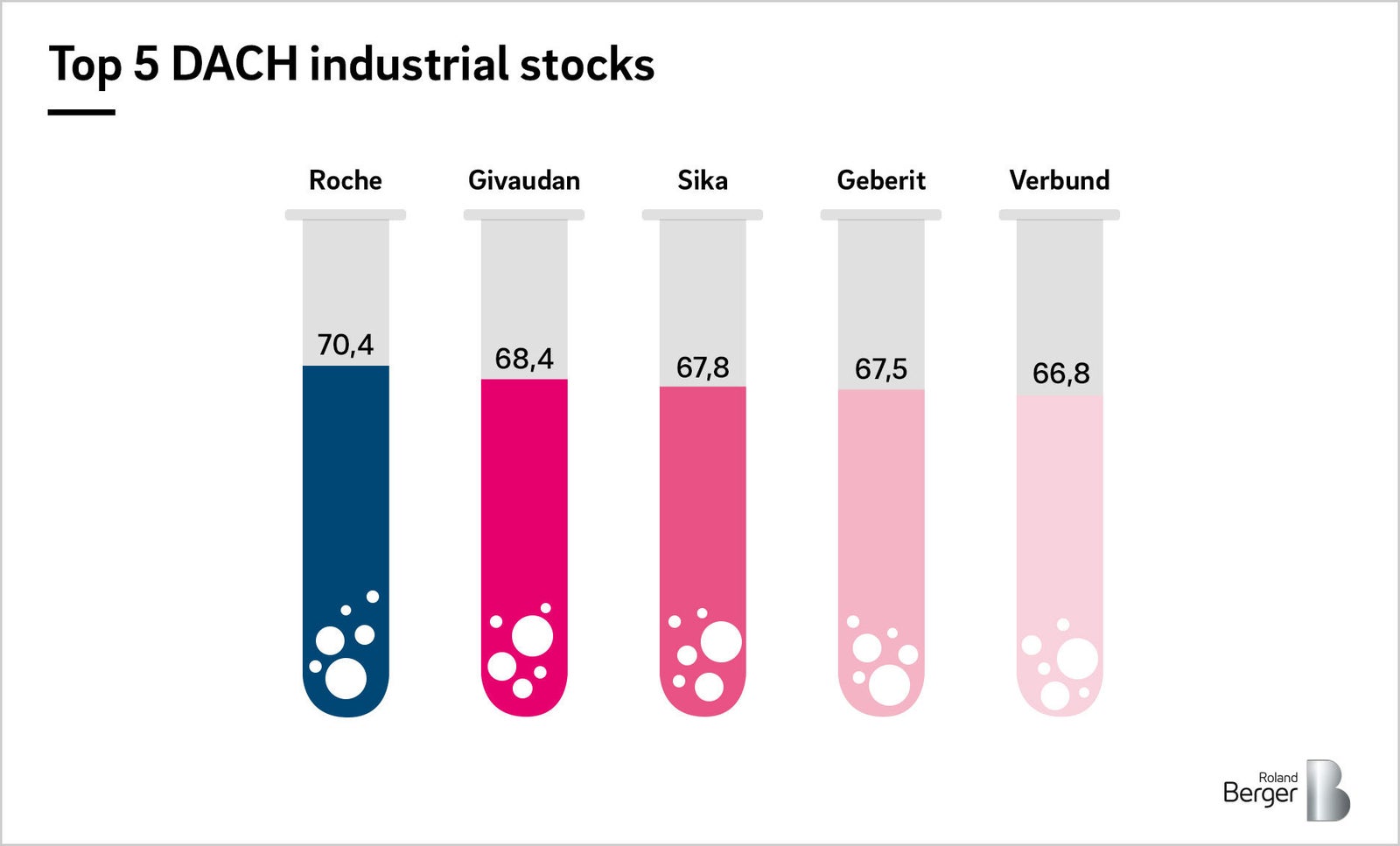
How are companies in the German-speaking region of Europe currently positioned? Where do they have strengths, where are they vulnerable? And who is best able to convince activist investors? To find this out, we have developed a benchmark index that puts stock-issuing companies to the test on the basis of the relevant investor criteria and makes them mutually comparable. We analyzed the major industrial companies listed on the DAX, MDAX, SMI and ATX – a total of 68 stocks – and compared their earnings and financial position, share price performance and valuation, ESG and governance standards, investor sentiment, shareholder structure and voting behavior. More than 200 data points per company, drawn from stock exchange portals, company reports and media reporting, were included in the evaluation – condensed into six indices and then into a total score.
The overall result: 26 percent of the companies achieve a total score of more than 60 percent and can therefore be regarded as well prepared or less vulnerable. With a score of 55 to 60 percent, 24 percent of issuers are in the upper midfield, while a further 26 percent are in the lower midfield (50 to 55 percent), which already indicates the presence of significant weaknesses in various clusters. The remaining 24 percent of companies are very vulnerable in terms of the criteria important to investors (scoring less than 50 percent).
Stock price losses and profit warnings – sentiment couldn't be lower
Analyst and investor sentiment is extremely weak. For 79 percent of companies, analysts have been forced to lower their 2019 earnings outlook in the last twelve months – and by more than 20 percent in the case of 27 percent of firms. Profit adjustments for 2020 are similarly negative. At least 60 percent of the region's industrial stocks are performing significantly worse than their international peer group in terms of growth expectations and profit adjustments. The comparatively wide spread of analysts' estimates is also an indication that not all companies are successful in strategically managing expectations through analyst guidance and their equity story.
Of course, share price performance also contributes to the negative sentiment. 56 percent of the companies gave their investors a negative total shareholder return, while 43 percent of the issuers had a negative total shareholder return that was higher than 10 percent. This is accompanied by the fact that the fundamental valuation of companies in comparison to benchmark indices and the sector comparison group often indicates entry-level share prices.