Maintenance of financial scale
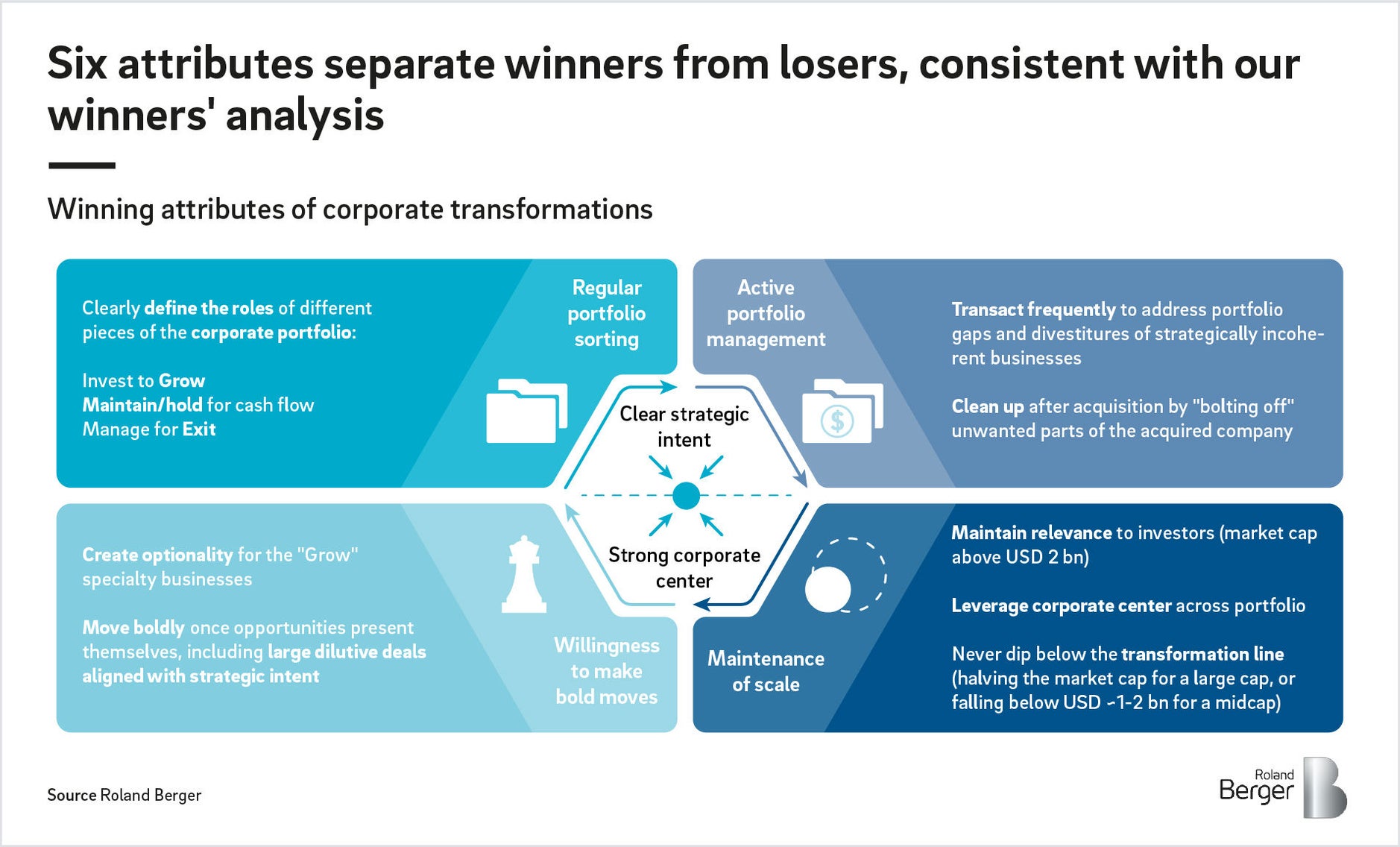
Retaining a critical mass to enable public equity market relevance and scale in corporate functions requires companies to maintain financial scale. Exiting non-core businesses all at once may not be possible for mid-size companies as it may make them too small to maintain inclusion in desirable trading indices or even justify a public equity listing, and it may also leave them with a significant corporate cost burden relative to the size of the portfolio. And whether a company suffers formal costs (like exclusion from trading indices) for divesting too quickly or too much, investors often consider size a virtue in and of itself. As the adage goes, perception is reality.
One small-cap specialty chemicals company defined its strategic intent around chemicals and materials leadership. After sorting its portfolio, it made the decision to quickly divest a non-materials business. However, it lacked an immediate plan to use the funds to invest in other more strategic businesses. Thus, the firm lost the necessary scale to succeed as a public company, and, despite having a debt-free balance sheet, it saw market capitalization drop significantly in subsequent weeks.
Willingness to make bold moves
Why should companies be willing to make bold moves? You never know when an opportunity will strike, and boldness can enable unique leadership opportunities. Companies should not be afraid to execute large, dilutive deals if they align with the long-term vision. Many firms miss the forest from the trees by strictly adhering to “the way it’s always been done” instead of thinking long-term about industry trends and strategic intent. Alternatively, impatience and fear can preclude companies from considering acquisitions that may hurt the stock price in the short run but help it in the long run. Financial markets reward these big, bold moves if they bring to life a previously announced strategic intent.
The Ag chemicals and food ingredients company described above got an opportunity to acquire a missing piece in its Ag portfolio. Even though its origins were in food, it made the bold move of swapping its food business for the desired Ag business, thus creating a unique Ag leadership position – a move that financial investors cheered.
Strong corporate center
Finally, a strong corporate center can help a company define its strategic intent, drive leadership alignment around clear business roles, and align the corporate structure while shaping the culture around the future vision. The strength of the corporate center is paramount.
One successful company had clearly identified that one of its businesses would get all the company's cash flow provided by the other two businesses in its portfolio. In talking to business unit executives at this company, the level of acceptance of business leaders with the role of their businesses in the portfolio was striking. There was no intent to compete for capital or vie for a higher-level leadership position. Executives understood that they were all on the same team; what’s good for the company is what’s good for everyone at the company. Organizational structures vary across companies and industries, but the necessity of companywide alignment around a stated strategy is universally important.
At another less successful company with over ten business units, nearly every unit leader competed for capital and C-level attention, in pursuit of the next CEO role. This drove a "fiefdom" culture and inefficient decision-making across and within businesses. Had a strong corporate center been in place, leaders would’ve prioritized the success of the company over their personal success or the success of their respective businesses.
Many chemicals companies do one or some of these things right in their transformation efforts. But these success characteristics do not work in isolation. For instance, an appetite for bold moves won’t mean much in the absence of a strong corporate center that can get the whole company behind those bold moves. A clearly articulated strategic intent will fail in the absence of a companywide willingness to take short-term lumps in favor of long-term gain. Regular portfolio sorting can backfire if companies fail to maintain financial scale.
Like an athlete looking to improve their skills, a company must think about how each piece of the puzzle fits with the big picture rather than seeing each of these six success characteristics as standalone attributes of successful transformations.
As chemical companies embrace the coming wave of transformation by considering acquisitions and divestitures that drive higher customer-centricity and align with sustainability goals, they will have many options. The key to superior shareholder value creation will be the fine art of selecting the right options and executing in a purposeful and timely fashion to manage strategic coherence. As with other industries and disciplines, success in chemicals transformations is where preparation and opportunity meet.