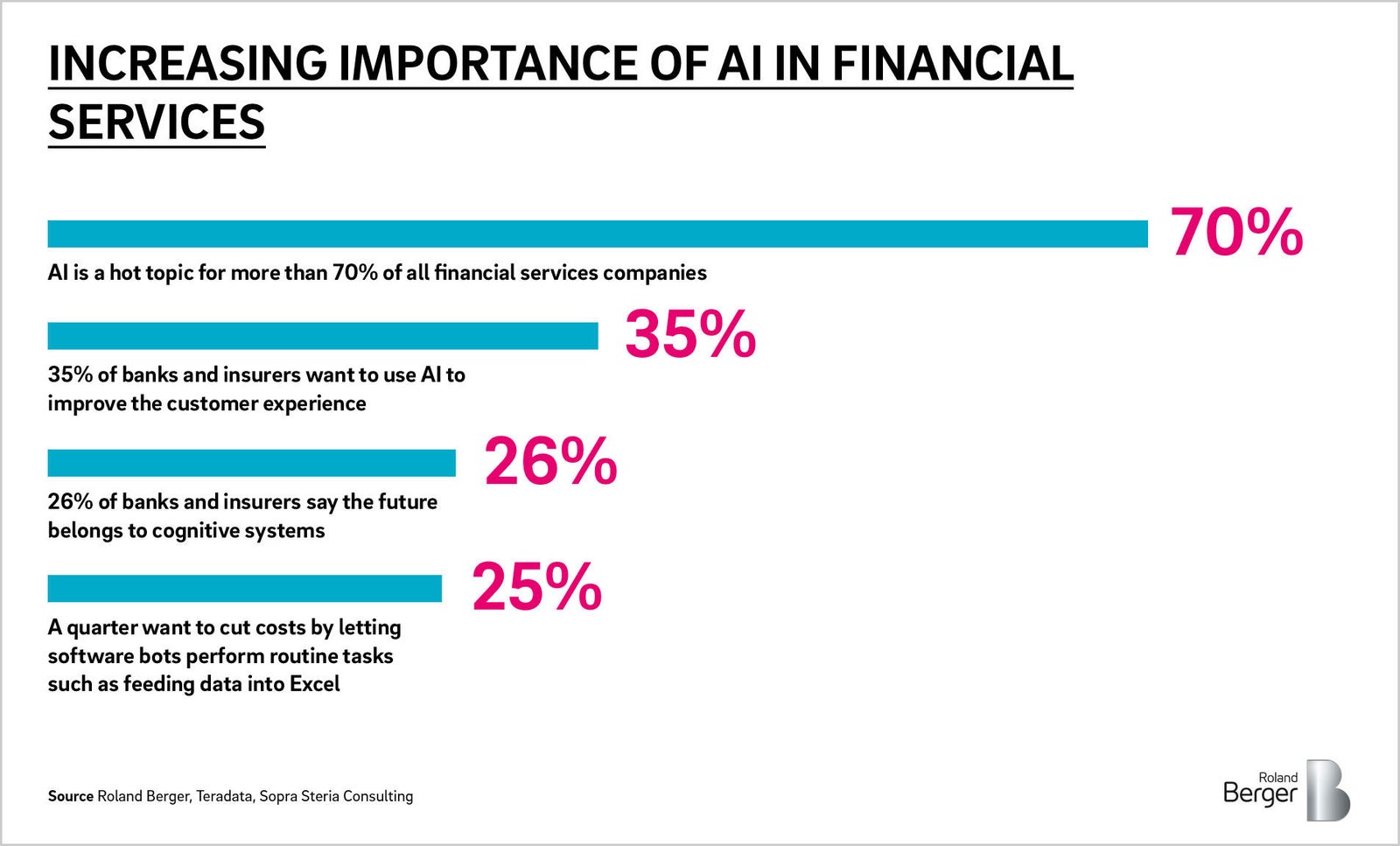
Banks and financial service providers can use AI as a tool to make many of the links in their value chain more efficient and as a means to counteract shrinking margins and growing competition and keep their business profitable.
Artificial intelligence, or AI for short, is actually nothing new: fundamental research into neural networks was going on as early as the 1960s. But it's since 2015 that the topic has become increasingly relevant to the financial service sector. Polls like our own "Retail Banking Survey" have shown that while end-to-end digitalization and platforms are the crucial issues for financial service providers today, the subject of AI is definitely gaining in importance. And there is a certain amount of catching up to do in many cases, given the dramatic acceleration in the pace of developments lately. For one thing, the technical requirements for the use of artificial intelligence are by and large already in place, with today's computers offering much faster processors for much lower prices. And for another, access to computing power is now considerably easier over the cloud. Not to mention another factor that's particularly crucial for the financial sector, which is that the necessary data – especially from the capital market side but also companies' own data – are readily available these days.