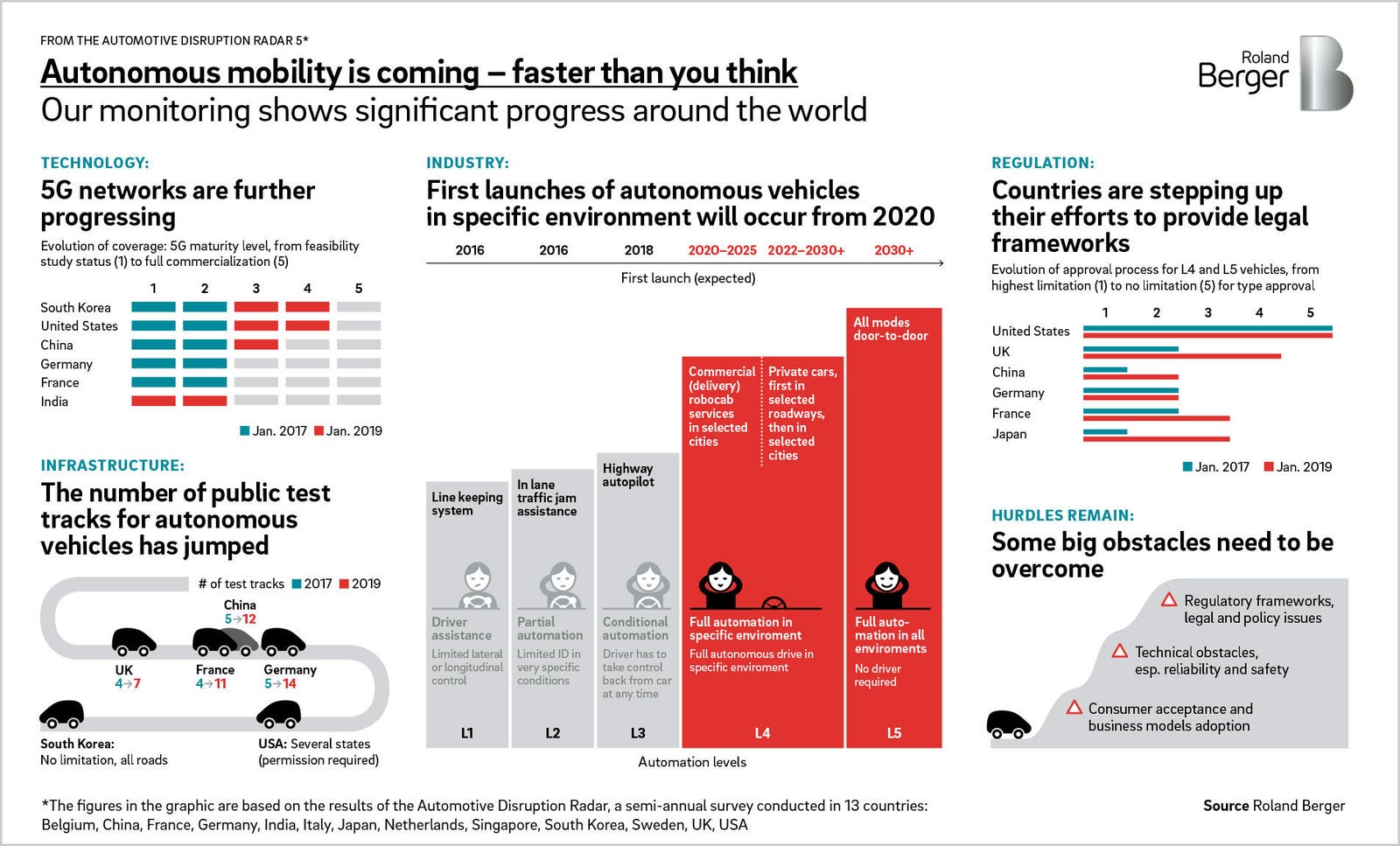

The transition to autonomous mobility will not take place overnight – but it will come much sooner than expected, even as the media hype dies down. This is one of the key findings of the latest Automotive Disruption Radar, Roland Berger's biannual analysis of the state of developments around autonomous mobility worldwide. As this fifth edition of the study shows, there has been substantial progress on almost all fronts – in the legal framework, in infrastructure, in investment and in consumer acceptance.
Following in the footsteps of the United States, other countries are opening up to autonomous vehicle testing and permitting vehicles to be operated without a driver onboard (e.g. the Netherlands, France). The most far-reaching regulation of liability issues to date has been achieved in the UK with the country's Automated and Electric Vehicles Act, which came into force last summer. Good progress is also being made in the expansion of 5G networks – a key prerequisite for autonomous driving. The first commercial networks recently went live in the United States and South Korea, while other countries such as China, Singapore and Dubai have completed 5G frequency allocation.