

Publication
brand-b.png

License to lead – The CXO view on CMOs

November 26, 2026

ROI proof and AI are redefining what CXOs expect from marketing leaders in 2027

Marketing leaders operate with continuously constrained budgets, faster change, and growing pressure to prove what marketing delivers. At the same time, executive teams are redefining what they expect from the CMO. Is marketing a growth-driving investment or a cost line? For the second time, Roland Berger, the Institute for Marketing & Customer Insight at the University of St. Gallen (HSG), and Heidrick & Struggles have run their study to investigate the views of the CXO peers of CMOs and the marketing function.

Marketing credibility is under pressure

Only 49.4% of DACH-based CXOs still see marketing as an investment (–24.4 pp; international: 59.3%), and only 34% expect budget increases in 2027 (–15 pp). The belief that a CMO can become CEO has almost halved from 34.4% to 18.8% in DACH (international: 27.8%). Our study looks at what lies behind this shift. It combines a survey of around 139 CXOs with more than 15 in-depth interviews with CXOs and CMOs. It shows how the CEO's mindset, the business model, and the economic conditions shape the way marketing is judged – and where that leaves CMOs who want to change the verdict.

"While many CMOs are taking the opportunities to lead growth and organizational change in the AI era, our study shows that many more still need to take that stance and gain credibility and influence."
Beate Rosenthal
Partner
Frankfurt Office, Central Europe

Measurement, access to the CEO, and a changing role

Credibility depends on evidence that the CFO and the CEO accept. Advanced measurement methods remain rare in DACH: marketing mix modeling is used by 9.7% of respondents and attribution modeling by only 4.6%. Softer proof points such as surveys and reach no longer protect budgets. CMOs need P&L-linked evidence, communicated consistently to executive stakeholders. The study shows why measurement and storytelling need to work together, and what successful CMOs do differently when they speak to finance and other executives.

The study also addresses where marketing should be positioned in the organization and what access it has to the CEO. The answers show a clear gap between CMOs' ambition and where executive teams place them.

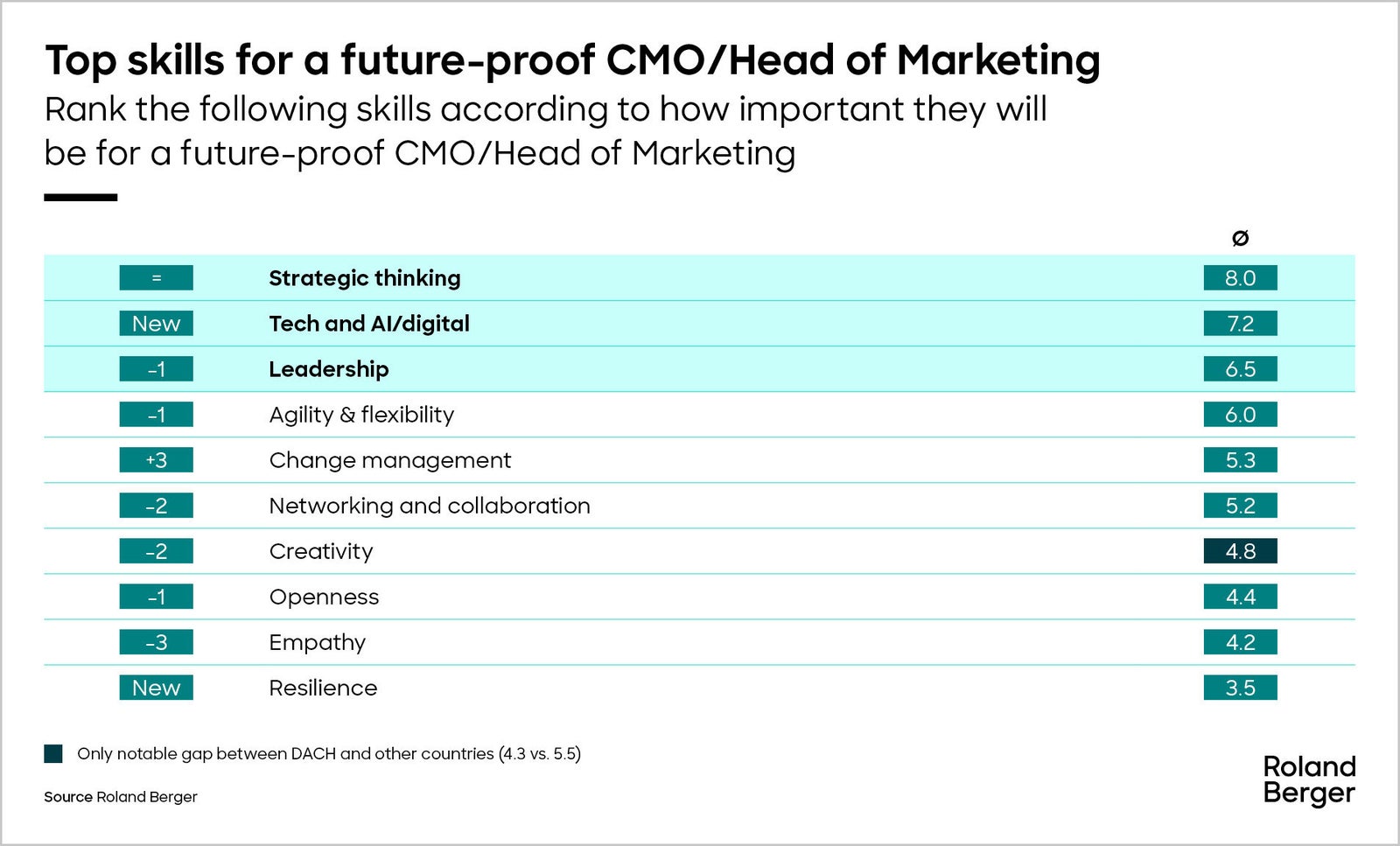
With 82.8% of CXOs anticipating a change to the CMO role, the question is no longer whether the role changes, but in which direction. It may broaden toward growth, digital, or sales, or become more specialized toward experience or customer ownership. The outcome depends on the industry and on the skills marketing leaders bring. Strategic thinking, leadership, and technology skills are in high demand. Creativity, a traditional strength of marketing, is valued less, especially by DACH CXOs (ranking 7th among the top skills, –2 vs. last year).

AI as a chance to redesign the marketing model

AI is the number one trend for marketing leadership. It lets CMOs rethink which capabilities to build in-house, which to buy, and where to work with partners and technology. It also forces a question that in many companies still has no clear answer at executive level: who actually owns AI. At the same time, our interviewees agree that people remain essential for strategy, differentiation, and responsibility.

For CMOs, the question is therefore not only how to adopt AI, but how to use it to strengthen their position in the executive team. The study closes with an action agenda for 2027 that sets out where marketing leaders should concentrate their efforts. Download the full study for the complete data set, the DACH–international comparisons, and the 2027 action agenda.

What is the study about?

It shows how CXOs view CMOs and marketing leadership, and what shapes credibility, influence, and future role scope.

Who was surveyed?

Around 139 CXOs across industries and company sizes, plus 15+ interviews, with 61% of the respondents coming from the DACH region and 39% of respondents being based in 14 additional markets across Europe, the US, and Asia.

Who conducted the study?

Roland Berger, the Institute for Marketing & Customer Insight at HSG, and Heidrick & Struggles.

Does it cover AI?

Yes. It examines AI as the top trend for marketing leadership and its impact on skills, organization, and the marketing operating model.

Who should read it?

CEOs, CXOs, CMOs, and board members who shape marketing mandates, budgets, and organization.

What else does it offer?

An action agenda for 2027 for marketing leaders.

Download the full study
Request the full PDF here

Sign up now to access the full study. You will also receive regular news and updates, delivered straight to your inbox.

Further readings