A few more years passed. I changed jobs and moved to Hong Kong. Work would take me to Boston off and on and it felt weird going to HBS and not trying to meet Christensen. So I tried emailing again. Things had changed again, clearly. Now emails would generate an auto response asking you to fill a form regarding the purpose of the meeting. I did. It vanished into a black hole.
But I also had other meetings at HBS. As I was waiting to meet another professor at Morgan Hall, the building where Christensen’s office was, I saw him coming towards me. I was shocked to see him. He had lost a lot of weight and was walking with the help of a stick. He graciously said hello and walked past me. It was quite obvious he did not recognise me. It was then I realised how much he had been through over the years.
But clearly he wasn’t done yet. He wrote another book, with Efosa Ojomo and Karen Dillon, titled The Prosperity Paradox. There are different shades of innovation—sustaining innovations (that make a good product better), efficiency innovations (that make a good product cheaper) and market-creating innovations (that make products simple and affordable so more people can access them). The book makes a strong argument for how market-creating innovations can lift entire nations out of poverty, a better alternative to aid.
Perhaps things improved a bit because I saw Christensen’s name as a speaker at a management conference I was going to attend. I got in touch with my friend in communications at HBS and asked him if I should even attempt requesting him for an interview—now that I had seen how Christensen was, was it even appropriate to ask? My friend replied positively, and in fact, walked over to Christensen’s office and requested his assistant to help with my request. Things started moving again but Christensen cancelled his engagement at the conference, presumably due to another health episode.
Two months later work took me to Boston again. I nudged my friend who confirmed that things were better and I could try for an interview again. His assistant confirmed. About an hour before the interview she emailed saying Efosa Ojomo would join us because Christensen sometimes has trouble with words due to his stroke.
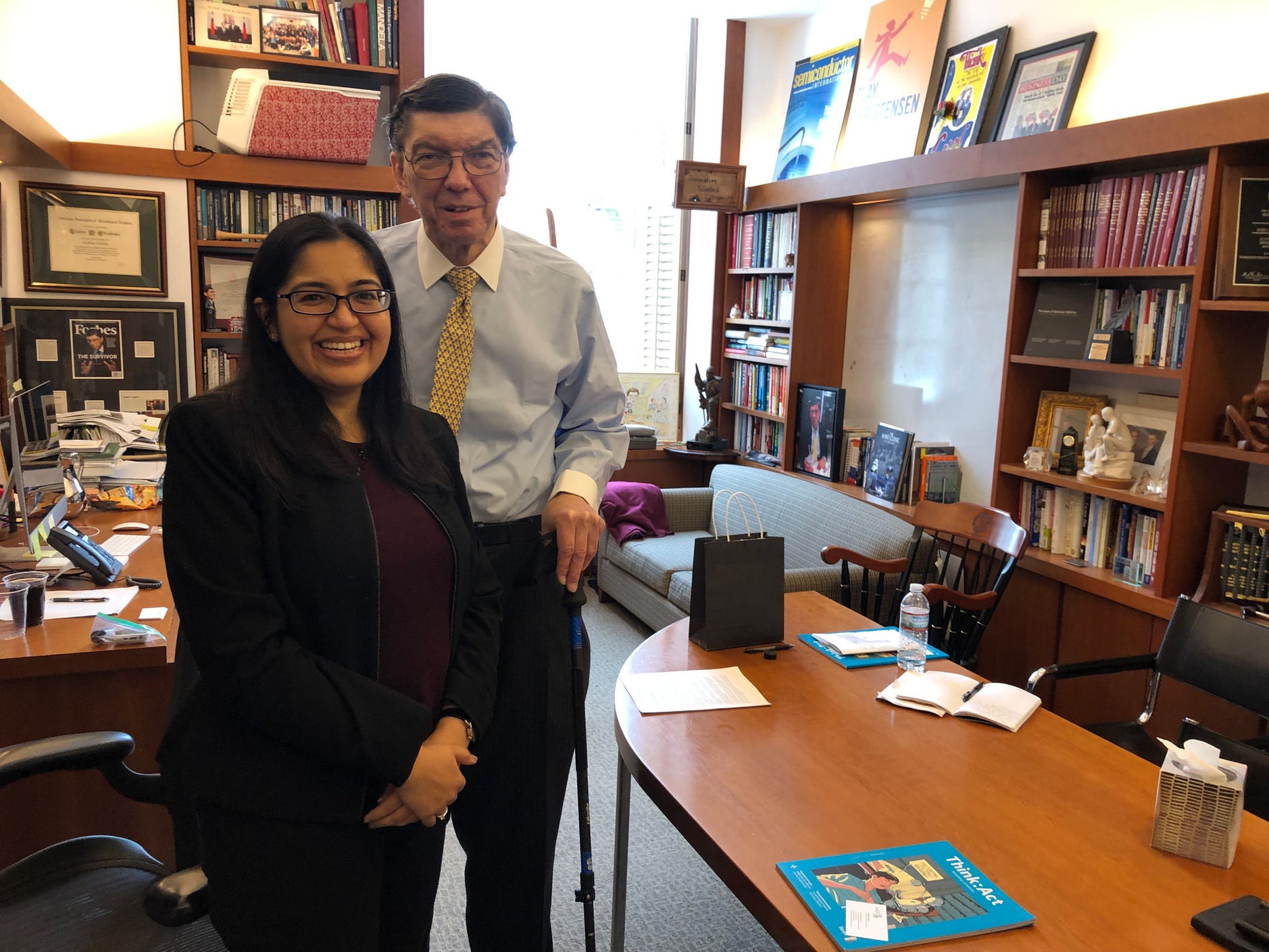
And so I walked into his room and met both him and Ojomo. He had clearly no recollection of who I was and I thought it best to not remind him, given the tight time slot. Before we began, he told me he would have to keep walking as we talked because of a neurological issue he had developed. It’s then I realised this would be harder than I had imagined. We began the interview. Christensen would start answering my questions but he would often stumble over a word. Then he would nudge Ojomo to complete the answer, which he would brilliantly, not a word out of place. In short, just as Christensen would have answered it. Clearly, articulation was a big issue, but the logic and clarity were still there in his mind. Christensen was not having the best day, physically. He struggled to open a can of soda and pour it, as we both looked on concerned. Eventually Ojomo helped him. We somehow finished the interview, and as I got ready to leave, he looked at my business card and said: “Your name is familiar. Have we met before?”
I said yes, and reminded him of our first meeting. He had not forgotten Mumbai’s torrential rain. “Oh Efosa,” he said to Ojomo with a twinkle in his eye, “the water was up till here.” He gestured at his waist.
We talked a little more before I left, and it hit me somehow that this might be the last time we meet. I knew I wouldn’t be asking him for an interview again. It just wouldn’t be right.
It seems he also knew he didn’t have much time left, even though there was still a lot more his brilliant mind had to offer. His mind was still brimming with ideas and he prepared several others—like Ojomo, a brilliant thinker and speaker in his own right—to pick up on his work from where he left off.