Europe Must Play To Its Strengths
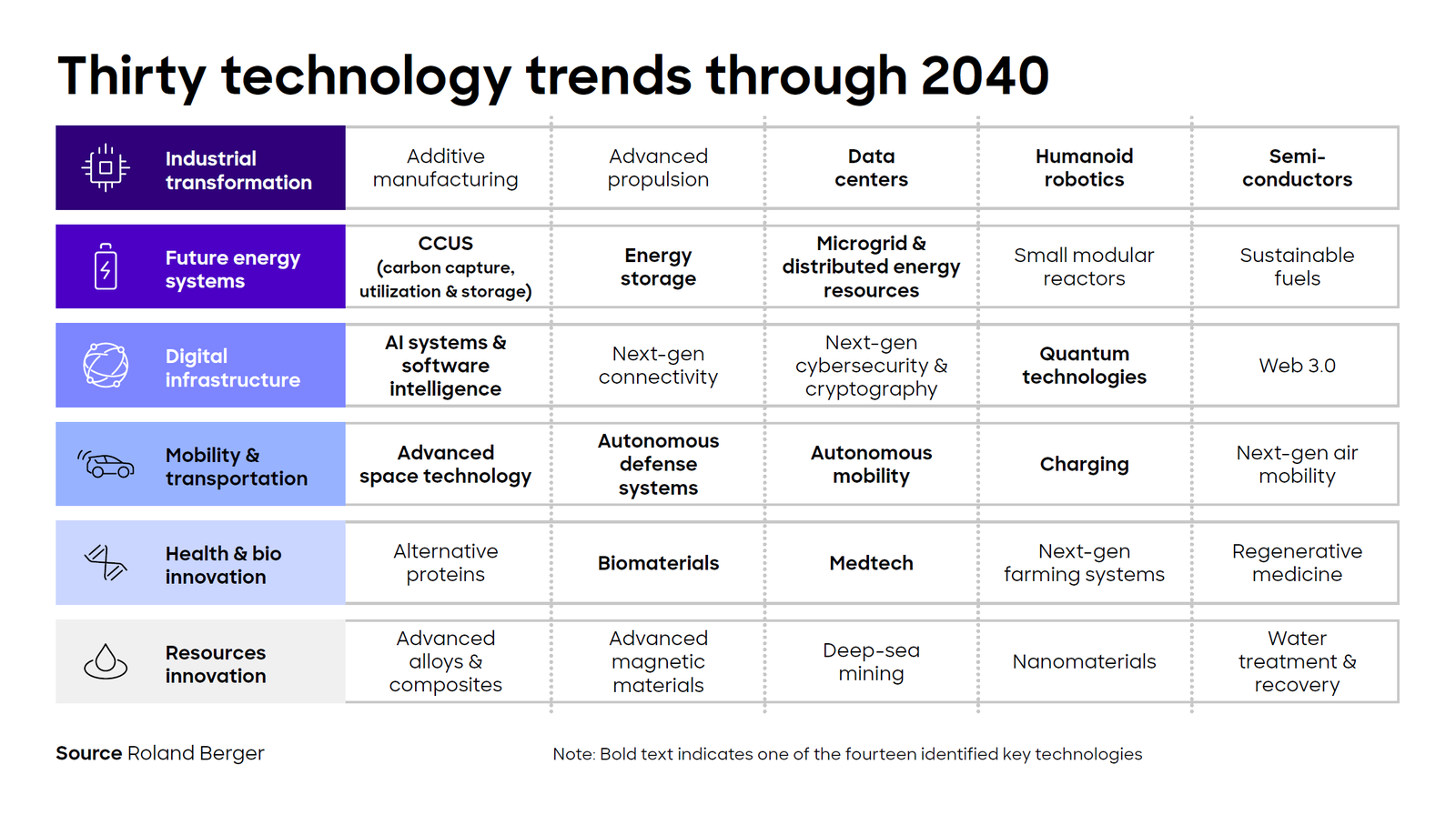
Despite its world-class research capabilities and strong industrial base, Europe has lost ground to the United States and China over recent decades. According to the study, the main reasons are insufficient scaling, limited access to growth capital and institutional complexity. At the same time, Europe remains well positioned in a number of future-oriented technology fields, including quantum or medichal technologies (MedTech). In these areas, Europe could still achieve global leadership if policymakers and industry players align their efforts more effectively.
"Europe faces a clear mandate for action. Policymakers and industry leaders must work together to create the right conditions for investment and scaling. Otherwise, the value creation generated by the next wave of technology trends will take place elsewhere," says Felix Mogge, Partner at Roland Berger.
According to the analysis, Europe could capture around 20% of the global industrial market potential represented by the 14 most important technology trends by 2040, equivalent to approximately EUR 3 trillion in value creation. The study identifies three strategic pathways for achieving this:
- Global Leadership: In technology fields where Europe already possesses strong research and engineering capabilities, such as microgrids, quantum technologies, MedTech and carbon capture, a strategy focused on global market leadership remains realistic, provided gaps in financing and commercialization can be addressed.
- European Markets: Not every technology requires global market leadership. In areas such as autonomous defense, humanoid robotics and charging infrastructure, Europe’s strong domestic demand, security requirements and targeted support measures can create substantial market opportunities on their own.
- Localization of Foreign Players: In other areas, including large language models and next-generation semiconductors, the gap to global leaders may already be too wide to close. In these cases, attracting international technology providers to establish local operations in Europe represents the most pragmatic approach to securing access to critical technologies.
"Europe has the technologies and the talent to compete for global leadership in a number of fields. The challenge now is to choose the right strategy for each technology area and secure Europe’s long-term competitiveness," says Stefan Riederle, Partner at Roland Berger.
While China and the United States actively promote and support key future technologies, Europe still lacks a clear industrial strategy in many of these fields. Existing initiatives such as the AI Act, the EU Battery Regulation and the European Chips Act have so far fallen short of their ambitions. The study therefore calls for EU-wide initiatives that enable scale, encourage greater risk-taking and provide long-term certainty for emerging markets.
However, the industry also has a critical role to play. Companies need to place larger bets on future technologies, accelerate the commercialization of innovation and focus more strongly on competitiveness and scaling rather than technical perfection alone.