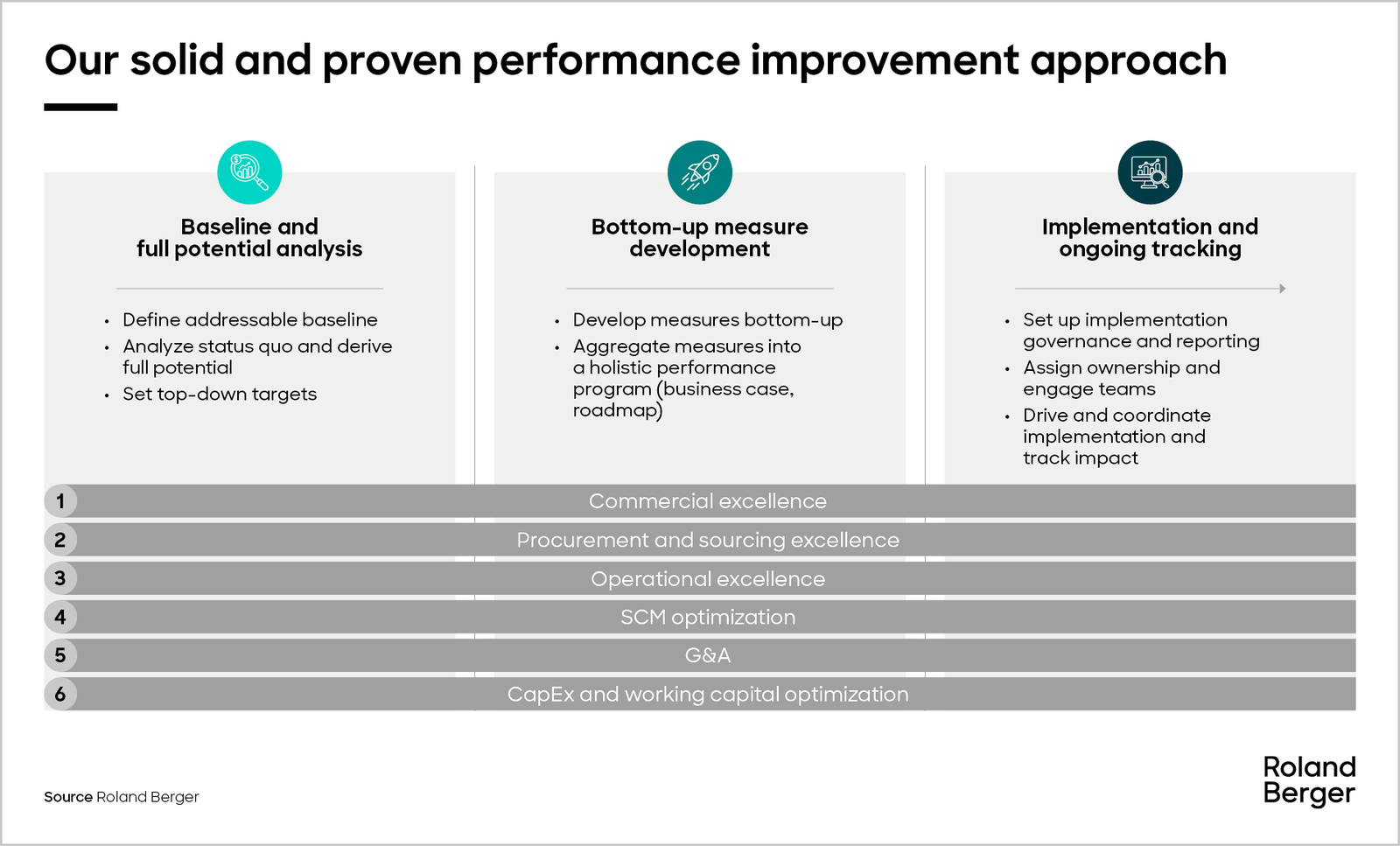
With a focus on execution, the Roland Berger performance improvement methodology is based on experience gained from hundreds of performance projects in Europe and overseas and consists of three core phases:
Phase 1: Baseline and full-potential analysis
Our full-potential analysis identifies and quantifies the relevant value levers throughout the entire P&L. For each area, we derive ambitious top-down targets, always based on transparency and facts. Having the overall program structured into excellence modules allows flexible adaptation to any client's situation.
Phase 2: Bottom-up measure development
Efficiency measures are at the heart of a performance program. Our extensive project experience has given us a broad spectrum of best practices and optimization levers to draw from, which we then adapt to individual needs. We develop the measures bottom-up together with our client to ensure they will have an impact, can be executed and will be accepted within the company.
Phase 3: Execution and impact tracking
A performance program is only successful once measures have been systematically executed and the impact is permanently visible in the P&L. We ensure the detailed tracking of financial and operational KPIs to facilitate this, supported by RBboost, our digital execution and tracking tool, which is in action throughout the whole process, from the identification of measures to the realization of impact.