Trend 4: In addition to foreseeable monetization models like freemium, tipping, and ads, AI agent stores represent another pathway to commercialization.
The rapid development of these stores is poised to create an "App Store moment" in the era of large models. AI agent stores function as digital marketplaces where developers and creators can publish their custom AI agents, offering users a broad selection while generating new revenue streams for both creators and store operators. Drawing inspiration from Apple's App Store monetization model, AI agent stores have the potential to generate revenue through platform commissions, paid promotions, and advertising exposure. Leading general AI assistants have already begun exploring this model:
- ChatGPT launched the GPT Store, positioning it as more than just an app repository—it's a dynamic platform fostering a thriving community of innovators and users. With comprehensive features such as categorization, trending lists, and curated selections, the store now hosts nearly 3 million AI agents—surpassing Apple's App Store in the number of apps in just two months.
- Doubao introduced its AI Agent Platform, innovatively establishing a "Brand Zone" to serve as a testing ground for traditional apps transitioning into AI agents. Over ten branded AI agents, including Dongchedi, Tongcheng Travel, and Taopiaopiao, have already gone live.
- Kimi launched the Kimi+ AI Agent Store, currently offering over 20 AI agents across categories such as productivity, writing assistance, social entertainment, and everyday utilities.
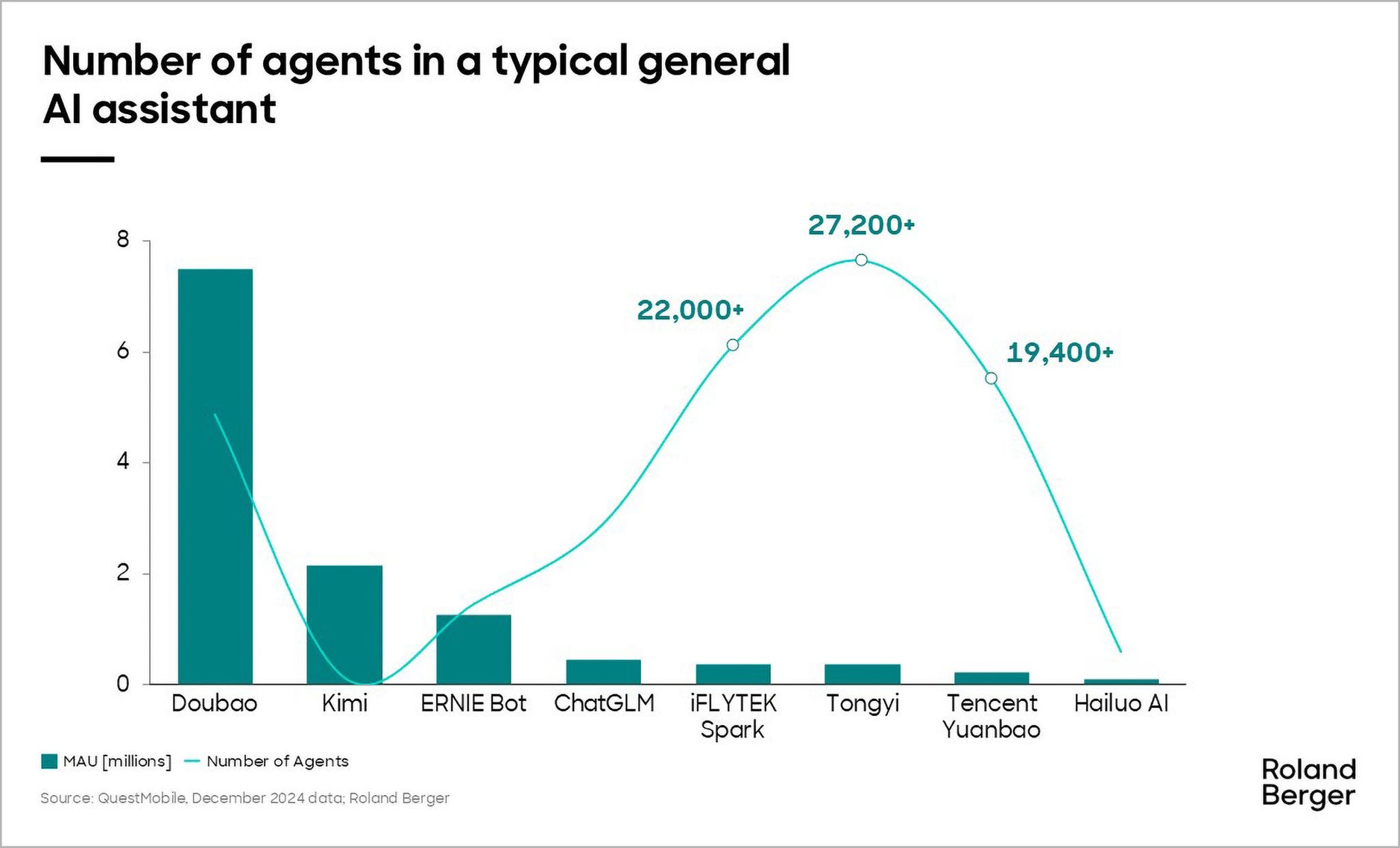
However, AI agent stores are still in their early stages and face challenges such as high quantity but low quality, weak user engagement, and limited stickiness. By December 2024, the number of AI agents across leading general AI assistants had exceeded 100,000, surpassing the number of WeChat Mini Programs with more than 10,000 MAU (approx. 7,000+). Yet, despite this large volume, sustainable traffic generation remains elusive.
Some platforms, such as Tongyi, iFlytek Spark, and Tencent Yuanbao, have experienced a mismatch between agent quantity and user engagement—ranking among the top three in agent count but failing to surpass 5 million MAU. In contrast, platforms like Doubao, Kimi, and Wenxiaoyan have demonstrated a more balanced growth in both agent numbers and user adoption.