GenAI’s implications and value for procurement
When it comes to digitalization, during the last 20 years chief procurement officers (CPOs) have typically focused on areas like source-to-contract, purchase-to-pay process, spend analysis, digital contracts and supplier web-portals. More recently, natural language processing (NLP) applications like chatbots and negotiation bots have emerged, which enable, more interaction such as asking questions or giving commands.
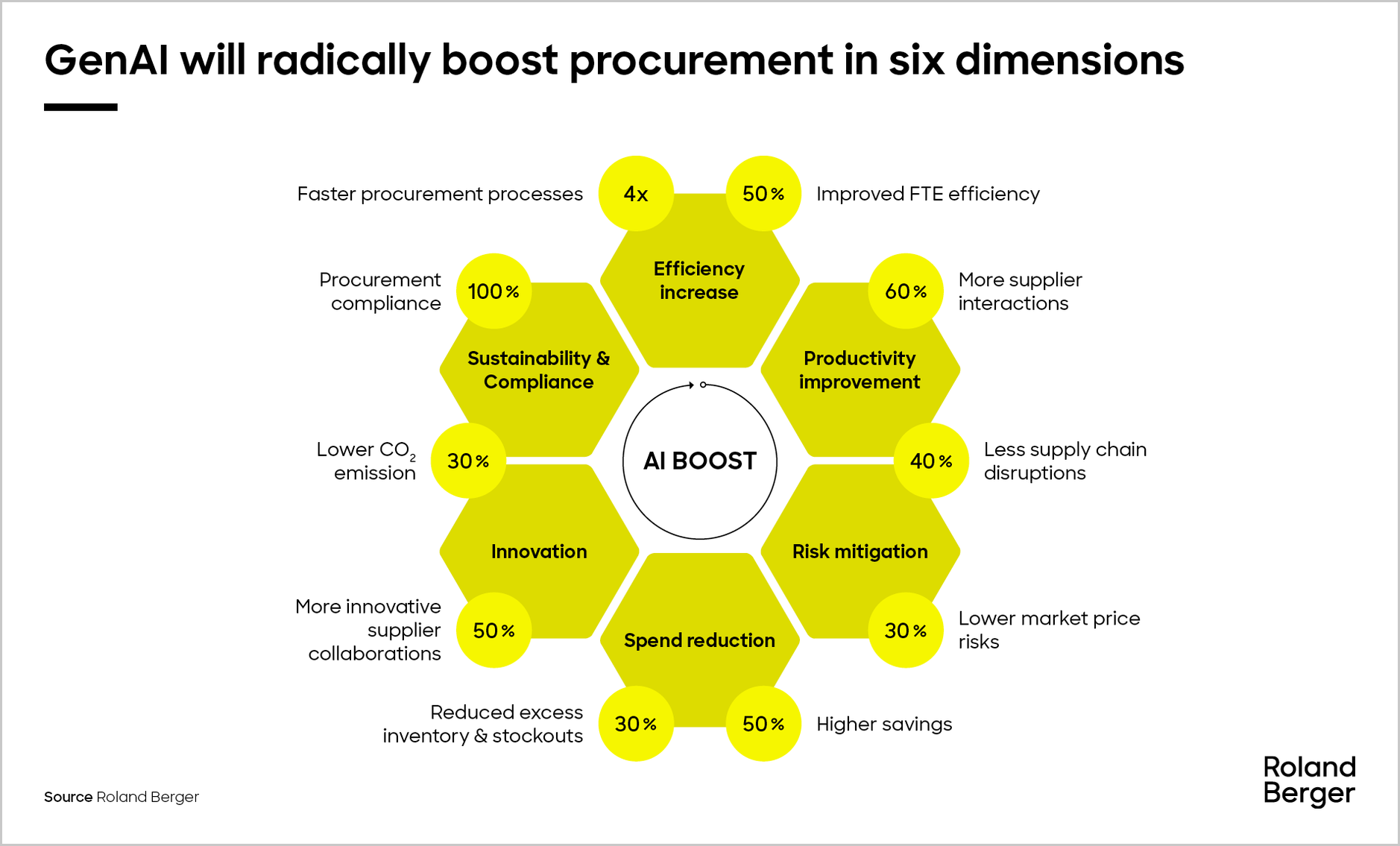
Now, however, GenAI applications enable creation of new content based on existing data. By automating tasks, providing valuable insights, and improving transparency, generative AI can help CPOs take their organizations to new heights with tremendous rewards expected across six core dimensions:
- Increased efficiency: includes process automation and simplified execution of procurement tasks, such as strategy development, tender management, negotiation preparation and contract management.
- Productivity improvement: includes freeing up employees from mundane tasks and allowing them to focus on value-maximizing activities, such as performance-based supplier development.
- Innovation: such as analysis of market developments, suggestion of alternative material specifications, and AI-supported ideation platforms.
- Risk mitigation: includes GenAI-powered early warning systems, evaluation of risk scenarios, and development of risk mitigation plans.
- Spend reduction: through areas like improved knowledge management, optimized procurement decisions, and accelerated procurement procedures.
- Sustainability and compliance: includes real-time CO2 footprint analysis and P2P process compliance monitoring.
But which use cases should companies start with to immediately and effectively leverage GenAI? As a starting point, GenAI should be used to quickly generate knowledge and ideas using LLMs, while at the same time increasing transparency of internal company data and knowledge. Altana, winner of the 2023 Intelligent Spend Management (ISM) award sponsored by Roland Berger and SAP, developed a knowledge graph including GenAI features that connects internal data from ERP systems, such as spend categories, suppliers, and countries, with external data like category risk, supplier risk, CO2 impact or country risk.
In a next step, a variety of LLM applications are conceivable using networked data and knowledge. These include analyzing and optimizing processes (GenAI-conducted process mining), evaluating suppliers (inventory and potential new suppliers), and risk analysis. With GenAI, procurement can quickly analyze complex business activities and predict future market developments. It will empower CPOs to revolutionize procurement strategy development and implementation by enabling a comprehensive and dynamic evaluation of a company’s current state in alignment with relevant sales and procurement market dynamics.