Technological challenges and constraints
While acknowledging the impressive advances that have already been made in core technologies, the Roland Berger study also highlights the need for more key breakthroughs if humanoid robots are to become widely accepted and firmly established. As eye-catching as their party tricks may be, their actual industrial uses remain severely limited at the present time.
Importantly, these robots are not just machines: They are the hardware embodiment of
artificial intelligence.
As such, they require the seamless integration of advanced hardware and software components. They must also learn constantly and be able to adapt to unpredictable situations. Humanoid robots thus still face key challenges in terms of reliable and predictable motion, rapid reactivity and unambiguous communications.
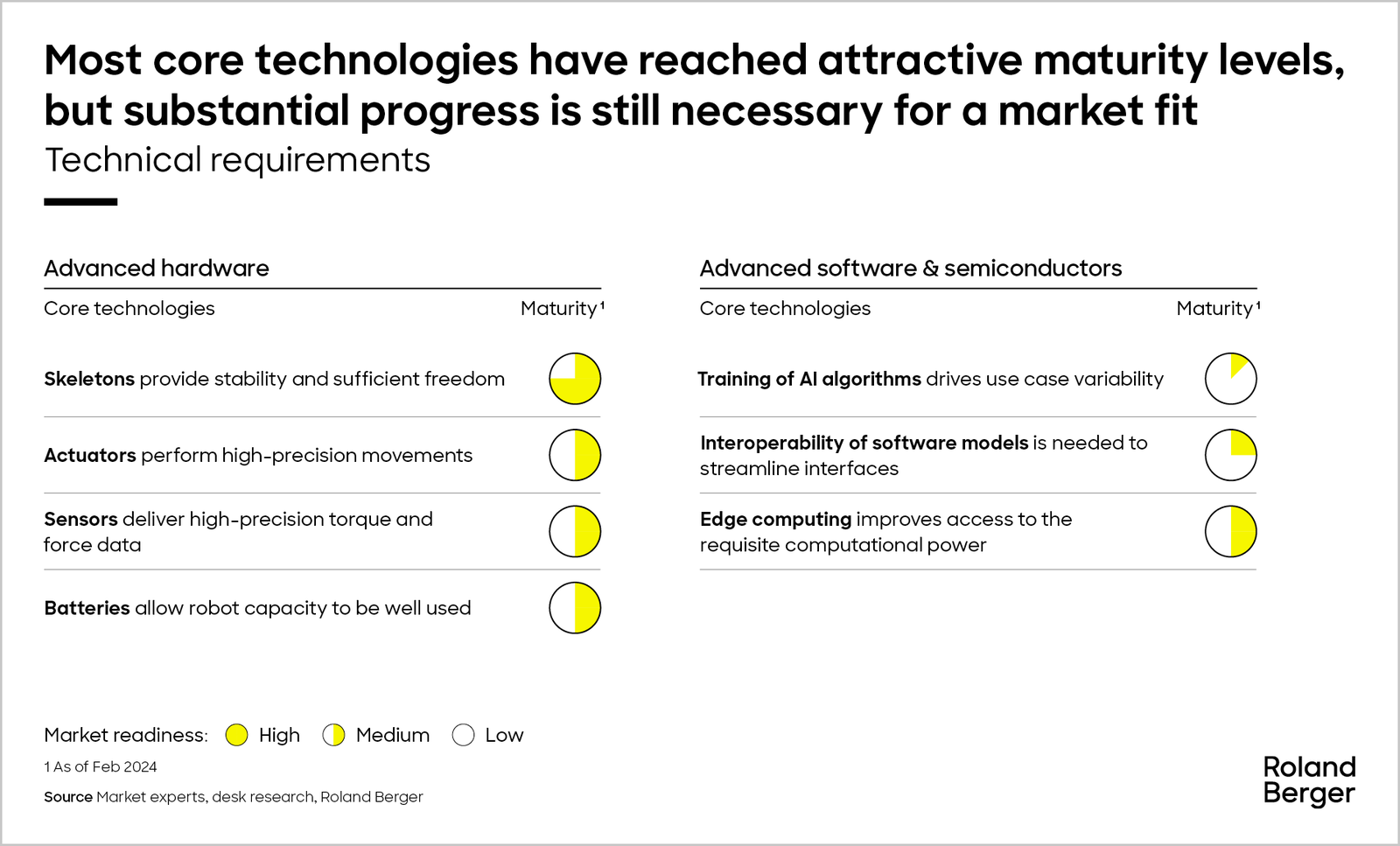
To overcome these and other challenges, humanoid robot developers need to master a daunting array of core technologies around skeletons, actuators, sensors, batteries, AI algorithms, software models, edge computing and cloud computing. Most of these technologies have already reached attractive maturity levels. Here again, however, much further progress is still necessary to achieve market fit. Moreover, it is vital to streamline and optimize the interplay and interoperability of all these technologies.