Key areas for boosting services
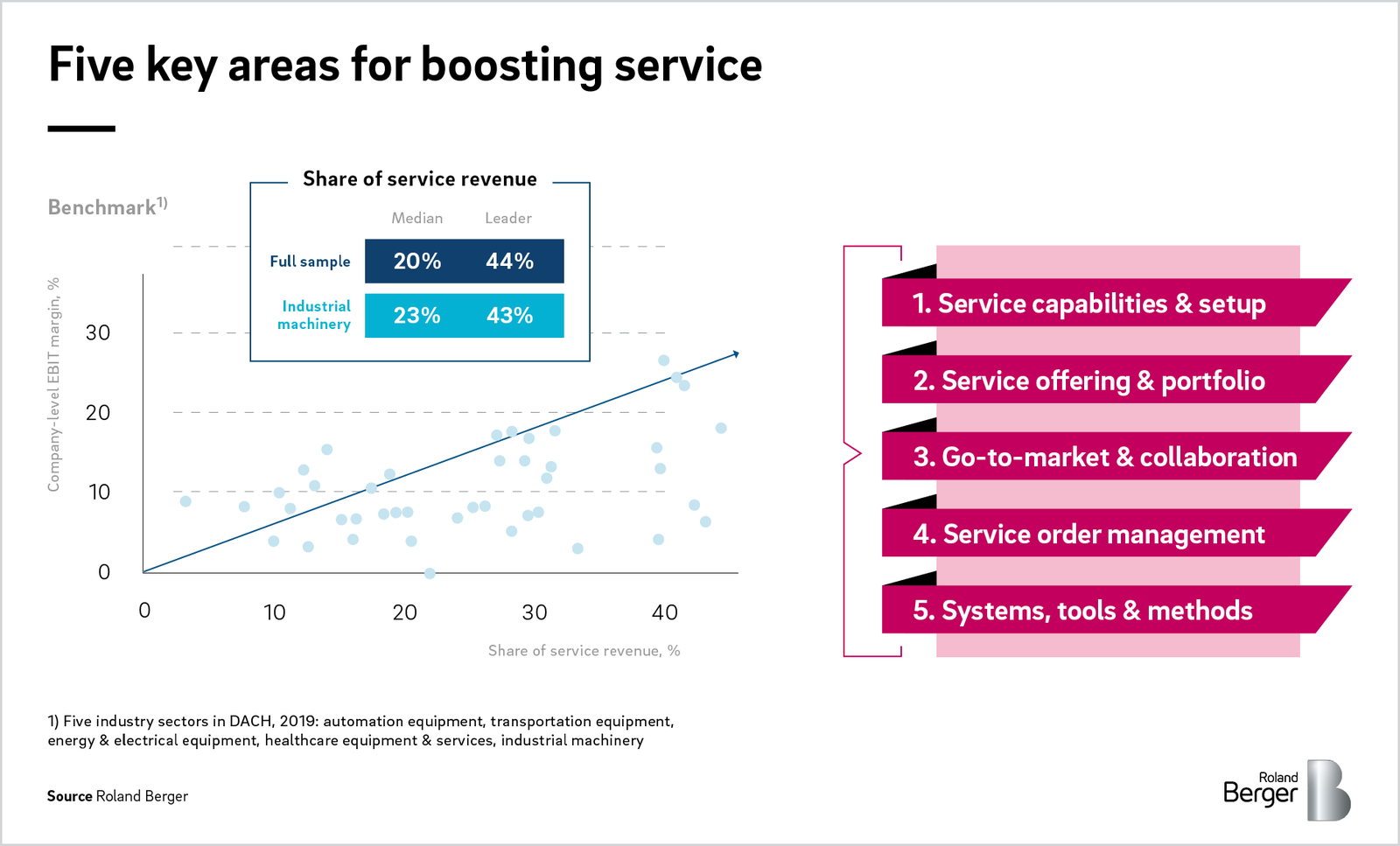
We identify five key areas in which players can boost their services and in so doing turbocharge their revenues: service capabilities and setup, service offering and portfolio, go-to-market and collaboration, service order management, and systems, tools and methods. In the area of service capability and setup, to take one example, they can consolidate their service activities and competences by setting up hubs for their operations, thereby reducing organizational complexity and avoiding redundancy in capabilities. As part of this, they should consider implementing strict first, second and third-level support structures, customer interfaces and helplines, while aligning their procedures and best practices by introducing standard processes.
In the area of go-to-market and collaboration, companies can streamline their service sales channels and improve collaboration with and across company functions. They should also consider coordinating their sales approach for services across all channels. This can include defining clear rules with regard to "service giveaways", say, or goodwill evaluation between new sales and service.
Companies operating in different markets or parts of the value chain are employing different service models in order to maximize their profitability. For example, providers of large equipment, such as PET filling machines, traditionally already use their service business to generate profits, as the sales of the machines themselves are often barely profitable. Here, some providers have built a comprehensive lifecycle service business model ranging from spare parts and embedded engineers to digital services.
Large beverage carton and equipment providers have started to shift their focus towards the service business. Major suppliers employ a "razorblade" business model, in which their largest revenue share stems from sales of packaging materials – in other words, they sell their machines at a low price while pushing up overall revenues through the sale of complementary goods. This part of their business is increasingly exposed to competition from non-system suppliers. Overall, the share of revenue deriving from services is comparatively low, at around ten percent. However, system suppliers see services as a key revenue pool for the future and a way to enhance customer loyalty through digital services and customized service contracts.
Converter companies (companies that produce or modify packaging materials) are also increasingly shifting towards advanced service offerings. For example, packaging material suppliers in the food and beverage industry are offering smart packaging solutions in the form of digital prints and QR codes that consumers can scan into their phone to access promotions. They support their offering with consulting and data analytics services, which then form the basis of their clients' marketing campaigns.
In the waste and recycling business, paper-based packaging companies are working more and more directly with supermarkets, providing a free waste pick-up service. That means they can collect paper material for their recycling operations, while at the same time strengthening the relationship with their customers. It's a strategy that also creates a clear incentive for customers to use their services, as those customers enjoy both cost savings and free service provision. In some cases, this service is also extended to secondary packaging.