
The age of accumulating telecom networks is coming to a close. The financial and environmental case for decommissioning (‘Decom’) legacy networks—when fully understood—is just too compelling. But whilst some operators are making progress, in our view, most are not positioned to take full advantage and reap all of the benefits. To an extent this is understandable, since there are so few recent precedents for large scale decommissioning. Without a clear-eyed view of the full case, operators are missing a trick and risk needless delays on one of the most financially and environmentally attractive decarbonisation (‘Decarb’) programmes available today. In this research, Roland Berger outlines which levers are most often overlooked by operators and use a case study to show the full value of pulling all levers in the business case from both an economic and emissions perspective. We identify the key benefits and concerns pinpointed by industry participants, and summarise the three types of operators who stand to benefit most from rethinking their decommissioning plans.
Operators are right to have high hopes for network decommissioning
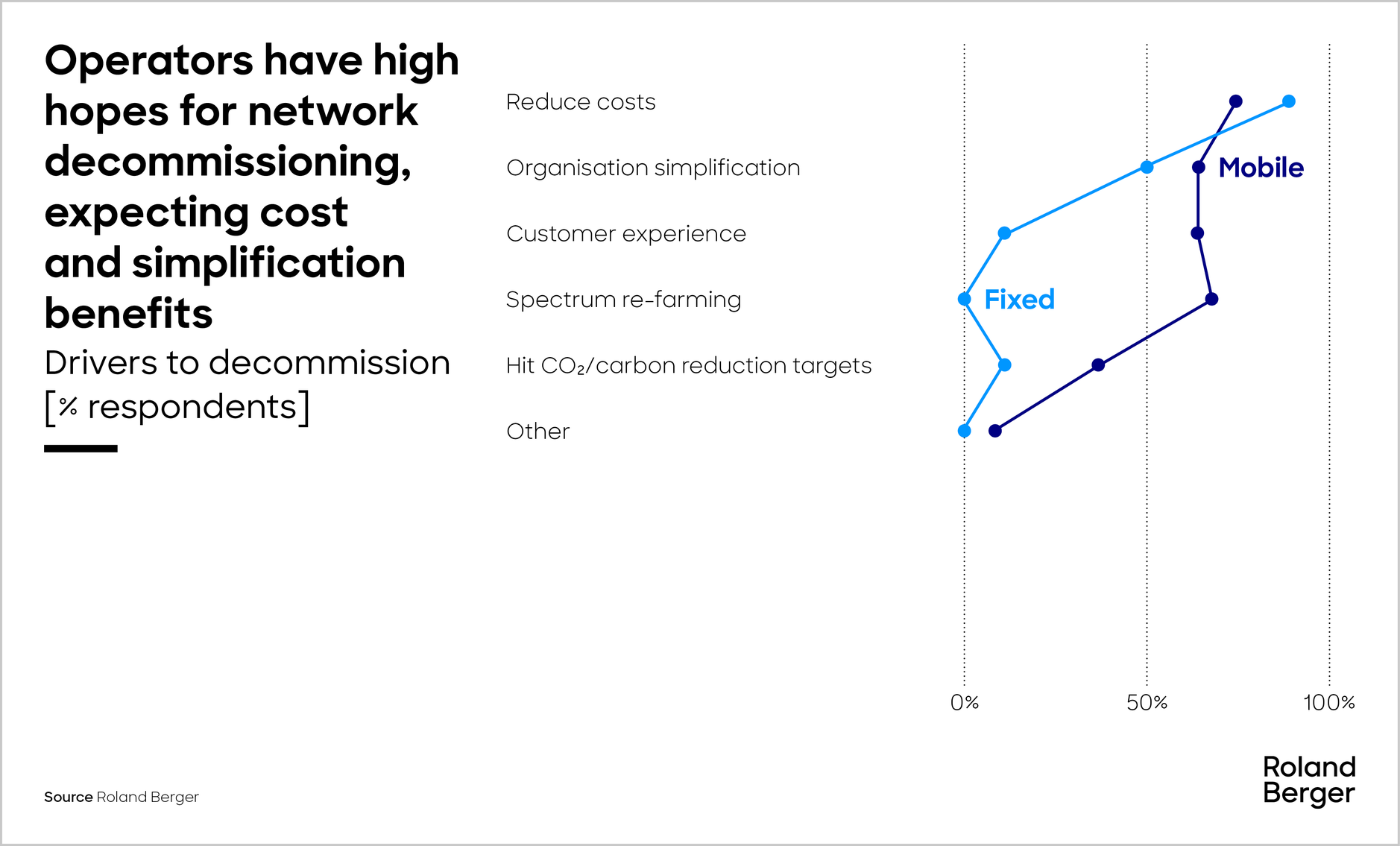
For many, the answer has been to prepare for PSTN/copper switch off in fixed line and 2G/3G shutdowns in mobile. In our study, both fixed and mobile operators anticipate reduced costs (power savings, less maintenance, etc.) and simplification (for example, network planning). Mobile network operators also expect benefits from spectrum farming (i.e., redeploying 3G spectrum towards 5G usage) which should improve customer experience.