Risks and remedies: Tight regulation and public sector control mean diligence is required in several areas
Despite the attractiveness of Spain’s PTI market, there are numerous potential pitfalls at the macro, regional and portfolio level which may need to be addressed by investors. These include:
Tariff indexation and correction lags
CPI indexation is standard in concessional regions, but annual adjustments may lag and are sometimes implemented in multi-year catch-up increments.
Action: Assessing the historical and expected frequency of tariff updates will ensure smoother planning.
Contract expiry and model evolution
Several regions operating under concession or authorization models are approaching contract expiry. The strategic question is whether these regions will renew under the same model, shift to a more competitive regime, or seek to rebalance the market structure. The direction taken will have material implications for market share, margin and capital requirements.
Action: Align early with the regional administration and prepare for all outcomes.
Impact of electrification
The long-term rise of electric vehicles (EVs) will change the inspection mix. While EVs do not require emissions testing, they will need new, more complex safety and battery checks. This could offset lost revenue from traditional tests. However, the timing and regulatory adaptation will vary by region.
Action: Model the impact on inspection volumes, pricing and required investment in new testing capabilities.
Compliance rate evolution
Compliance rates (the share of vehicles actually inspected) are rising, driven by regulatory enforcement and industry lobbying. However, there are significant regional and segment differences. For example, compliance is highest for passenger cars in urban areas, and lower for light vehicles, motorcycles and in rural regions.
Action: Develop a good understanding of compliance dynamics to accurately forecast demand and identify growth opportunities.
Relationships with public administrations
Understanding the dynamics of negotiation, contract management and regulatory adaptation with regional public administrations is essential.
Action: In the Spanish context, where the wheels of bureaucracy tend to move at a measured pace, it pays to build close relationships with local government.
Constraints on operational efficiency
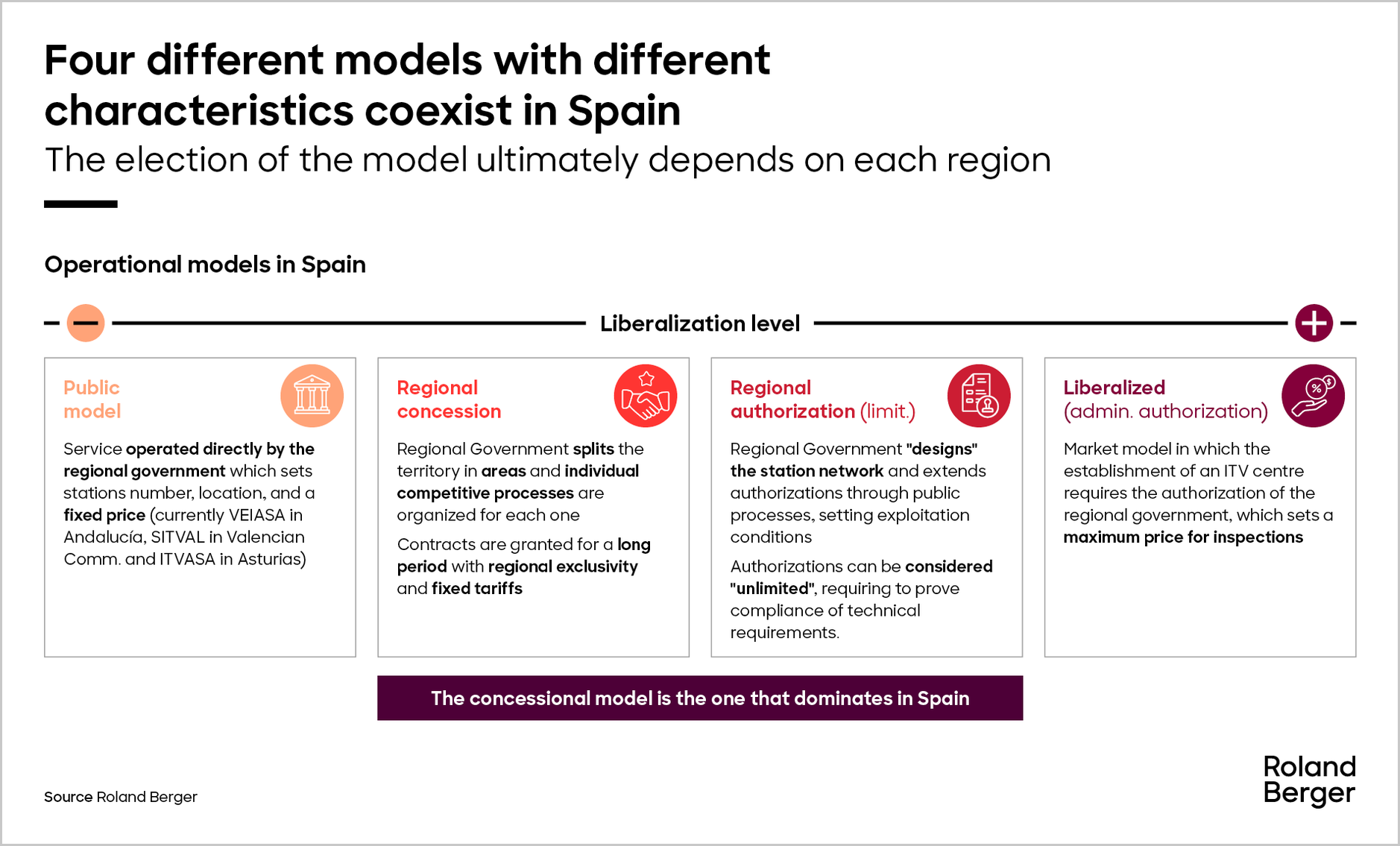
The degree of flexibility to improve operational efficiency varies by model. In public and concession models, labor terms and minimum staffing are often contractually fixed, limiting levers to optimize processes and invest in new technology. In limited authorization and liberalized models, operators may have more room to improve staffing, scheduling and service offerings, but must balance this with competitive pressures and regulatory oversight.
Action: Diligence should focus on efficiency levers that are truly actionable in the applicable regime and the potential impact on margins.
Vehicle connectivity, AI and remote testing
The increasing connectivity of vehicles and advances in AI are likely to transform the PTI landscape in the coming years. Remote diagnostics and the potential for certain tests to be performed without physical attendance at a PTI station could disrupt traditional business models, especially in urban and technologically advanced regions.
Action: Assess regulatory openness to remote inspections, the readiness of operators to adapt and the potential impact on station utilization, capex needs and competitive dynamics.