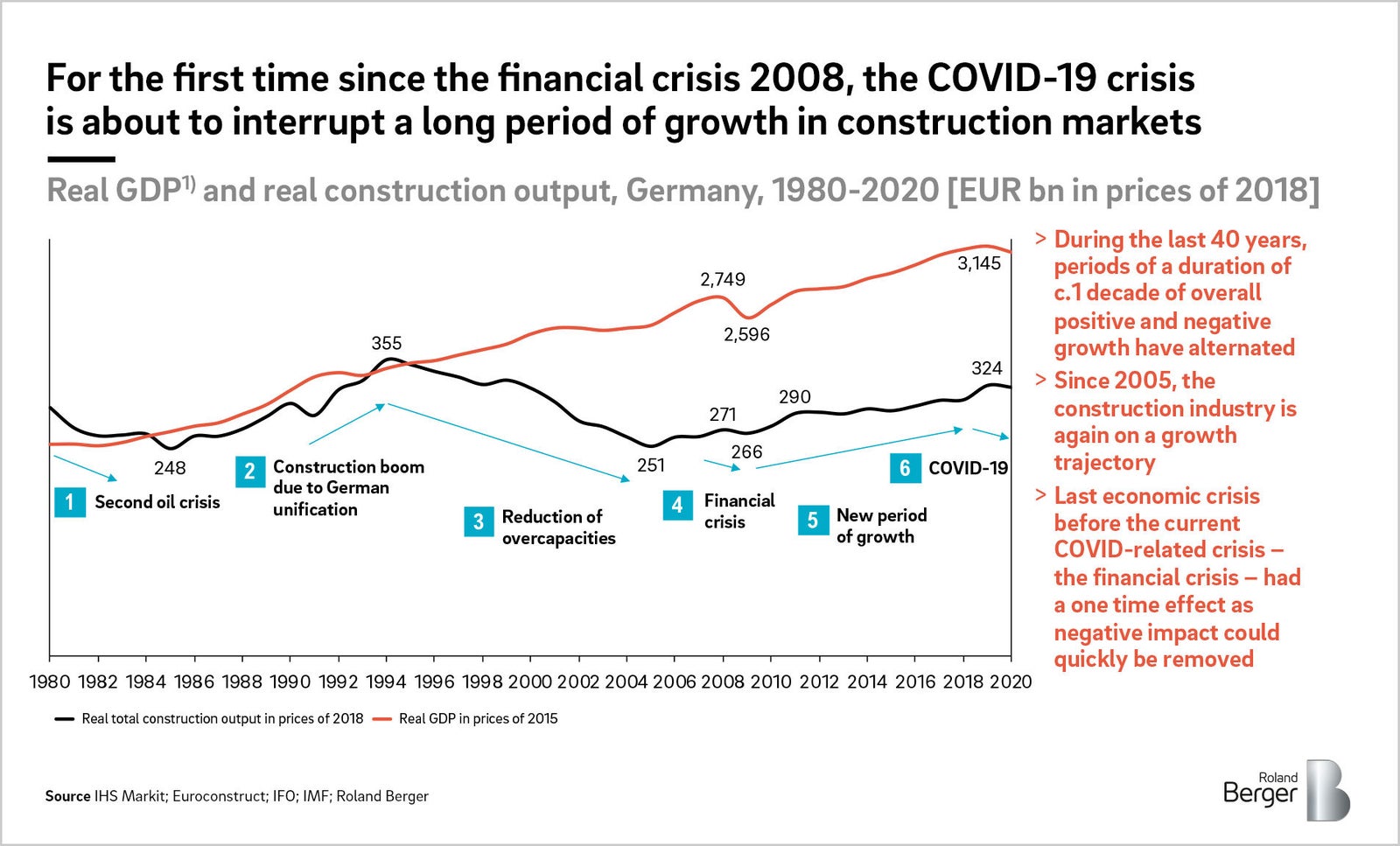
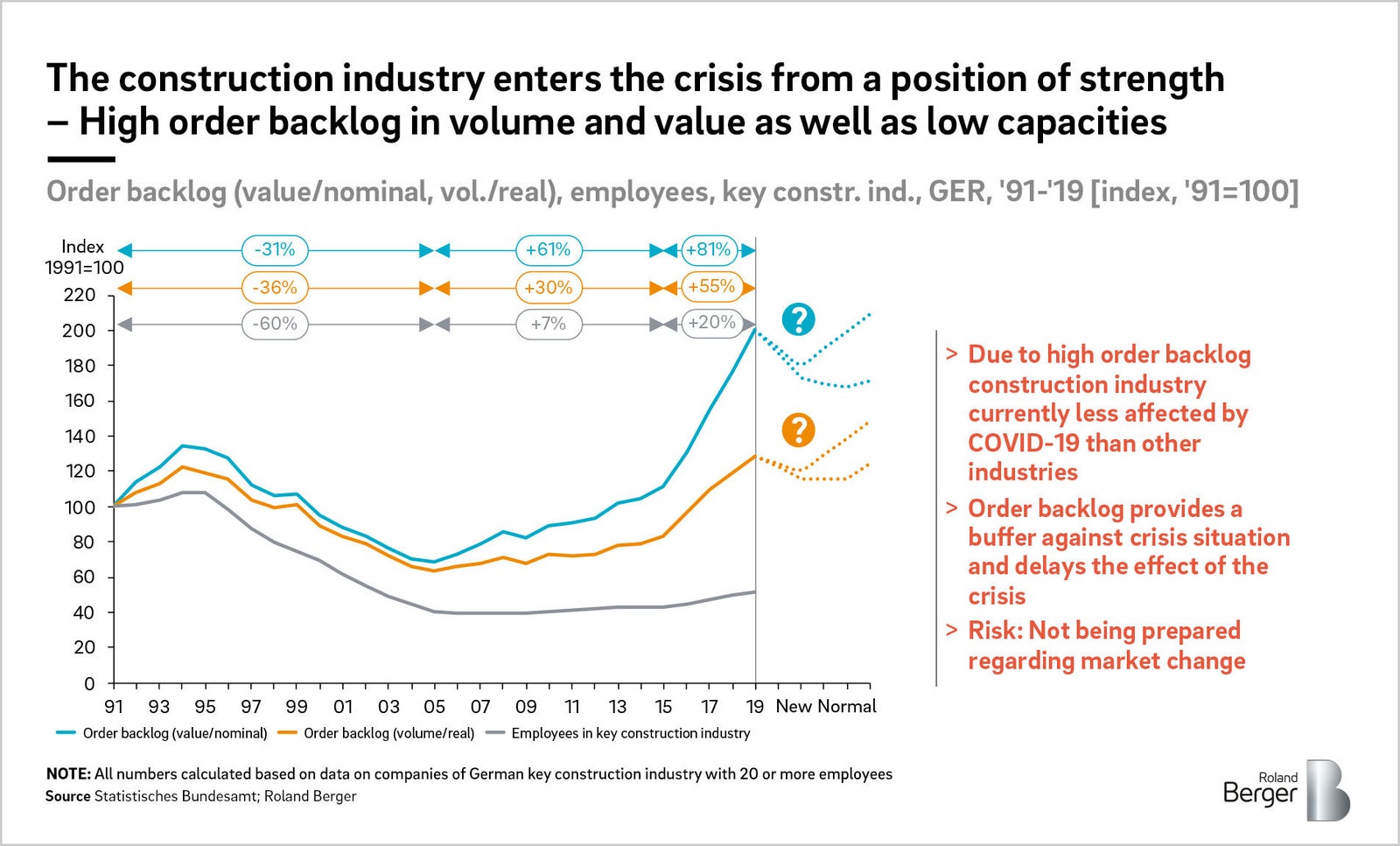
However, the current situation is not comparable with any of the earlier crises in the sector as the cause is fundamentally different and the construction industry is entering this crisis in a much stronger position, both in terms of the general economic conditions under which it's operating, such as low (mortgage) interest rates, and the circumstances within the sector itself. These include coming out of a growth phase spanning more than 10 years, low or even undercapacities (with the construction industry now employing about half as many people as it did in 1991) and an order backlog of a volume and value not seen in 30 years. But the German construction industry already began to show the first signs of a coronavirus slowdown in March 2020, when new orders in the sector were more than 7% down on the volume seen in March 2019.
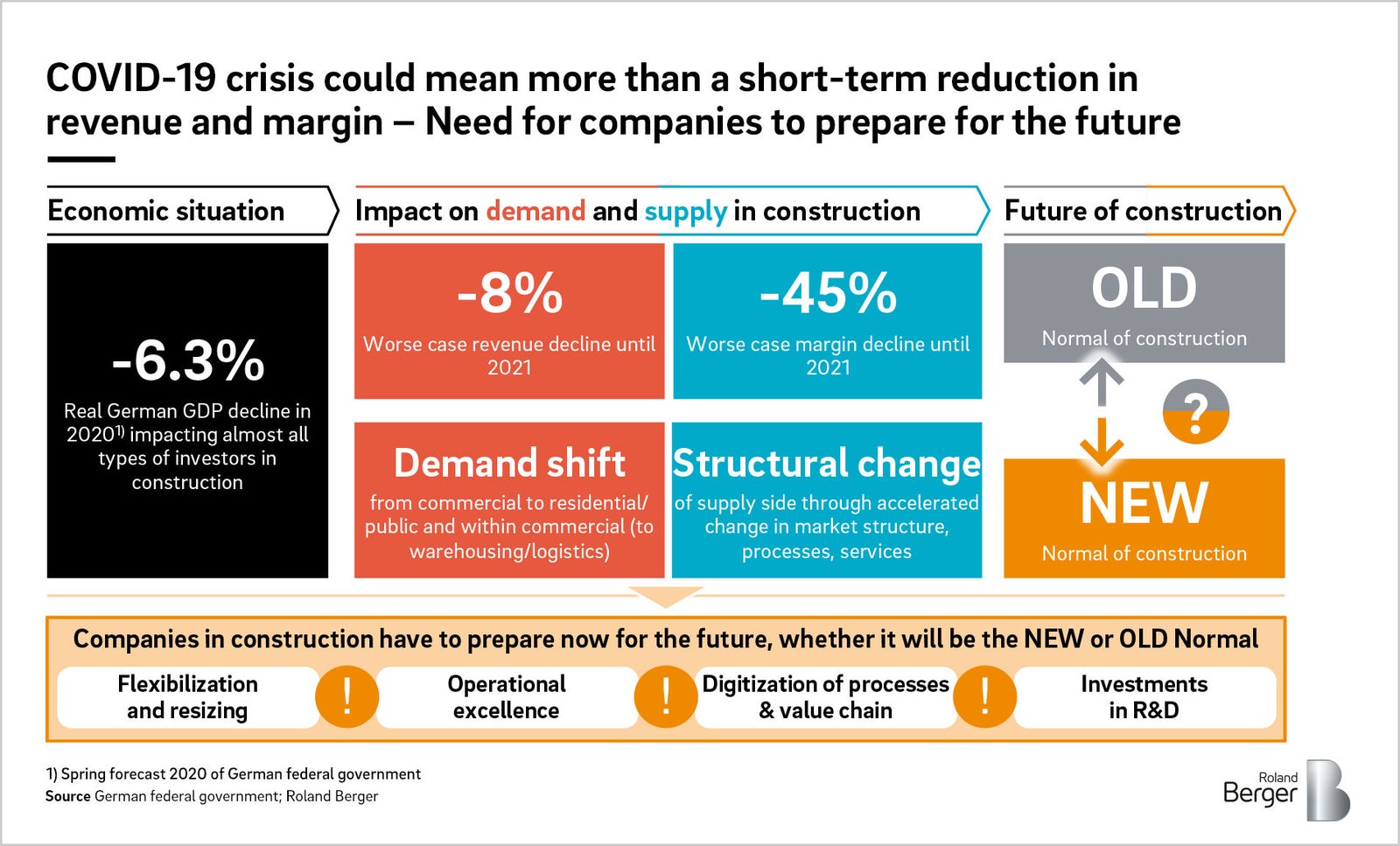
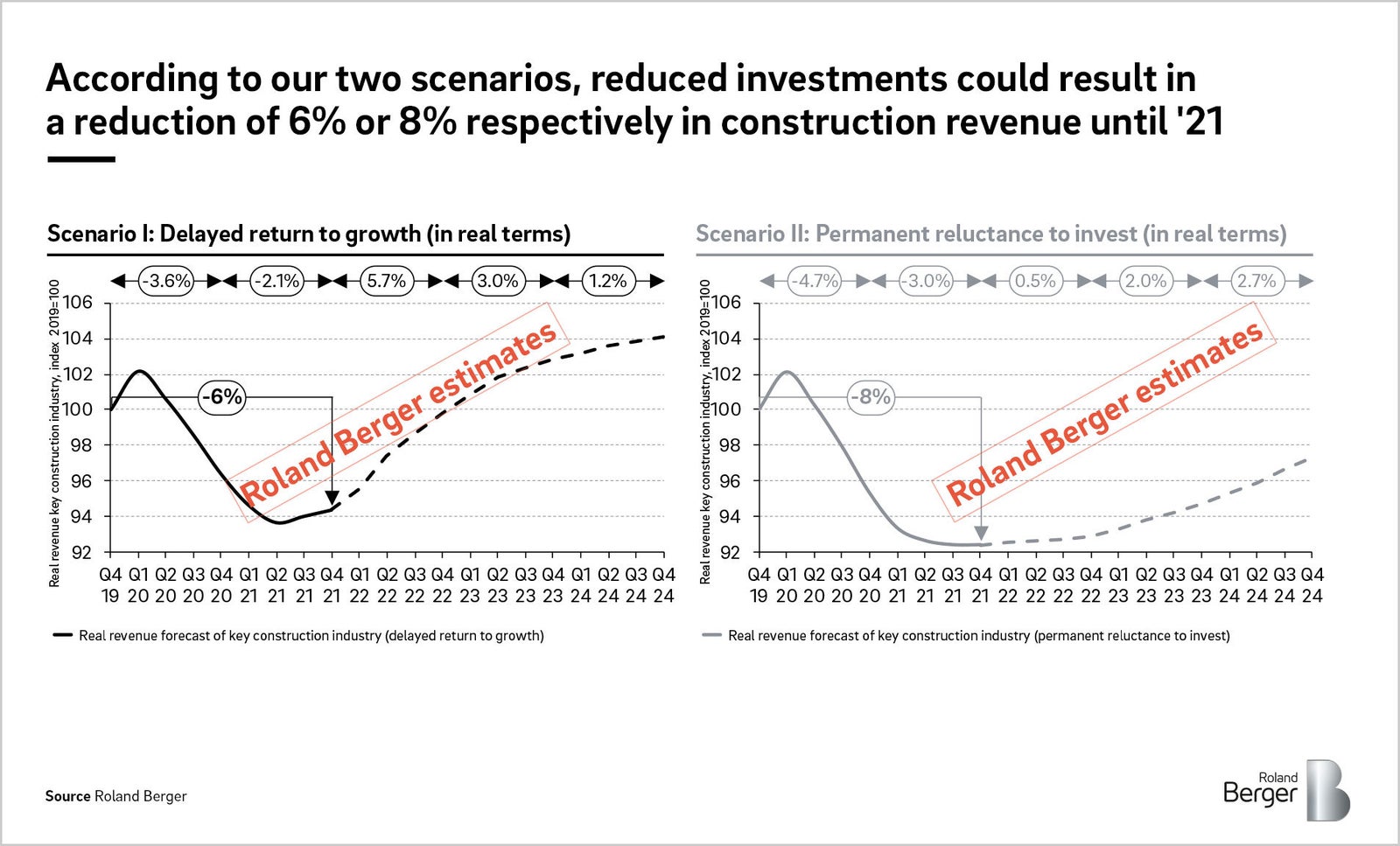
8% real decline in revenues and 45% lower margins due to reduced or postponed construction spending as a result of the Covid-19 crisis
On the demand side, Germany's construction industry will primarily feel an indirect hit from the effect the coronavirus crisis is having on investor groups. Private household investments will likely be impacted by the increased level of (perceived) uncertainty around unemployment (+19% unemployment in April 2020 compared to April 2019) and short-time work (more than 10 million employees had been put on short-time work by the end of April). Politicians may be willing to use rent caps to support tenants affected by the coronavirus crisis. Behavioral changes such as regular working from home have the potential to make living in the countryside more attractive – but in most cases there is already sufficient accommodation available there.
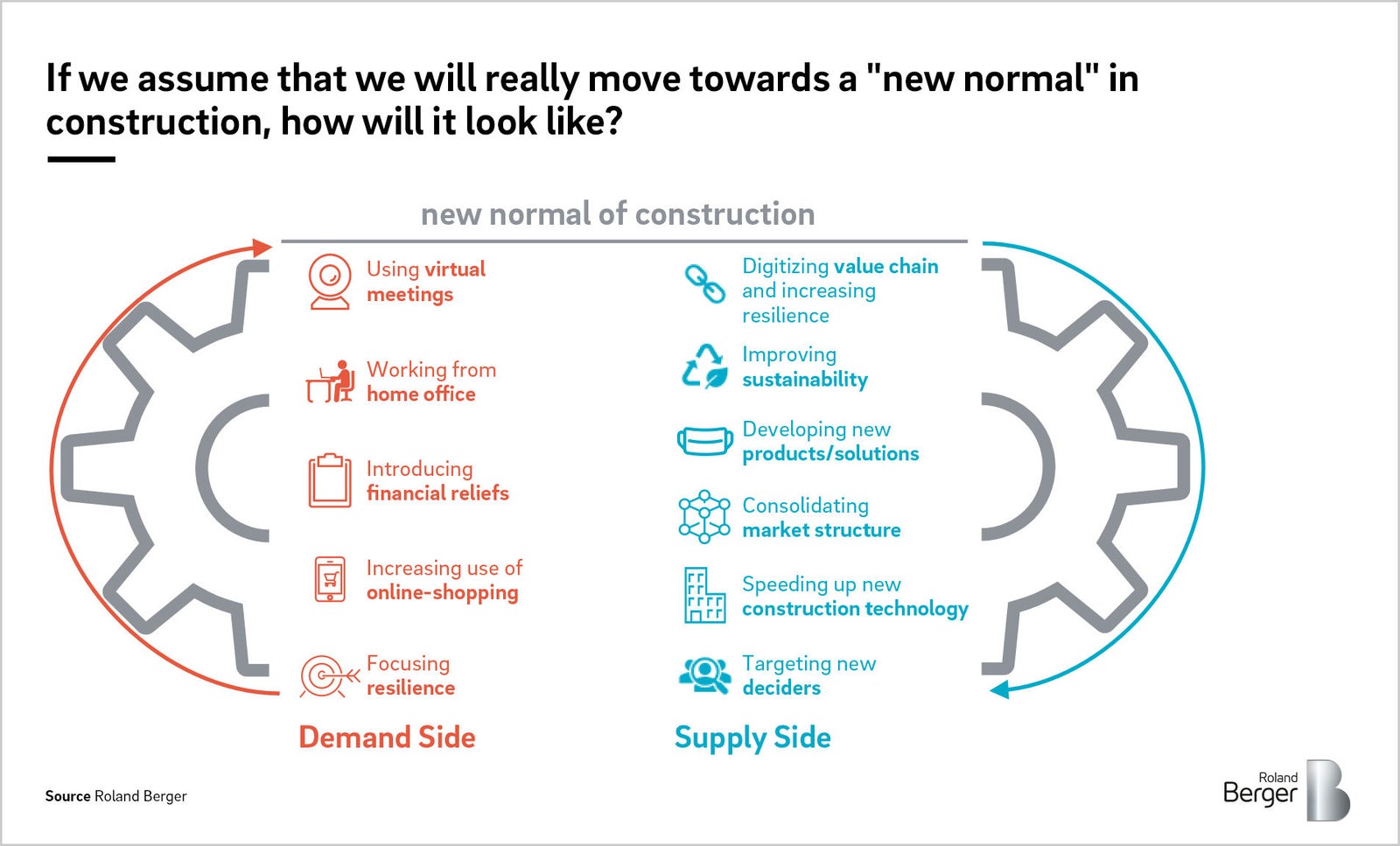
In commercial construction, companies' demand for building work may decline due to the massive slump in sales and profits some firms are experiencing, a typical reaction to the coronavirus crisis being to completely cut all non-essential spending. Furthermore, the structure of demand may also change as a result of (permanent) changes in behavior: fewer hotels (as there will be fewer business/leisure trips), fewer offices (as there will be more remote working), less retail space coupled with increased demand for more warehouse/logistics space (as there will be more online shopping).
Public sector construction spending can be expected to suffer, mainly under the weight of the mounting debts faced by cities and local authorities who are responsible for the majority of such spending. Levels of debt were already high here and the situation is now being exacerbated by the loss of business tax revenues in the wake of the Covid-19 crisis. Economic stimulus programs – which tend to be linked to sustainability criteria – or any debt relief granted by federal or state governments to the local authorities would likely help stabilize construction spending on modern infrastructure (e.g. high-speed internet, intelligent building control in the context of the Internet of Things) and "green" public buildings. In order to meet this demand, a large proportion of construction companies will need to invest in expertise and equipment, in some cases substantially, as relatively few companies so far specialize in these segments.
Against the backdrop of shrinking investments and the changing demand structure, Roland Berger has drawn up two scenarios for how the revenue trend could develop for construction companies. The scenarios are based on regression analysis of selected indicators combined with empirical values from past crises. The scenarios show that the construction industry will likely reach its nadir in the first or second quarter of 2021, somewhat later than the economy as a whole. At the end of 2021, real revenues may thus be 6% lower than at the end of 2019 in the base scenario (U-shaped recovery), and as much as 8% lower in the negative scenario (L-shaped recovery).
Given the nature of construction projects with their lengthy planning, approval, financing and execution phases, we believe that the full impact of the coronavirus crisis will be felt here later than in many other industries – not until the end of this year or early next year. So the sector will only get back to something approaching pre-crisis levels towards the end of 2022. We anticipate that the biggest losses will be driven by commercial construction, where a 6% drop in real terms could be seen in 2020 owing to the collapse in revenues – with some firms making zero sales during lockdown. This effect will likely continue into 2021, where a further decline of 2-3% is possible. Housing construction will likely feel the impact in the latter part of 2020 as households express lower demand for newbuild homes (about 2% lower in real terms in 2020). The crisis impact could extend into 2021 (-1% to -2% in 2021). If policymakers react with countermeasures as described above, offering suitable economic stimuli or debt relief programs for municipal authorities, public spending has the potential to exert a stabilizing influence, bringing growth rates of between 0% and 1% in real terms in the years 2020 and 2021.