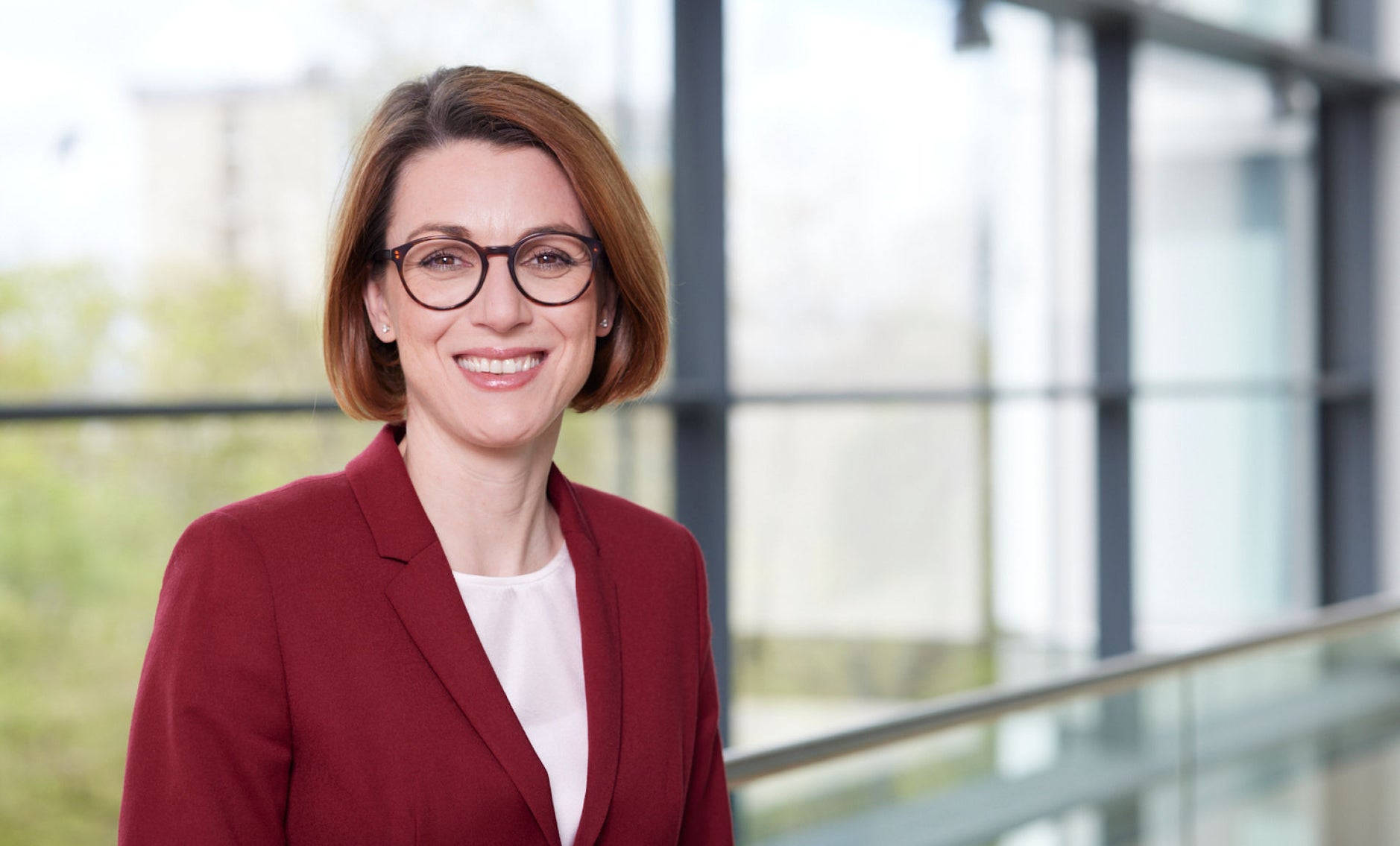
Nina Feuersinger: Speaking of leadership, you developed a new Leadership Framework. What does it regulate and what elements are particularly important to you at Ergo?
Dr. Lena Lindemann: Our Leadership Framework has four pillars. Central to it is the definition of a leadership standard that applies across all areas. Our aim is to set a lean, uniform and clearly structured standard for leadership situations through continuous, structured dialogue between teams, managers and individual employees. The second pillar concerns the strategic direction of leadership development. Here, we are setting priorities and deliberately focusing on topics that are strategically relevant to us right now. These are then driven forward by all of our leaders - from the Management Board to the Group Managers. Our shared leadership culture is the third pillar of the Leadership Framework. It not only supports standardization but also helps us communicate uniform messages to our people. The fourth pillar comprises diagnostics-based selection and development of leadership personnel at all levels. Especially in times when many far-reaching change processes are taking place, it is particularly important to get people on board with transformations, to get them moving and to work together towards a common goal. The balance between performance and leadership must always be maintained. That is the focus of our diagnostics.
Nina Feuersinger: You have headed up Ergo's HR work as Chief Human Resources Officer since 2022. What other topics are you currently dealing with in the HR organization?
Dr. Lena Lindemann: We have defined four pillars within the strategic HR agenda. The first is about positioning Ergo as an employer. This includes both the brand as a whole and recruiting target group specifically. In addition to specialist staff and experts, apprentices and trainees are a particularly important target group for us. The second pillar goes by the name of "Grow" and is aimed at global talent management and our employees worldwide. It focuses in particular on how ways of working are exemplified across countries and companies. The Leadership Framework we already mentioned is part of the third pillar. The focus here is on leadership, people and performance management. And all of this is based on strategic HR planning and HR analytics. In order to make well-founded HR decisions, we need high-quality data and state-of-the-art IT solutions for HR.
Nina Feuersinger: Another important topic is global talent management. Employee development is of paramount importance in the future skills context. At the same time, employee development is often seen as exclusively a leadership task. How do you manage to provide key impetus here as an HR department?
Dr. Lena Lindemann: Particularly in the context of talent development, it is important to empower the entire organization. Skills must be fostered across the board, regardless of which function they are found in within the company. We want to embed technology skills and a digital mindset at all levels through targeted upskilling and reskilling. Strategies such as digital first or digital only underline this priority and are closely linked to our business strategy. HR plays a key role in this by developing and implementing suitable training programs.
Nina Feuersinger: Finally, what top issues do you see coming up on the HR horizon in the future?
Dr. Lena Lindemann: In addition to the topics already mentioned, lifelong learning will be increasingly important. We need a new understanding of job security and at the same time a personal mindset of wanting and needing to develop ourselves further. I recently came across a nice image in this context: A bird on a branch doesn't worry about whether the branch might break – it trusts that it can fly. Translated across to learning and skills, this means trusting that you can acquire new skills and develop yourself further instead of remaining in a fixed role. Our biggest task in HR is to foster a corporate culture that firmly integrates lifelong learning and the acquisition of new skills.
Nina Feuersinger: Thank you very much for your time today.