Despite years of momentum surrounding Environmental, Social, and Governance (ESG) practices, many corporate resilience strategies are falling short. Internal silos, fragmented data, outdated technology, and insufficient risk governance capacity hinder effective action. The complexity of today’s threats - ranging from climate change and nature loss to regulatory pressures and supply chain vulnerabilities - overwhelms governance structures that were never designed for such interdependence.
The
sustainability
conversation is evolving, too. Following a period of rapid growth and high expectations, ESG is now undergoing critical reassessment. As organizations pivot, sustainability teams must navigate a more complex landscape that demands nuance, transparency, rigorous evidence and value generation in an environment with overlapping and unpredictable risks.
This is where next-generation AI, particularly agentic AI, comes into play. Designed to adapt under uncertainty and synthesize distributed information, agentic systems are uniquely positioned to tackle the complexities of sustainability and resilience. By connecting internal and external data at the product level - spanning suppliers, raw materials, and environmental risks - agentic AI enables holistic risk management. It facilitates the transition from fragmented efforts focused solely on costs or carbon reduction to integrated actions that support smarter decisions, faster responses, and more durable outcomes.
Harnessing agentic AI to tackle interconnected risks
As systemic challenges like climate change and nature loss intensify, advancing
artificial intelligence
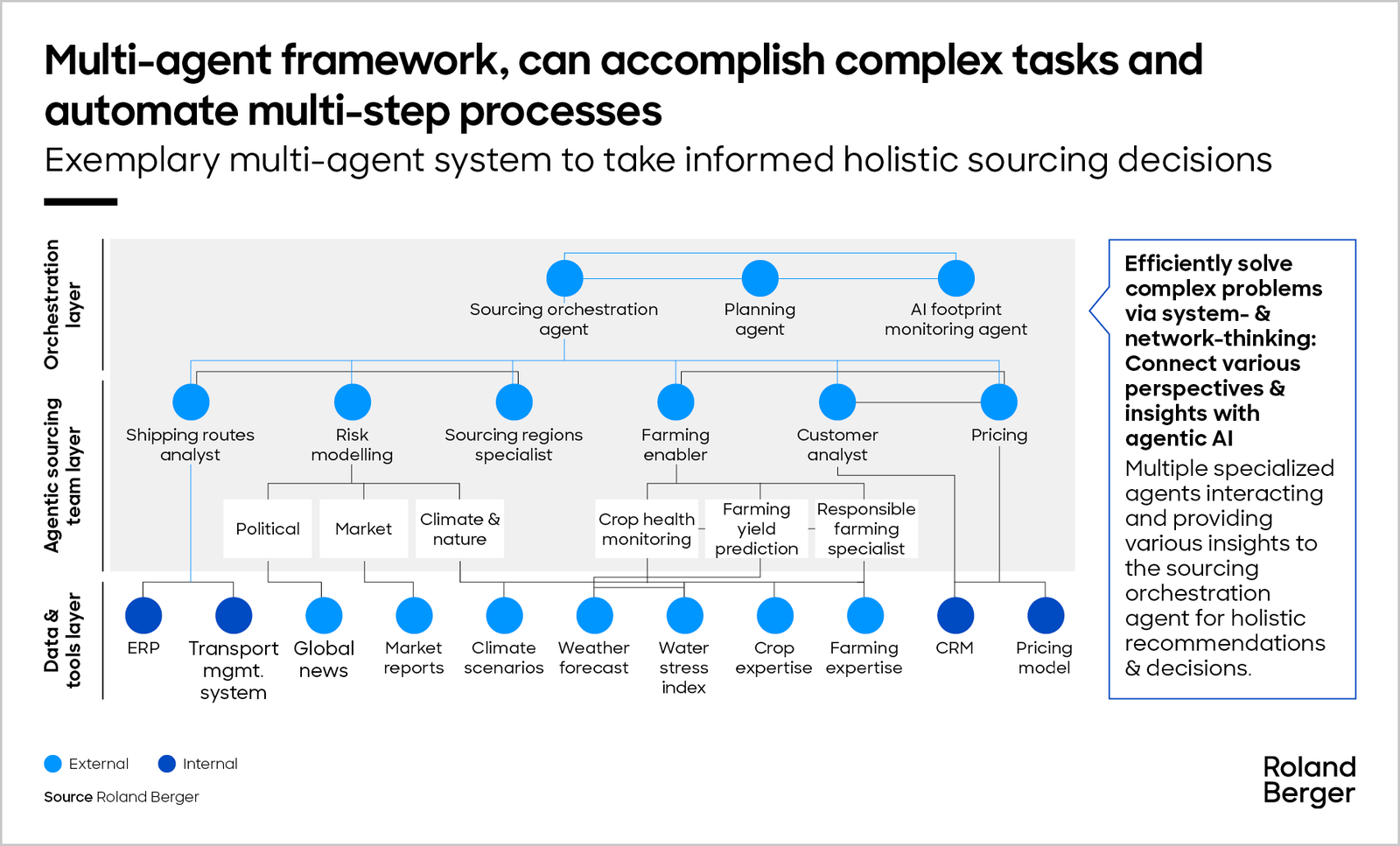
becomes critical. Among the latest breakthroughs, agentic AI stands out as a transformative solution capable of addressing the complexity and interconnectivity of today’s risks. Built on multi-agent systems, agentic AI enables holistic insights across domains such as climate, politics, supply chains, and market dynamics, enabling organizations to navigate interdependent challenges and make informed decisions.
Industry investment reflects this momentum. Tech giants are projected to spend USD 60 to 80 billion each on AI in 2025, while the green tech and sustainability market - largely driven by AI - is expected to triple, reaching USD 73.9 billion by 2030. Although Europe currently leads in adoption, the Asia-Pacific region is emerging as the fastest-growing market.
Agentic AI expands the role of AI to drive sustainability and build resilience beyond automation and efficiency, revealing its transformative potential for addressing systemic risks. Unlike traditional AI, which focuses on isolated processes, agentic AI leverages multi-agent systems to enable specialized analyses across diverse domains. This dynamic coordination allows organizations to make decisions that consider the interdependencies and cascading effects inherent in complex systems.