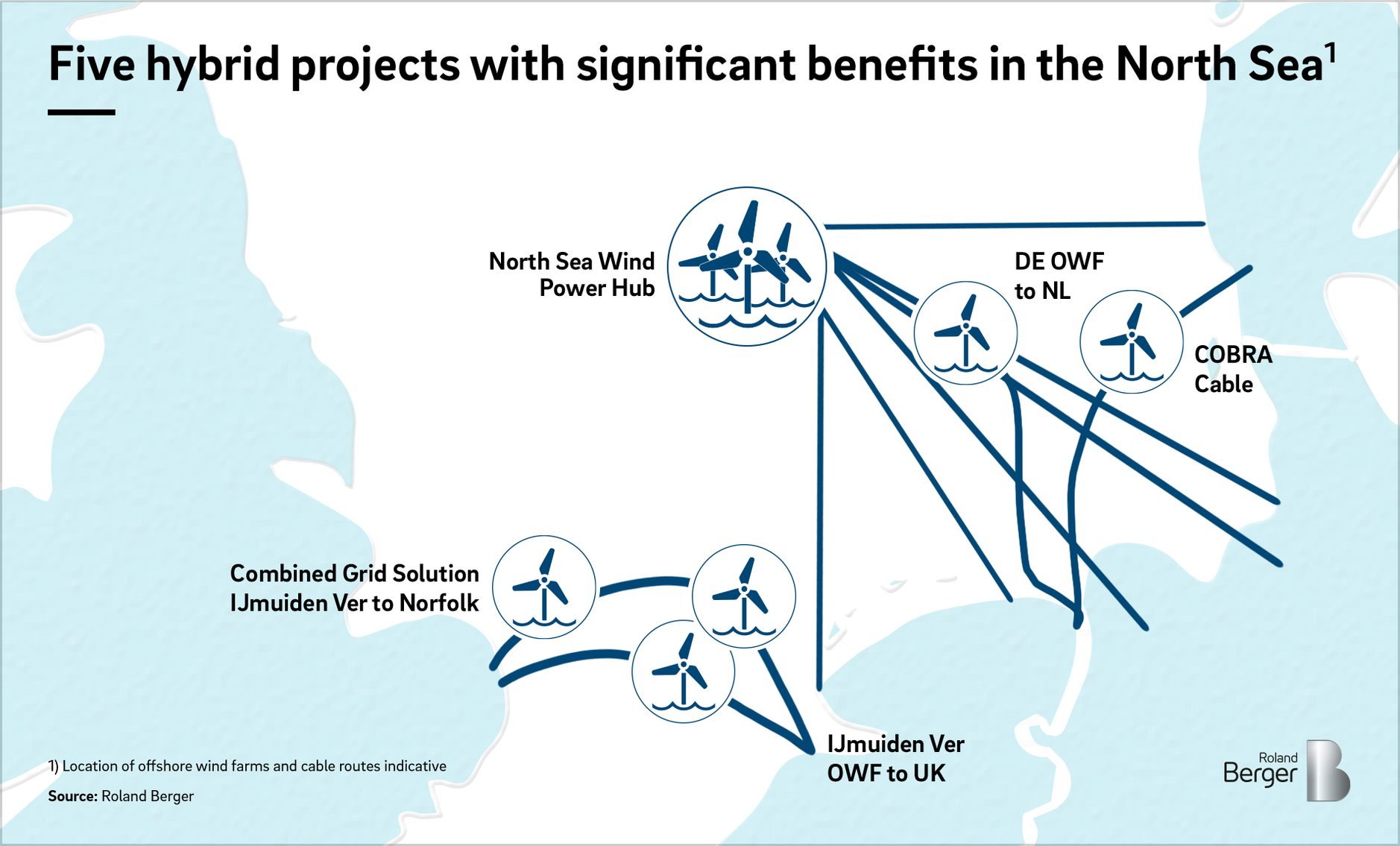
Of the 18 hybrid projects, five are found to be significantly more beneficial than their respective reference case. The five projects show potential for cost savings of between EUR 300 million and EUR 2,500 million, depending on the size of the comparable conventional project. This translates into 5-10% of total project costs.
Legal, regulatory and other barriers hinder the development of hybrid projects. The construction of the Kriegers Flak hybrid project in the Baltic Sea, the one hybrid project nearing commissioning, shows that these barriers are surmountable if stakeholders make a concerted effort. To ease the process, Action Plans containing specific mitigation measures to overcome the relevant barriers have been developed. In general, the measures tackle ad hoc or project-specific problems. But where they concern hybrid projects in general, they could also be effectively addressed at European level.
How to make hybrid projects a reality?
To tackle the barriers to the increased realization of the North Seas offshore wind potential through the implementation of hybrid projects, four main recommendations can be summarized. These are based on project-specific assessments:
1. Implement HANSAs, project-specific legal agreements to provide security for developers: Although the European Union is planning an internal energy market, most countries still place more emphasis on their own energy policies and rules. This hinders the implementation of transnational projects, such as the hybrid projects. Hybrid Asset Network Support Agreements address this problem. They ensure that specific mitigation measures designed to overcome relevant legal and regulatory barriers are developed and implemented, offering both shorter-term certainty and the possibility of informing future legal frameworks.
2. Provide public funds to de-risk pilot projects: Hybrid projects are riskier than conventional offshore developments. They are largely untested, require collaboration between multiple parties and integrate several projects into one. Developers therefore need incentives to switch from a conventional offshore project to a hybrid one during its early stages. Public financial support is key to this, helping developers and investors to de-risk pilot hybrid projects and allowing for early-stage alignment across assets and countries.
3. Agree rules to fairly share costs and benefits among countries and stakeholders: Stakeholders are unlikely to commit to a hybrid project without first knowing what benefits and costs it will bring them. For example, while country A may carry the burden of grid connection costs, country B may benefit from cheaper electricity. Such inequalities call for clear rules governing the fair allocation of costs and benefits in hybrid projects.
4. Widen the hybrid approach towards an integrated regional energy system (sector coupling): Hybrid projects can be expanded and improved by combining them with so-called power conversion technology. This converts electricity into another source of energy, typically gas, to ease transmission or store fuels during periods of oversupply. In combination, hybrid projects and conversion technology can help to avoid onshore grid congestion and supply risks. It will ultimately be essential in establishing an energy system that can integrate significantly more capacity from renewable sources.
Hybrid projects can make a significant contribution to Europe’s energy transition and its decarbonisation. In the shorter term they reduce costs and needed space, while in the longer term they pave the way towards an integrated and future-proof European energy system in the North Seas region.
The entire study by Roland Berger on hybrid offshore projects in the North Seas can be found
here.