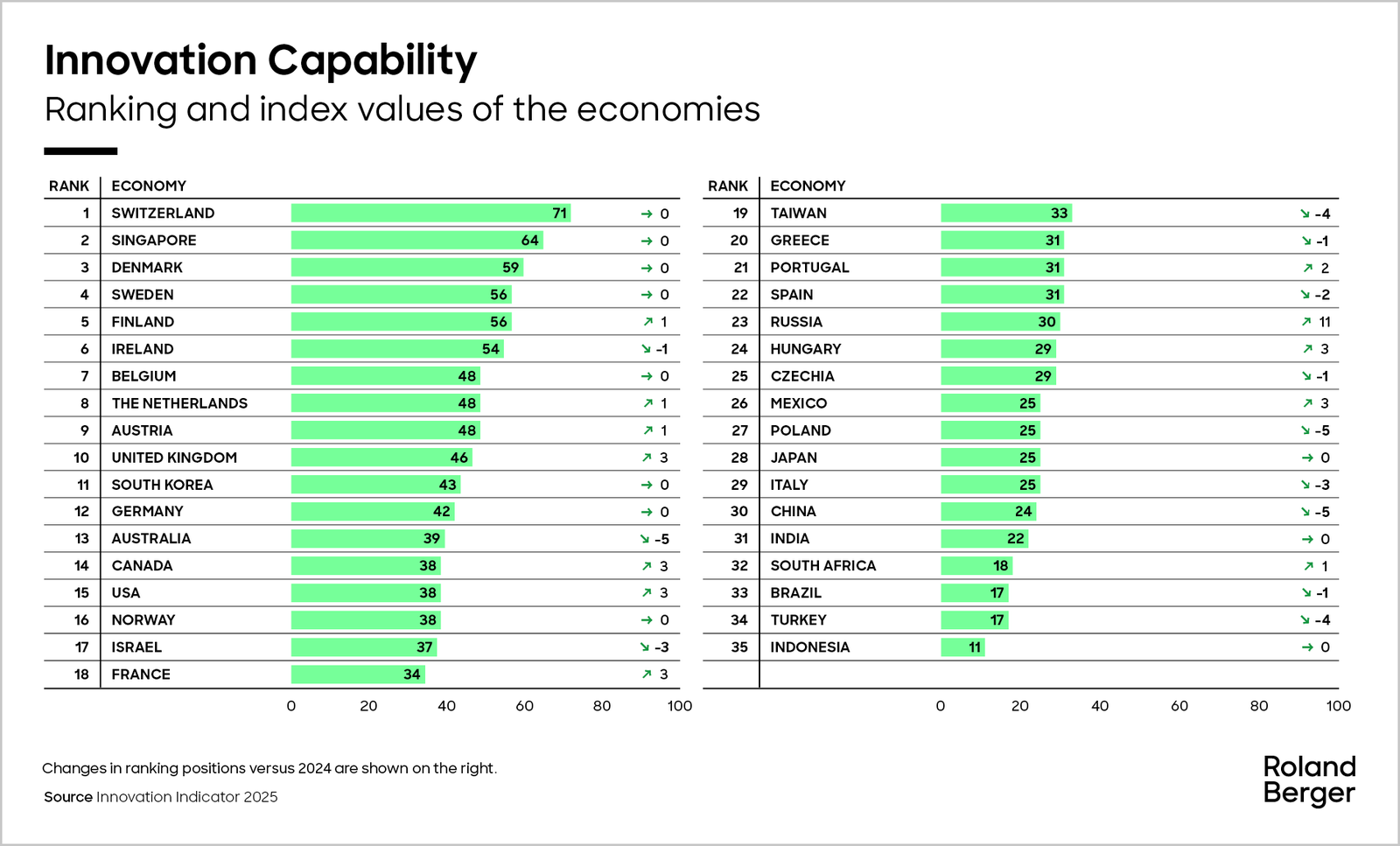
Sustainability performance also shows notable shifts. Several countries that previously ranked high have lost ground, including Germany, Denmark and Finland. Others improve significantly: Especially China shows strong performance driven by
environmental innovations.
These movements reflect both policy choices and the ability of national innovation systems to develop and scale environmentally relevant technologies.
Many economies generate knowledge effectively but face difficulties in bringing new ideas to market. Efficiency challenges are visible in countries such as Austria, where strong knowledge generation contrasts with weak commercialization. At the same time, openness in innovation systems has declined in recent years, triggered by the Covid-19-pandemic and exacerbated by growing protectionism and a stronger focus on
technological sovereignty.
Some economies, including Switzerland, Denmark, the Netherlands and Singapore, remain comparatively open, while others such as Japan or the United States show low levels of international integration.
The Innovation Indicator 2025 highlights the importance of targeted investment, international partnerships and the ability to translate scientific strength into economic impact. Economies that succeed in balancing openness and strategic security and manage to adapt their innovation systems to a more dynamic, uncertain environment are likely to maintain stronger long-term innovation performance.