The results reveal that the share of IT budget as a percentage of revenue has increased by more than 27 percent compared to our survey four years ago. At the same time, an increasingly larger share of expenditures is flowing into ongoing operations. 95 percent of institutions observe a shift from CAPEX to OPEX, i.e., away from depreciable investments toward operating costs. The trend among software vendors to increasingly use Software as a Service (SaaS) and subscription models instead of traditional one-time licenses continues unabated.
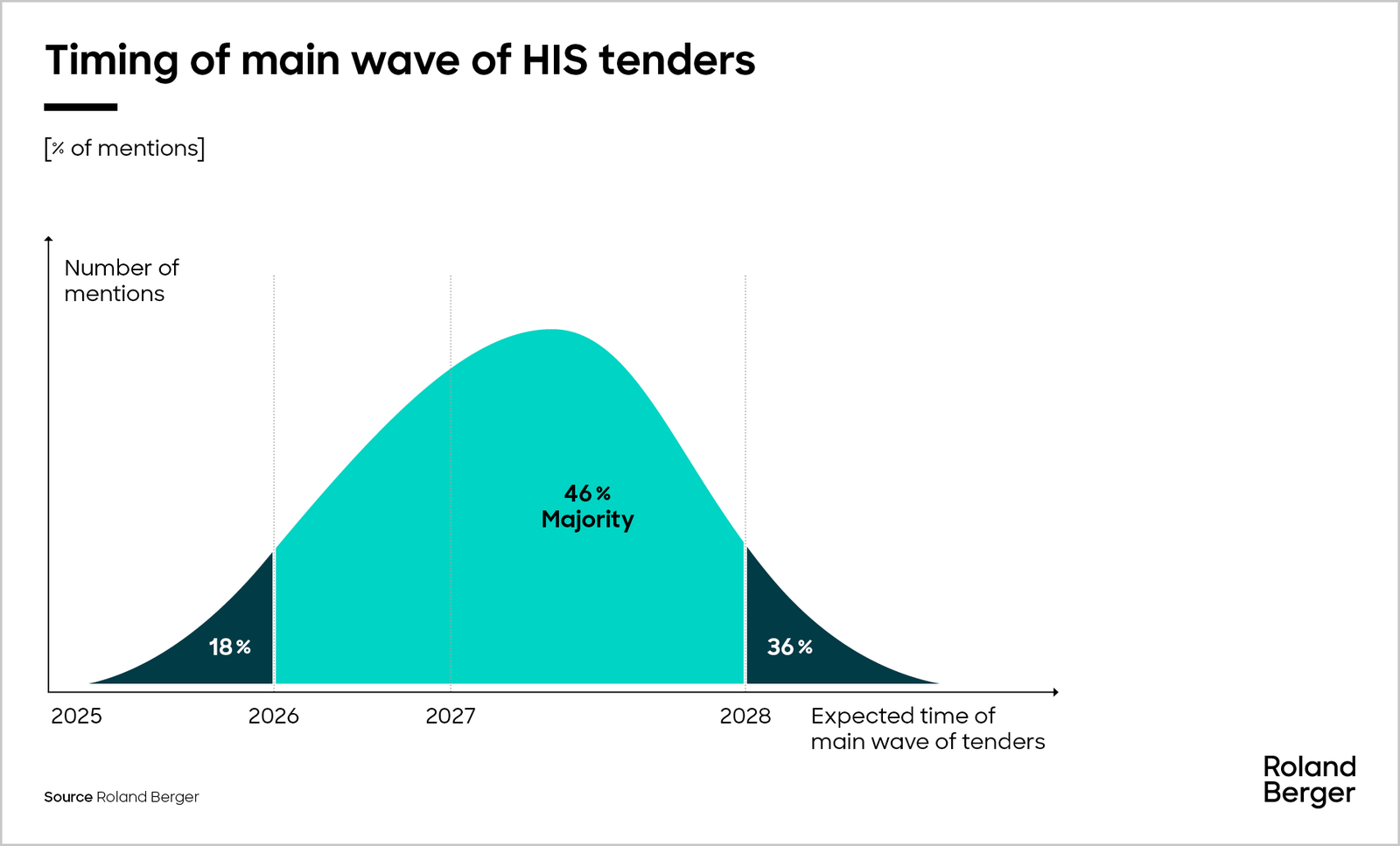
HIS: Main tender wave expected in 2027
Back in our 2023 survey, 27 percent of the hospitals surveyed already indicated they were planning to change their HIS. In our most recent survey, the figure stands at 30 percent. Participants cite the discontinuation of IS-H and the goal of realigning their IT strategy as the most important reasons for the change (86 percent). For 71 percent of hospitals, existing technical restrictions are the primary driver. A majority of 46 percent expect the main tender wave for HIS solutions to occur in 2027.
In the ERP domain, SAP is clearly the market leader in the German hospital market: 76 percent of the hospitals surveyed use an ERP system from SAP, with 52 percent of them using SAP ECC and 24 percent the newer version S/4HANA. Nearly eight out of ten respondents advocate a clear separation between HIS and ERP in the transformation. Thus, the approach of first transforming the ERP system and only then addressing the HIS appears to be the most sensible path for the hospitals surveyed.
The issue of staff and capacity shortages also continues to weigh heavily on respondents. For the HIS transition, capacity-related implementation challenges are therefore expected – both at the vendors and within the hospitals themselves.
Recommendations for successful transformation in hospital IT
Particularly in view of further rising IT budgets, Roland Berger experts recommend leveraging hospital IT as a strategic differentiator and positioning it specifically at C-level. In addition, internal budget structures for IT projects should be adjusted and alternative funding modalities coordinated with the federal states to account for the increasing CAPEX-OPEX shift and the focus on operating funds. A coordinated ERP and HIS transformation requires a common target state. To this end, an HIS strategy with concrete scenarios should be developed to optimally manage technological and organizational dependencies. Fundamentally, the experts note, IT projects should always be derived from concrete challenges to ensure measurable added value.