When it comes to
building business robustness
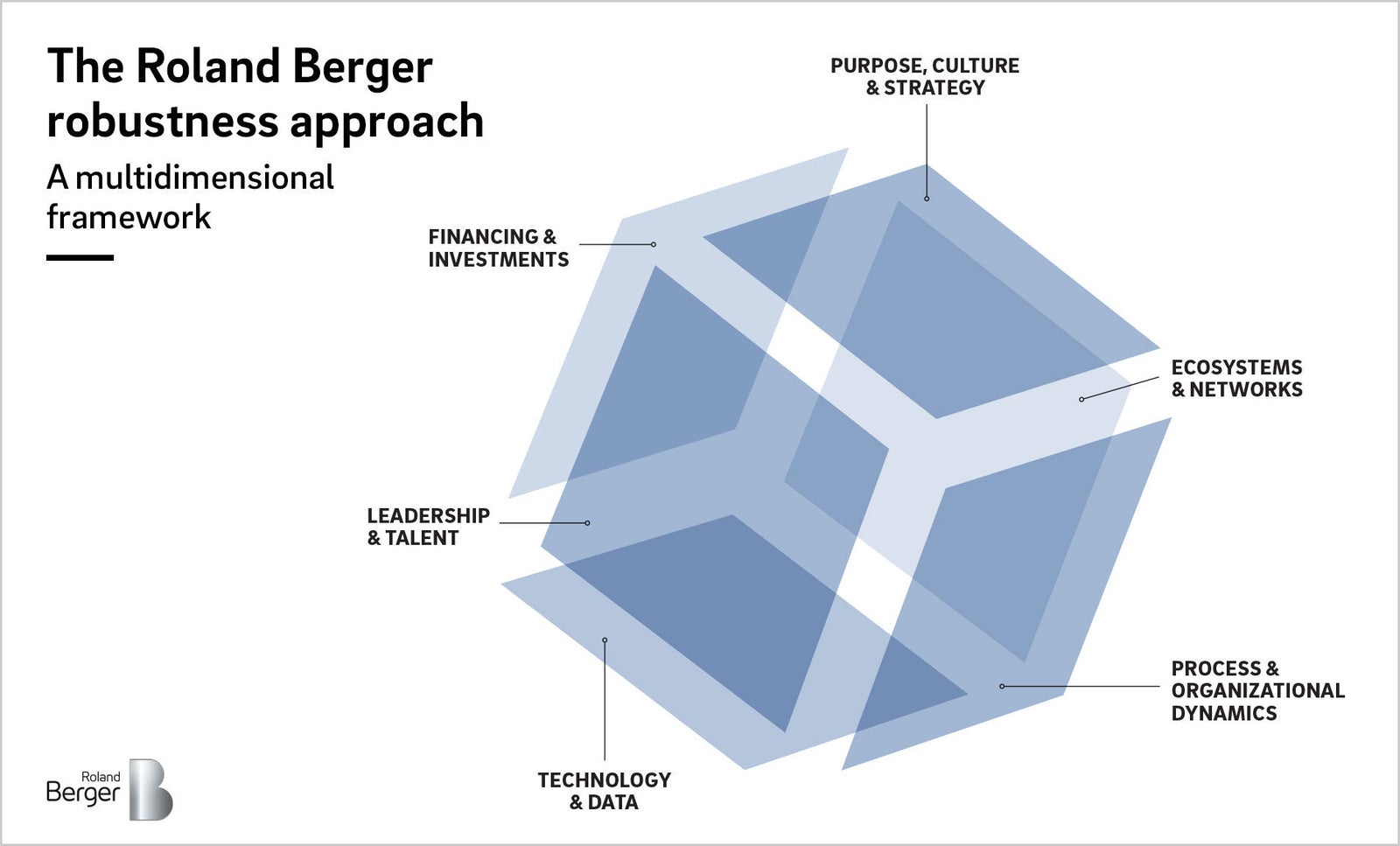
most organizational theories focus on specific ingredients of success, specific events or specific issues. Our approach is more holistic. It focuses on a special type of business resilience that we call robustness, which we identify as having six key dimensions.
The first dimension of true
business resilience – or robustness
– is purpose, culture and strategy. History shows that long-lasting organizations are driven by a shared purpose, culture and strategy: Purpose-driven brands, for example, grow much faster than others despite having to navigate times of crisis. The second dimension is leadership and talent. Inspiring leadership is essential for driving change and innovation while retaining resilience. And just as importantly, organizations with true resilience must be able to secure the talent that they require – something that is increasingly difficult in a transparent, global job market.
The third dimension of true business resilience is financing and investments, in particular having short-term liquidity, a capital buffer, a balanced long-term investment portfolio and fast allocation of financial resources. This enables organizations to act in times of growth as well as during a crisis, whether it be a financial crash or COVID-19. Fourth comes process and organizational dynamics. Rather than searching for the perfect organizational structure to ensure business resilience, companies should rely on clear rules to adapt their structural setup to the needs of the moment. Particularly important are strong support and business-platform functions that cut across different businesses.
Ecosystems and networks form the fifth dimension of business resilience. A well-established ecosystem that enables the organization to seize opportunities and leverage capabilities means that they can sense and anticipate innovation and upcoming disruption, while ecosystems, with their partnership networks and innovation hubs, make a key contribution to an organization's strategic development both in terms of its value proposition and in building its knowledge, talent and access to shared resources. Finally, in the area of technology and data, a clear digitalization strategy, modular supporting IT systems, clear business alignment and efficient data and information sharing can significantly speed up bottom-line optimization, top-line development, new operating models and products, the scaling of systems, technology-driven sensing and decision-making.