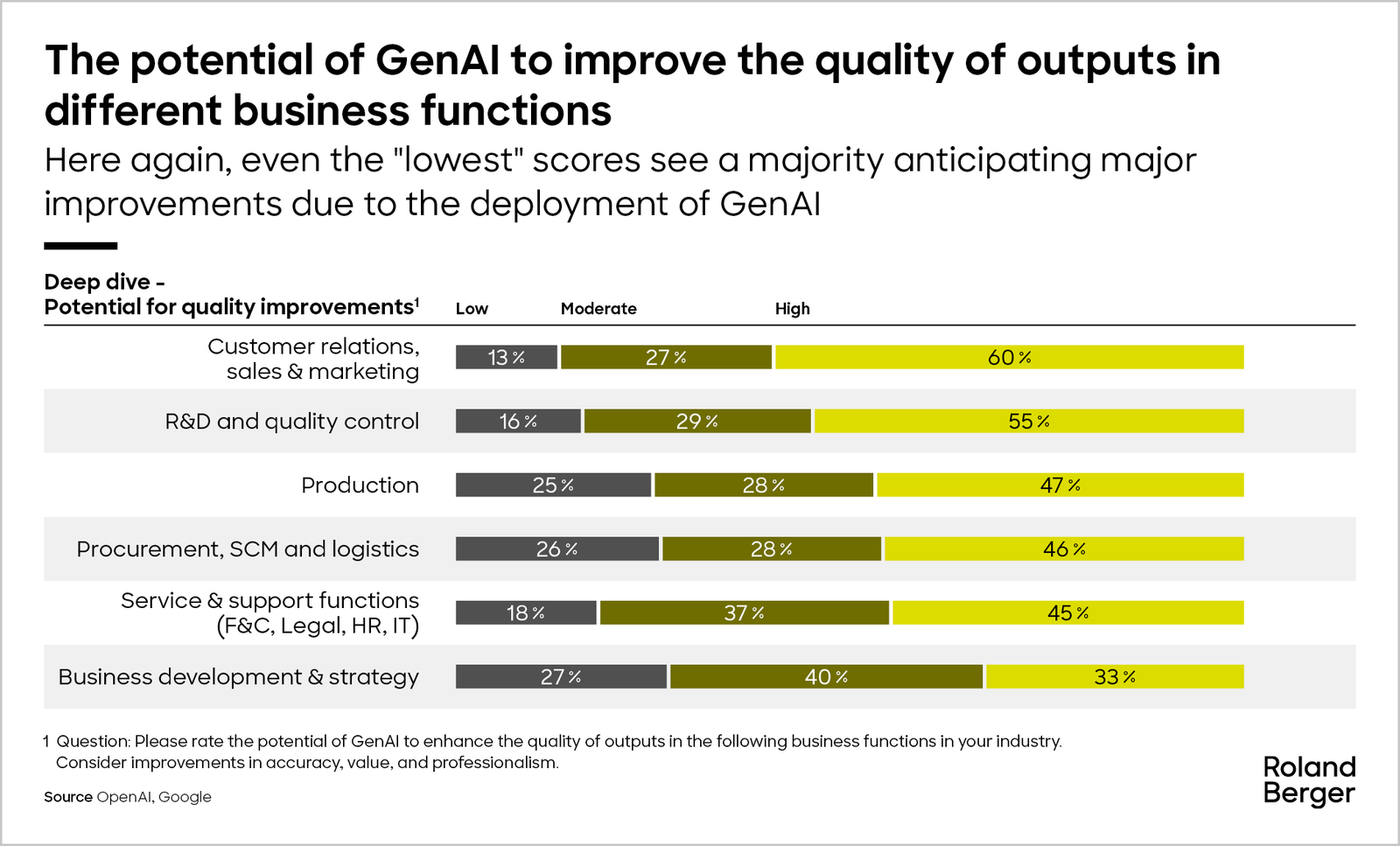
Interestingly, while the clear focus is on customer-facing business functions such as sales, service and support, Roland Berger’s interviewees still see very significant benefits even in those areas where they perceive the least potential. This finding underscores a further critical issue: the need for whole organizations to adapt and boost their (largely still lacking) AI maturity if they are to genuinely reap the handsome rewards of this technology.
Adopt and adapt!
The main focus of the study thus turns to the issue of transforming organizations and getting them “GenAI-ready”. Referencing its own still-unfinished GenAI journey, Roland Berger proposes a catalogue of practical steps derived from lessons learned. This six-point guideline includes the imperative of a clear strategy for the long term, proper governance structures, full-spectrum organizational alignment with the target operating model, and sufficient flexibility to let companies continue adapting to an unfolding story whose last chapter has not yet been written.
The matter of how to implement these proposals – how to adapt the whole organization, in other words – is then rooted in four concrete principles: acceptance of the fact that GenAI “really will get everywhere” and will affect everything in every company; the need for a central, strategic AI unit to avoid uncontrolled and wasteful proliferation; the need to empower people with the right skills; and the need to master the art of managing huge volumes of data in a changing world. Enlightening case studies add texture to the real-world outworking of these crucial principles.
No time to waste!
In closing, the study distills the essence of this profound discussion of GenAI and offers five hands-on ways for companies to start the ball rolling. Above all, one point is made loud and clear: For companies that do not want to be left behind in a race that looks set to outstrip even much of the hype of recent years, the time to act can only be now.