Building blocks and success factors in sustainable restructuring
Strategic topics are thus moving front and center in the context of restructuring. Restructuring must include a level of transformation that suitably adapts both the business model and the top line. Specifically, our transformational restructuring strategy centers around three building blocks:
First, it is as vital as ever to set about optimizing the company’s costs and balance sheet.
Second, the top line must be managed by modifying and improving the existing product portfolio as well as the quality of prices and margins. Doing this puts the company on a sound financial footing during the restructuring phase and leaves sufficient leeway to go ahead with transformation.
At the same time, the third building block involves strategically repositioning the company and pressing ahead with advancing innovation. This will, of necessity, lead to the complete or partial transformation of the business model.
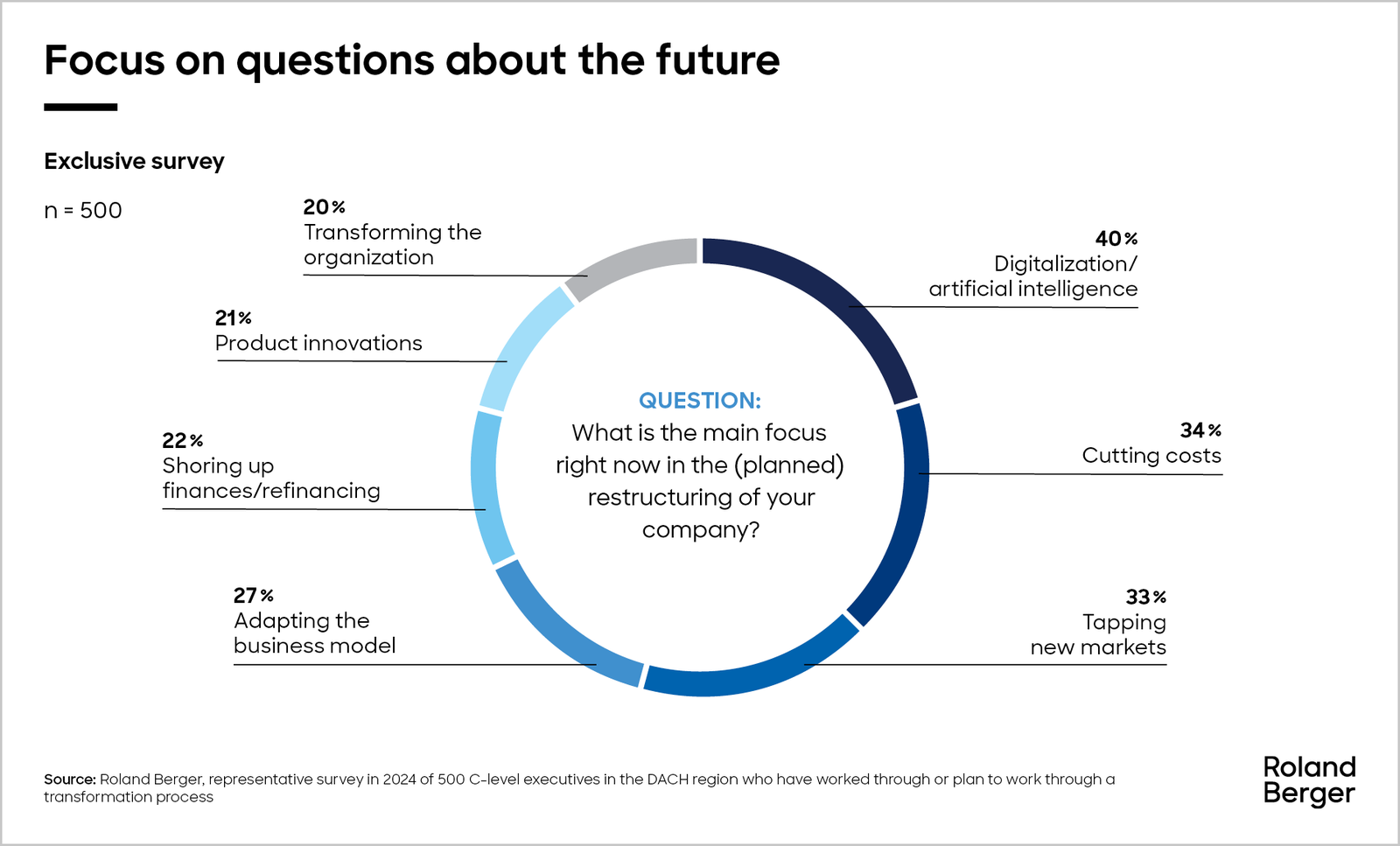
Most executives have understood the signs of the times. Asked about what key future issues are a major focus of current or planned restructuring exercises, 40% cite digitalization and artificial intelligence as their top priority. These topics are followed by conventional cost-cutting (34%), tapping new markets (33%), and adapting the business model (27%).
A word of caution is in order, though: However good the solution strategies outlined in the study may be, they will fall short of their full potential impact – or perhaps even fail entirely – if they are not properly fleshed out and anchored within the company, and if they do not have the full backing of actors and stakeholders alike. Above and beyond the traditional tools of the restructuring trade, other success factors that make a crucial difference include clearly defining the company’s strategic goals and formulating a target scenario for the whole organization. Getting staff to buy into the project is another important element of the transformation and restructuring process, as they are the central drivers and multipliers of change in practice.
Lastly, successful implementation hinges on having managers who can make decisions and get things done. These are the people who give external and internal stakeholders the sense of stability they need while change is in progress. Their resolute leadership keeps customers from jumping ship and keeps the company on a clear course. That is why
managers with experience and the right strategic skills
are essential to the turnaround process. They must also possess the determination, adaptability, and communication skills that are needed to navigate the organization through uncertain times.