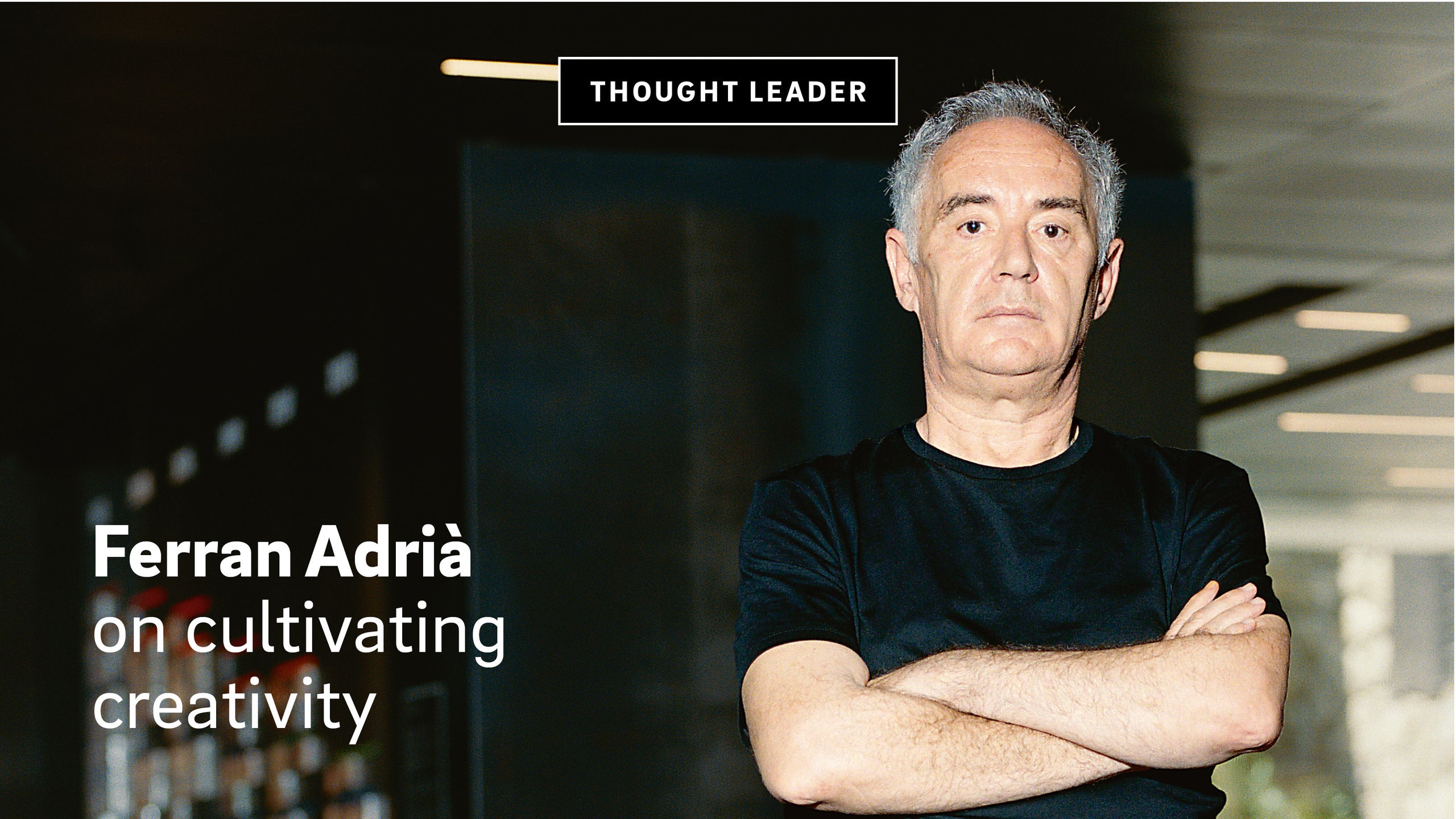
The reference to Picasso isn't random. Adrià was frequently compared to the artist because his work was so groundbreaking – and perhaps more than any other chef in history he had considered the question of whether food could also be an art form. In 2007, in fact, he was invited to the renowned documenta contemporary art fair as guest artist. Convinced that his authentic work could only be experienced in his restaurant, his contribution had him flying two of documenta's visitors to El Bulli for dinner each night.
That notion taps into his essential belief that creativity is something that can be learned. "It's true that creative talent matters, especially if you're working at the maximum level, where you're trying to change paradigms," he says. "But you can also train it, you can improve it," he says. It's exactly what Malcolm Gladwell said about the 10,000 hours – you train it by doing."
These are the kinds of questions that Adrià and his team have been exploring since closing El Bulli as a restaurant and transforming it into something that, in its own way, is just as unprecedented. They've spent the last decade developing a methodology, called Sapiens, for thinking comprehensively about cuisine, and then using it to compile an encyclopedia – the Bullipedia – of gastronomic knowledge. "In a certain way, we did it to explain ourselves to ourselves," Adrià says. "We had to create a method of understanding what we did."
When the El Bulli museum opens in 2023, complete with a high-tech visual history of the restaurant's dishes, a spectacular conference room that looks like it was transported from Tolkien's Middle Earth and those weird and wonderful sculptures overlooking the bay, it will make concrete the otherwise ephemeral legacy of El Bulli and the man, now 60, who made it the most innovative restaurant of all time. When he looks back on what allowed him to achieve what he did and maintain that incessant creative energy across decades, he comes up with a three-part formula: respect and admiration for the team that helped him realize the vision, serious effort as manifest in all those hours of work testing and retesting and, then, that ineffable sprinkling of talent.
But asked how others in different fields might also remain open to constant change, he remembers a fourth pillar. "You have to be brave. Ninety-nine percent of the businesses out there don't innovate; they just adapt models that are already successful. If you want to truly innovate, being brave is the most important thing."