Reasons for poor performance
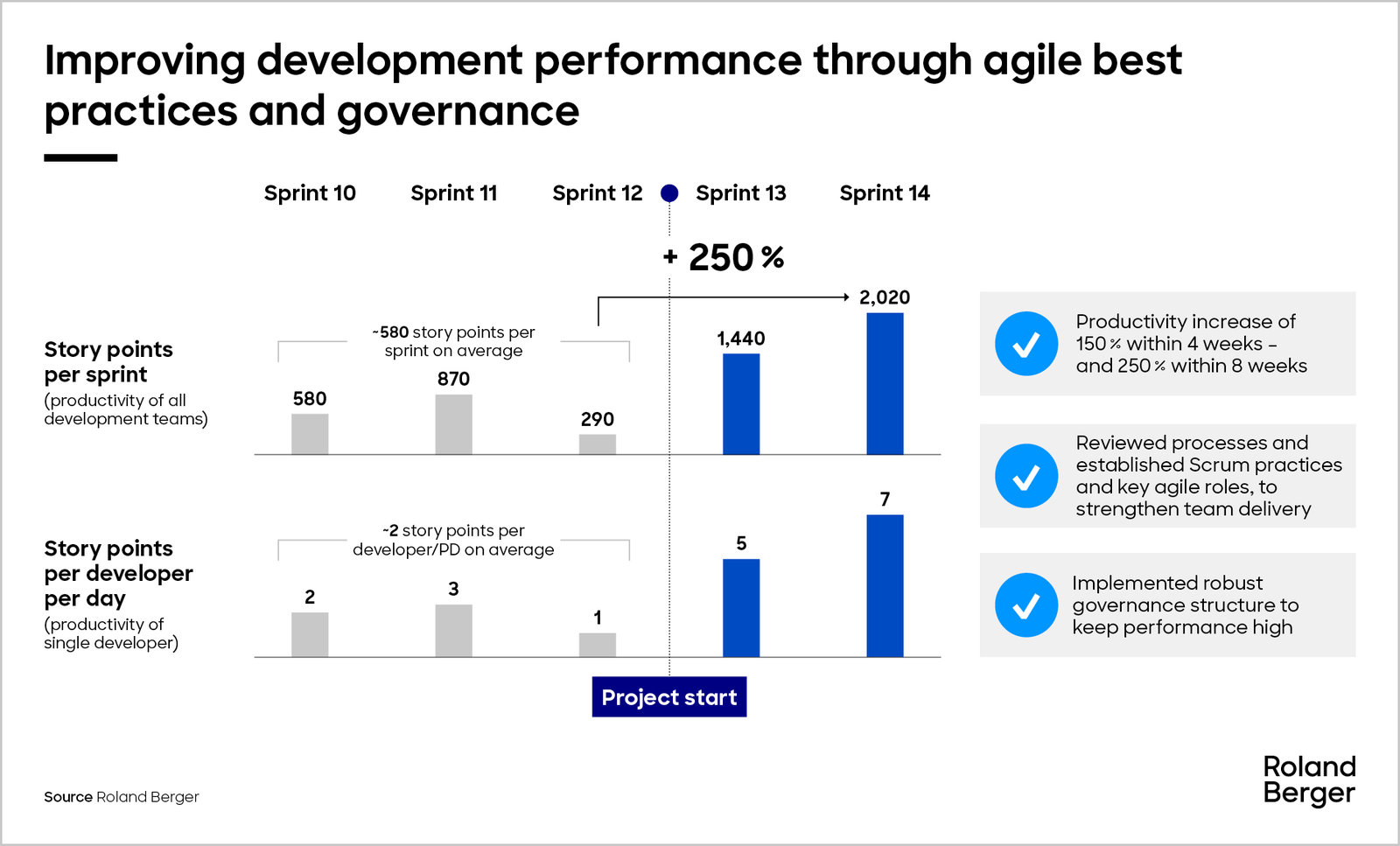
Output was measured in story points, with one story point representing one developer hour. Over the past three sprints, the team delivered an average of approximately 580 story points with 18 full-time employees. This equated to roughly two story points per developer per day – well below expectations. As a reference, a high-performing team would typically deliver more than 1,000 story points, or at least four story points per developer per day.
There were numerous reasons for this low performance:
Inefficient team setup: The development team consisted of 18 members but was organized as a single Scrum team. Scrum best practices recommend 5-9 members per team as larger teams make management inefficient and difficult to handle.
Lack of team orchestration: A critical role was missing – the Scrum Master, who is responsible for removing impediments, ensuring the team has the necessary inputs such as test data, and maintaining an organized backlog. Without this role, the team was essentially unmanaged, lacked support when needed, and worked with an unprioritized and poorly maintained backlog.
Code-review bottlenecks: Only one person, not allocated to the project full-time, was responsible for reviewing code quality. This created a significant bottleneck, as many completed user stories and features couldn’t be finalized due to delays in the review process.
Low maturity of agile processes: Scrum ceremonies and practices were applied inconsistently. User story refinements, for instance, were not institutionalized. Refinement is essential to ensure features are well understood and properly defined so developers fully understand what needs to be done. Skipping this step often results in poor-quality outcomes and dissatisfied stakeholders.
While reviews were held, they were used as status updates instead of demonstrating the product increment to stakeholders for feedback and acceptance.
Meanwhile, because the backlog was not properly prioritized or refined, client teams lacked clarity on when specific user stories and features would be implemented.
And instead of the Daily Scrum (a 15-minute check-in of the development team) to track progress and removing impediments, the developer team held just two meetings per week, with inconsistent attendance from developers. This led to weak accountability and poor transparency.