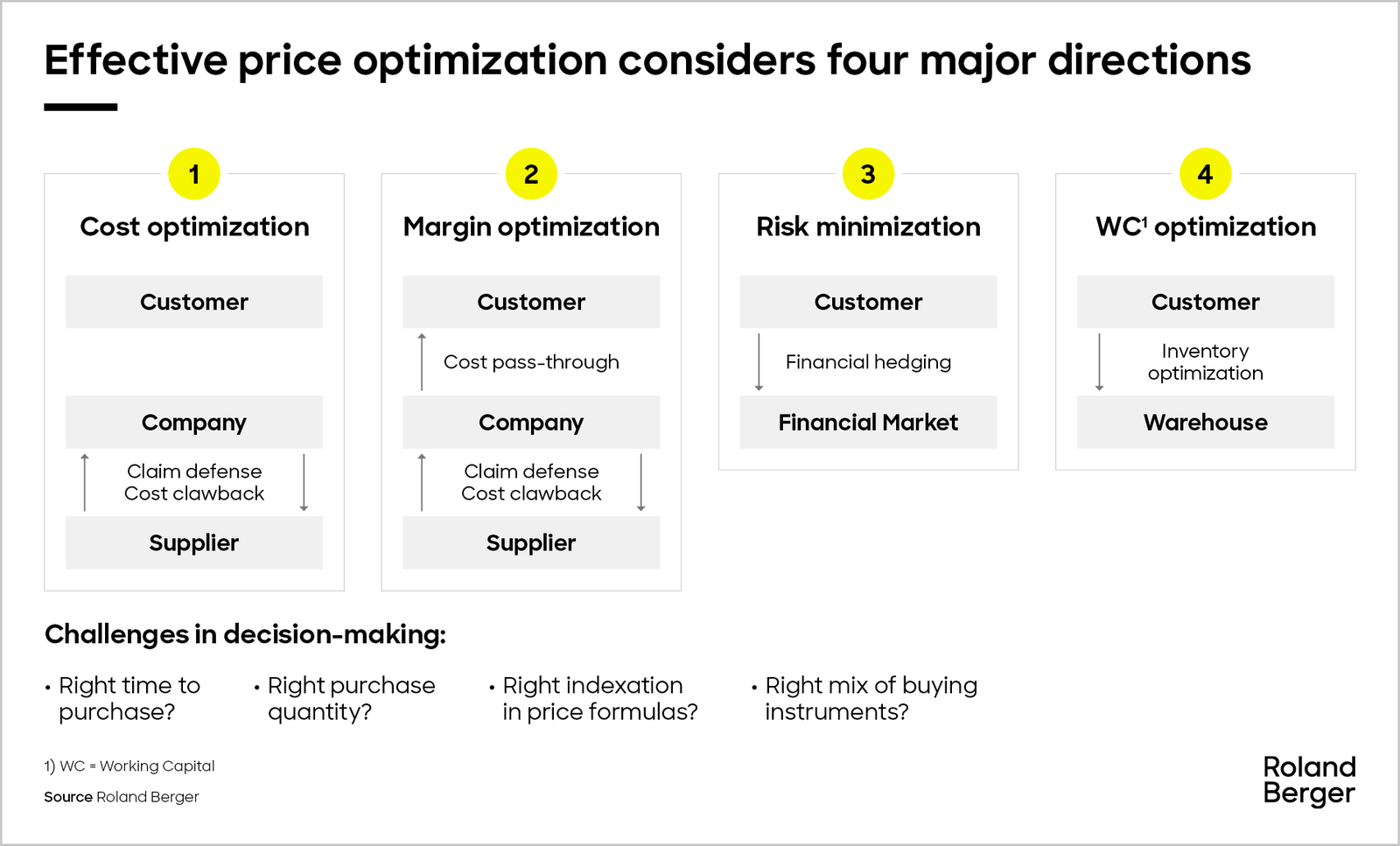
Cost optimization focuses on optimizing price agreements with raw material suppliers via fixed-price contracts for a specific period, index-based price formulas or effective price renegotiations. This also includes claim defense and cost clawbacks if suppliers raise their prices disproportionately to rising raw material and energy costs or fail to pass on falling market prices.
Margin optimization aims at passing on rising purchase prices to the customer. This requires appropriately designed price adjustment clauses in contractual agreements with the customer. The approach can be particularly effective if your own market power is high and/or the market power of the customer is low.
Risk minimization looks to externalize risk towards the financial market. This can be done by optimizing forward contracting at exchanges like the LME for industrial metals, the Baltic Exchange for freight, the European Energy Exchange (EEX) for energy or the Chicago Board of Trade (CBOT) for agricultural products, where monthly or quarterly contracts are traded for future delivery at a known price. This reduces price risk compared to the spot market, where price movements are very hard to predict. Futures prices can also indicate expected market movements.
Working capital optimization aims at optimizing inventory levels while considering price fluctuations. This may involve buying in advance whenever there is an attractive price opportunity, for instance, or consuming directly from storage when prices are rising. The benefit of forward buying must also be weighed up with inventory holding cost and the cost of capital, which have become increasingly relevant since 2022.
Each of these four elements comes with specific challenges for procurement managers: When is the right time to buy? What is the right quantity to buy in advance and store? What is the correct mix of instruments considering spot and forward or futures markets? Or what is the right index formula for a price adjustment clause in a contract with suppliers or customers?
To enable optimized procurement decisions for each aspect, it is beneficial to use machine learning to create an algorithm-based approach. This enables organizations to implement dynamic procurement strategies that fully consider market movements. Ultimately, digital tools can boost transparency and provide optimal support for decision making in all four aspects of our approach.