Engineering service provider (ESP)
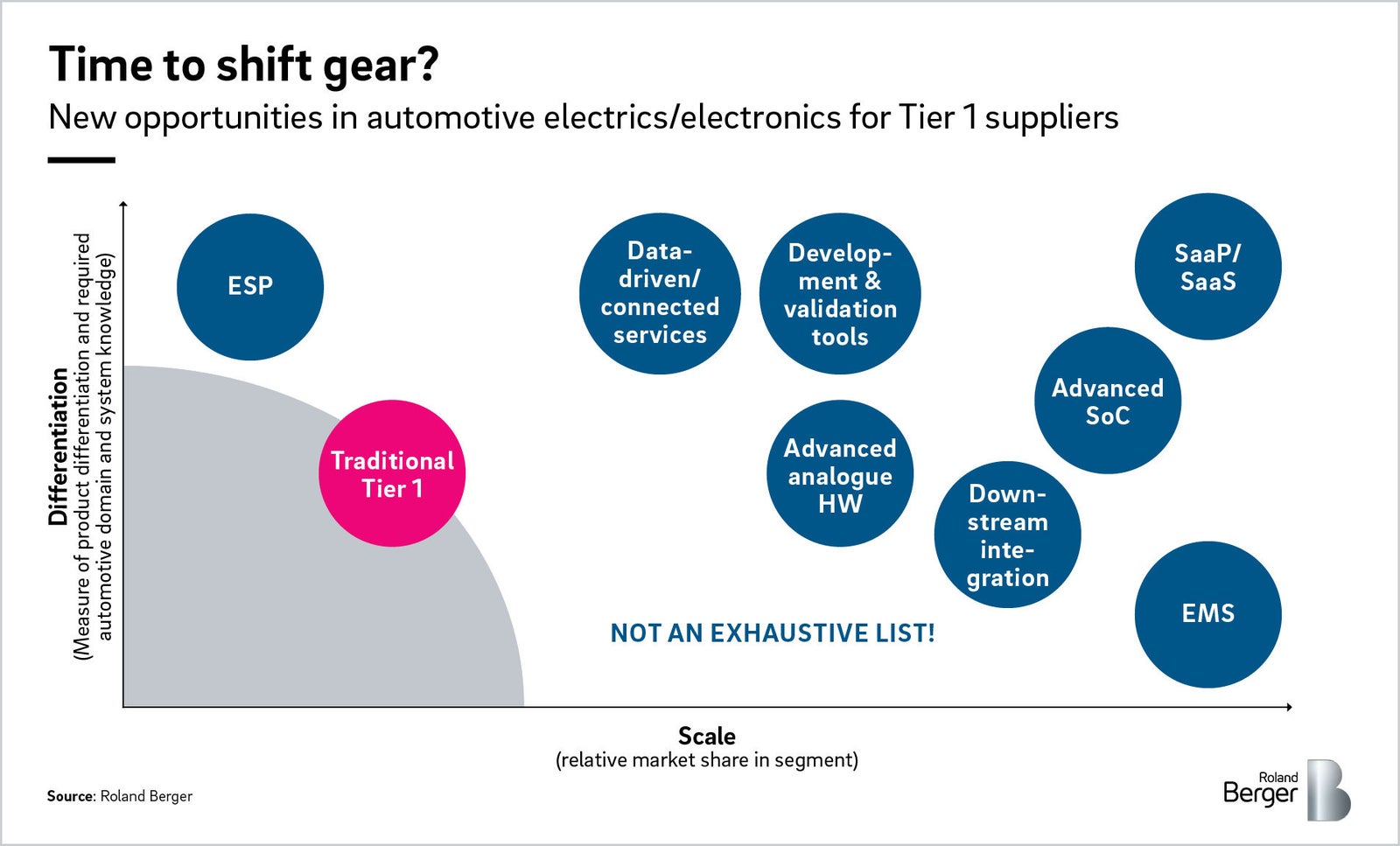
Offering development services for hardware and software in a pure service model is a perfect fit with existing Tier 1 suppliers' competencies. It offers potentially higher margins even than those they enjoyed in the past if properly set up as a professional services business. However, the field is small and highly competitive, and suppliers will need to achieve meaningful size for shareholders in order to secure success. The size of this opportunity is comparable to the EDD (engineering design & development) fee charged by Tier 1 suppliers as a share of the overall lifetime value of the entire program.
Data-driven/connected services
Providing data and connectivity-enabled services directly to consumers, OEMs and other players has enormous potential as an option for Tier 1 suppliers – and indeed the entire ecosystem of players. However, solving the adoption challenge will be critical to success. This topic has been on industry's radar for at least 15 years, with very limited adoption so far. Challenges include hesitance and lack of understanding on the part of consumers, the cost of data transmission, archaic software architectures, and difficulties dealing with complex OEM organizations. Tier 1 players would also need to ensure that they have the "right to play", including access to data.
Development and validation tools
Designing tools and tool chains for the entire development and continuous deployment process – "shovels and pickaxes" for the industry – is an area of growing relevance and could be an option for some Tier 1 players. The market is small, however, and can only take a few players. As almost no Tier 1 suppliers currently have the necessary competencies, going down this avenue will generally involve acquiring an existing player in this field.
Software as a product/service (SaaP/SaaS)
Providing software as a product or software as a service – that is, selling the platform or the functional (application) software – has strong growth potential as an option for Tier 1 suppliers. It is also a good fit with some of their existing competencies. On the negative side, the content per vehicle (CPV) is lower than in some other areas, while the supplier would potentially assume a greater volume risk. Achieving scale and dominance with differentiating features in specific segments will therefore be critical for success.
Advanced systems on chips (SoCs)
Developing high-value SoCs with a high degree of functional software stack integration is attractive for Tier 1 suppliers looking for a new role, particularly as it offers a dominant share of the component value. However, Tier 1 suppliers currently lack competencies in this area and will need confidence to step into the chip-making world. This option is likely accessible only to a very narrow list of current electronics Tier 1s.
Advanced analogue hardware
Designing high-value electronic and mechatronic components such as LIDARs – light detecting and ranging technology that uses lasers to measure distances – represents a good fit with existing Tier 1 suppliers' competencies. However, the current market is still of limited size and the technology is subject to commoditization. Continuous product innovation and active portfolio management are key for players entering this field.
Downstream integration
Entering the world of full systems, potentially all the way to producing complete vehicles, is another option for Tier 1 suppliers. This tactic offers high CPV but at the same time requires new players to develop major new competencies, step up in the value chain and potentially engage in supply and partner relationships with current competitors. As yet, market demand is uncertain and will need to be validated. Entering into competition with your current customers also harbors a certain amount of risk.
Electronics manufacturing services (EMS)
Large-scale, built-to-print electronics manufacturing is an area of strong growth in a large market. Competition is also strong, however, and players will need to keep costs low by achieving scale – potentially outside the automotive world – in order to achieve success.
Which of the options above are the most promising for individual Tier 1 suppliers is far from obvious. Suppliers will need to evaluate their specific situation, the domain they operate in, their scale, resources and their current competencies. On this basis they should then develop a clear portfolio strategy, define an appropriate operating model (potentially including partnerships) and draw up a roadmap for transforming their traditional business model into one that will stand up to the coming disruption. In some cases, they will likely have to operate several different business models in parallel. The need for Tier 1 automotive suppliers to shift gear is clear. But which direction – or directions – they should head in must be determined on a case-by-case basis.