Four phenomena of note
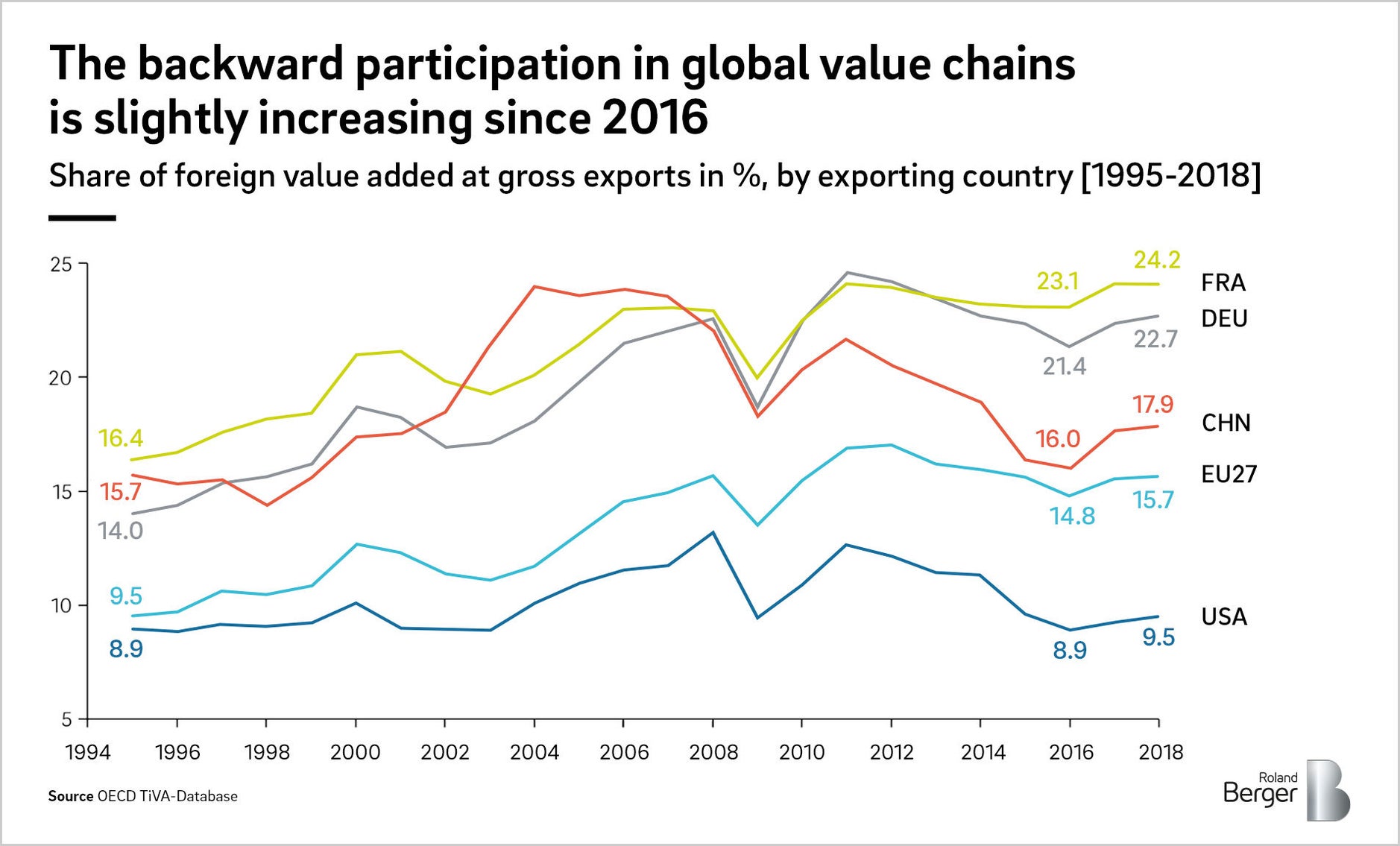
First, there is a striking variation in the degree to which the different economic zones are integrated in global value chains. This indicates that global value chains are not something that characterizes and affects all developed economies in exactly the same way in the era of globalization. The German and French economies, for example, are very strongly integrated in global value chains. If we take into account not only the intensive backward participation but also the high export ratio (ratio of exports to GDP) of the German economy, it is clear that the vulnerability and resilience of supply chains are particularly pressing issues for the German economy.
The USA, on the other hand, which has a much lower export ratio than Germany or France and whose imports go largely into domestic consumption, exhibits a much lower level of integration in global value chains than Germany or France.
Second, if we look at China, the USA and Germany alone, we can see that the respective highs and lows of their integration in global economic chains in the period 1995 to 2018 fall at different points in time. The highest level of backward participation was reached in China in 2004, in the USA in 2008 and in Germany in 2011 – confirming that globalization is a diverse and changeable phenomenon that does not automatically follow the same pattern for all economic zones.
The fact that integration in global value chains has tracked differently in the three economic zones over the last three decades is due to the respective states of these economies at the start of the period. The figures for China, for example, reflect the structural change the Chinese economy has gone through since the 1990s: China's economic boom began with the Chinese economy specializing in assembling imported intermediates into final products and exporting these out into the world market. Over the years, however, the intermediate inputs that China used to import were increasingly replaced by in-country production and thus the share of foreign value added in the country's exports fell.
A third point worth noting is that the backward participation of the Chinese economy in 2016 was only slightly higher than it was in 1995 (16.0% vs. 15.7%). For the USA, backward participation actually remained constant over the same period (8.9%). A different trend can be seen in Germany, where the figure for 2018 is now much higher as it was in 1995 (22.7% vs. 14%). The German economy, with its strong export orientation in sectors such as automotive and engineering, has become increasingly integrated into global value chains over the past three decades. This naturally opens up many opportunities to German companies, but it also makes them extremely vulnerable to a supply crunch in the event of a crisis.
A fourth observation is that since 2016, integration in global value chains has been increasing only slightly but is on a definite upward trend in all of the economic zones in the chart. What this makes clear is that all this talk of the end of globalization does not correspond to the economic facts. Indeed, to summarize all four observations, it is evident that globalization is constantly changing and that the globalization trend varies between economic zones.