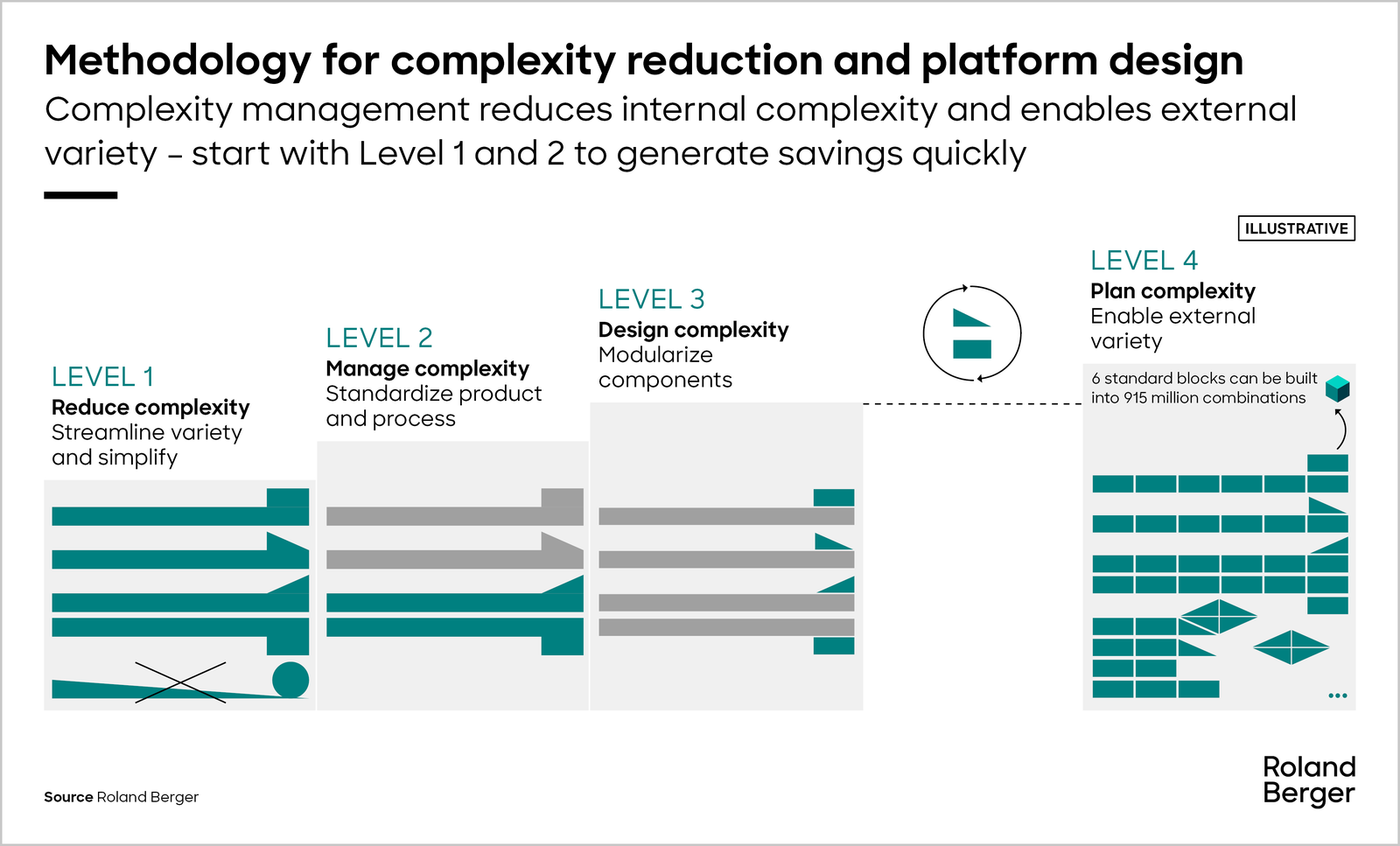
Level 1 – Reduce complexity: Streamline variety & simplify
The first step is to create transparency and clean up the portfolio:
- Cluster products into manageable groups
- Categorize variants based on features, performance, sales volume, and contribution margin
- Identify “long‑tail” products that add minimal value but high cost
- Eliminate legacy products and redundant variants
Case studies show immediate EBITDA improvement by phasing out loss‑making products and rationalizing options.
Level 2 – Manage complexity: Standardize products & processes
Once reduced, complexity must remain controlled:
- Re‑use common parts across products
- Introduce carry‑over components across generations
- Limit “allowed” variant choices to prevent new proliferation
- Rationalize part numbers and consolidate suppliers
- Enable economies of scale with higher purchasing volumes
In one client example, Roland Berger helped reduce unique product count by 45% and cut the number of module variants across major components without reducing revenue.
Level 3 – Design complexity: Modularize for flexibility
Modular product architecture unlocks long‑term efficiency:
- Define building blocks based on functional clusters
- Standardize interfaces
- Apply module drivers (variance, production, quality, after sales, technology evolution)
- Enable independent testing and lifecycle management of modules
- Integrate software‑defined variety
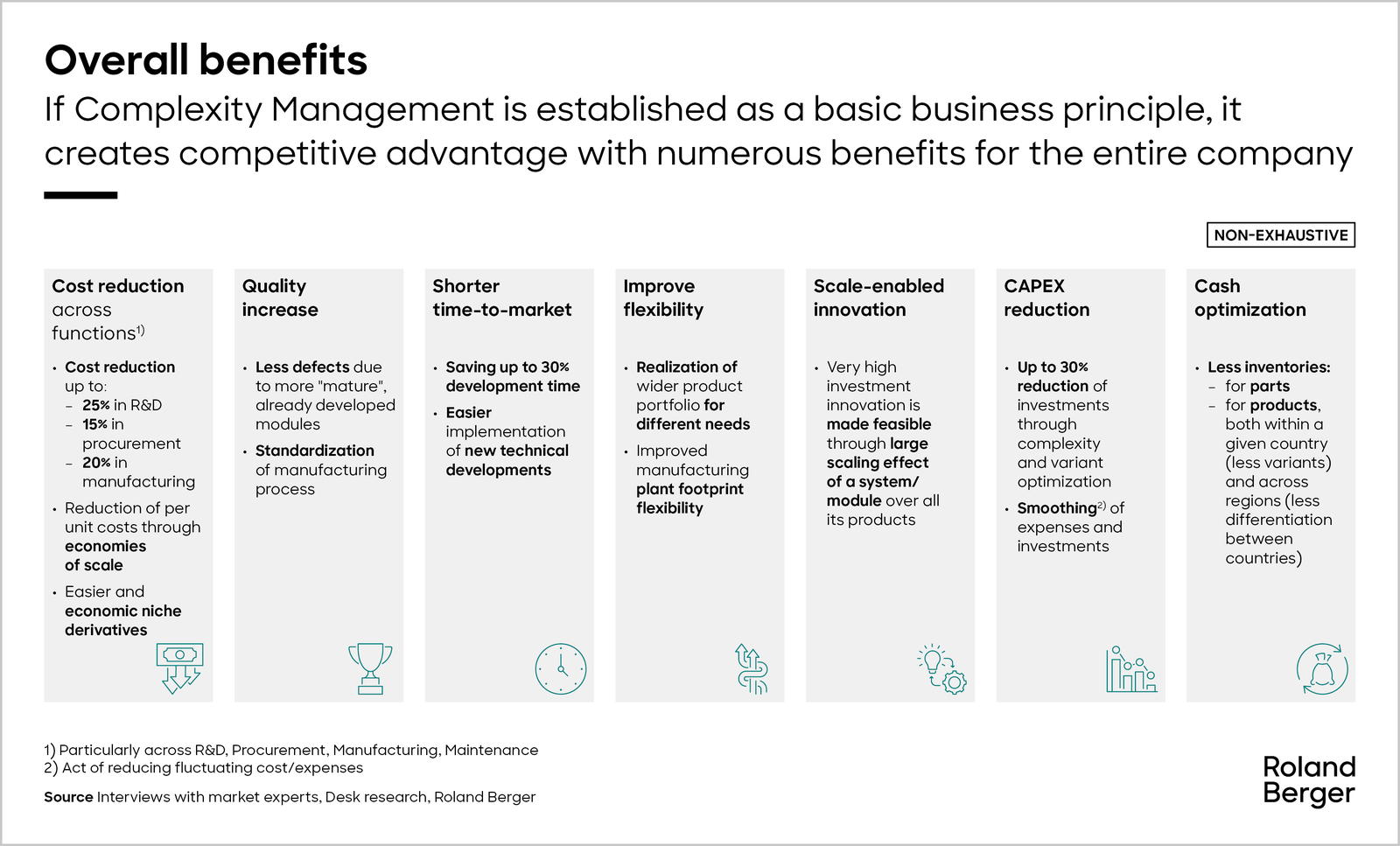
Modularization increases re‑use and allows companies to separate technology roadmaps, accelerating innovation and time-to-market while reducing cost.
Level 4 – Plan complexity: Enable external variety
Once modular systems exist, companies can expand external differentiation without adding internal complexity:
- Variation through configuration, not new unique products
- Late‑stage customization (e.g., regional options, add‑ons)
- Clear segmentation and catalog-based options
- Kitting for market‑specific needs
- Re‑using global modules for New Product Development
This approach helps companies serve diverse markets efficiently while maintaining a lean internal structure.
Governance that sustains results
Operating models must evolve alongside the product architecture. We typically recommend two pivotal roles:
1. Module owners manage a module’s lifecycle, technology roadmap, interfaces, and supplier strategy, ensuring carry‑over and reuse across business units.
2. System owners integrate modules into coherent systems, maintain system roadmaps, and translate system requirements into module requirements.
Clear governance, e.g. by a central Module Management Group responsible for the Module Master Lists, prevents “variant creep”, aligns investments with strategic platforms, and keeps accountability transparent across engineering, procurement, manufacturing, and service.