Reflection on indirect spend performance
When addressing indirect spend, it can be beneficial for executive stakeholders to start by gaining perspective and clarity on their businesses' performance in this area through benchmarking. Benchmarks, whether they concern the proportion of indirect spend, category shares, or actual rates obtained, are crucial for identifying areas for improvement. However, executives must appreciate the subtleties of benchmarking in their specific business and industry context. Critical considerations include:
- Accounting practices: In the manufacturing sector, logistics costs are often categorized as direct material costs, whereas for utility companies, utility expenses—typically a significant category—are not deemed indirect.
- Business nature: Benchmarking at the segment level should reflect industry-specific characteristics. Consumer-facing industries generally allocate more to marketing, whereas manufacturing sectors have substantial MRO expenditures.
- Comparative needs: For rate comparisons, an apples-to-apples approach is crucial. For example, logistics rates in the chemical or F&B sectors differ due to specialized transportation needs, while MRO spending in the energy sector often pertains to disaster recovery and tends to be sourced ad hoc at higher rates.
- Hidden costs: Identical products or services may incur different rates due to vendor incentive programs, including complimentary services like repairs or shipping, or rebates. A thorough contract review is often necessary to discern these distinctions.
While recognizing the nuances in benchmarking is vital, it is important not to use "company-specific circumstances" as a blanket justification for underperformance. Although a perfect comparison is never possible, the challenges associated with indirect spend are frequently common across many companies. A benchmarking exercise remains a fundamental step to identify issues, and it is the scientific curiosity and rigor in analyzing the results that distinguish top-performing procurement organizations from others.
Engage with experts
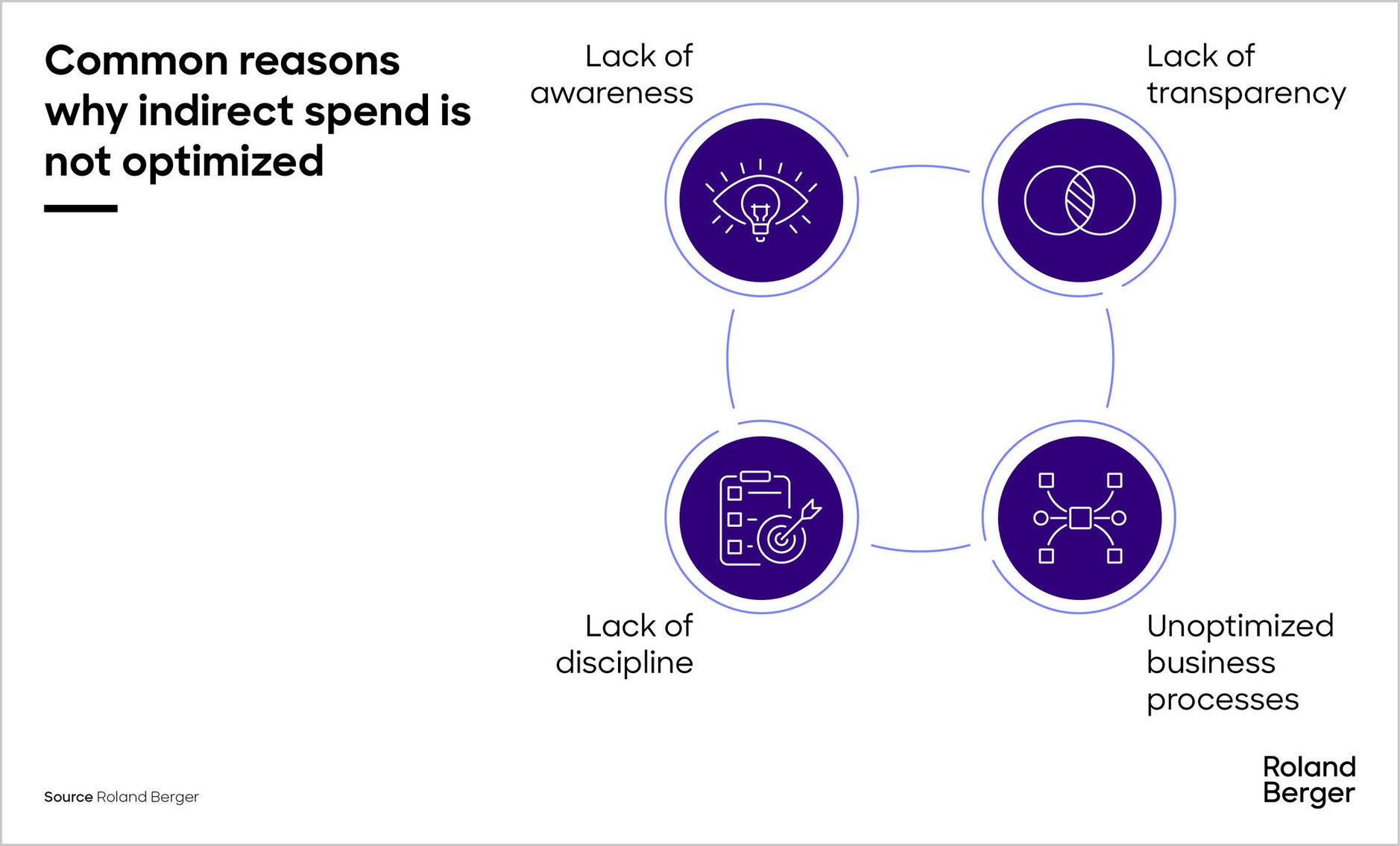
Beyond benchmarking, the complexity of addressing indirect spend can also raise a series of imperative questions: Do I, or my direct reports, have clear visibility into the company’s indirect spend? Are advanced spend management tools and data readily accessible to us? Is this the right time for a systematic initiative for optimizing indirect spend? How effectively are our procurement and cost control policies enforced?
As companies seek to navigate these complex challenges, partnering with seasoned experts can provide the necessary insights and outside impetus to challenge the status quo and fundamentally optimize indirect spend base. At Roland Berger, we specialize in helping organizations achieve a streamlined, cost-effective approach to indirect spend management. For a deeper dive into how we can assist your company in transforming your cost structures for greater efficiency and competitiveness, please reach out to our experts.