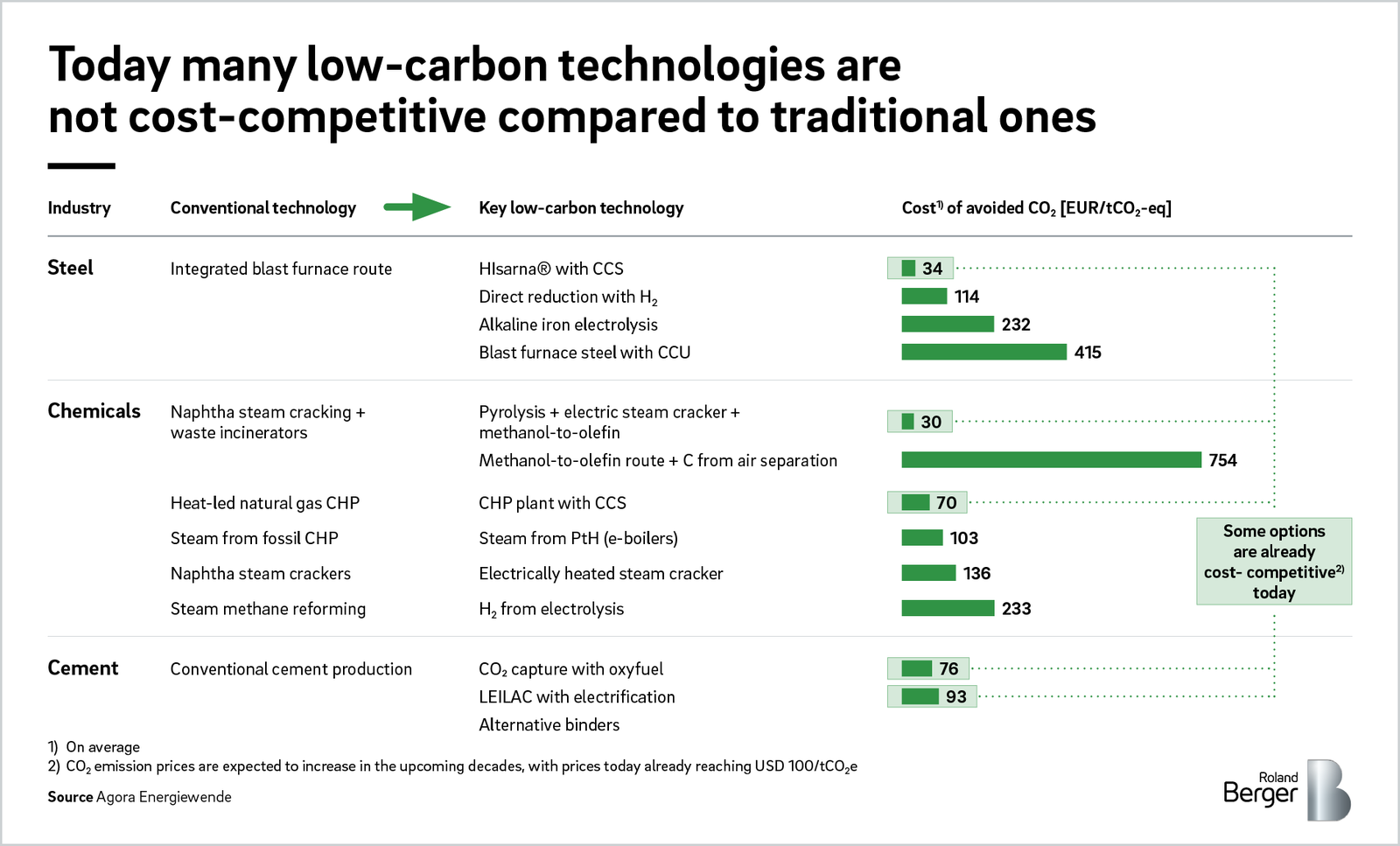
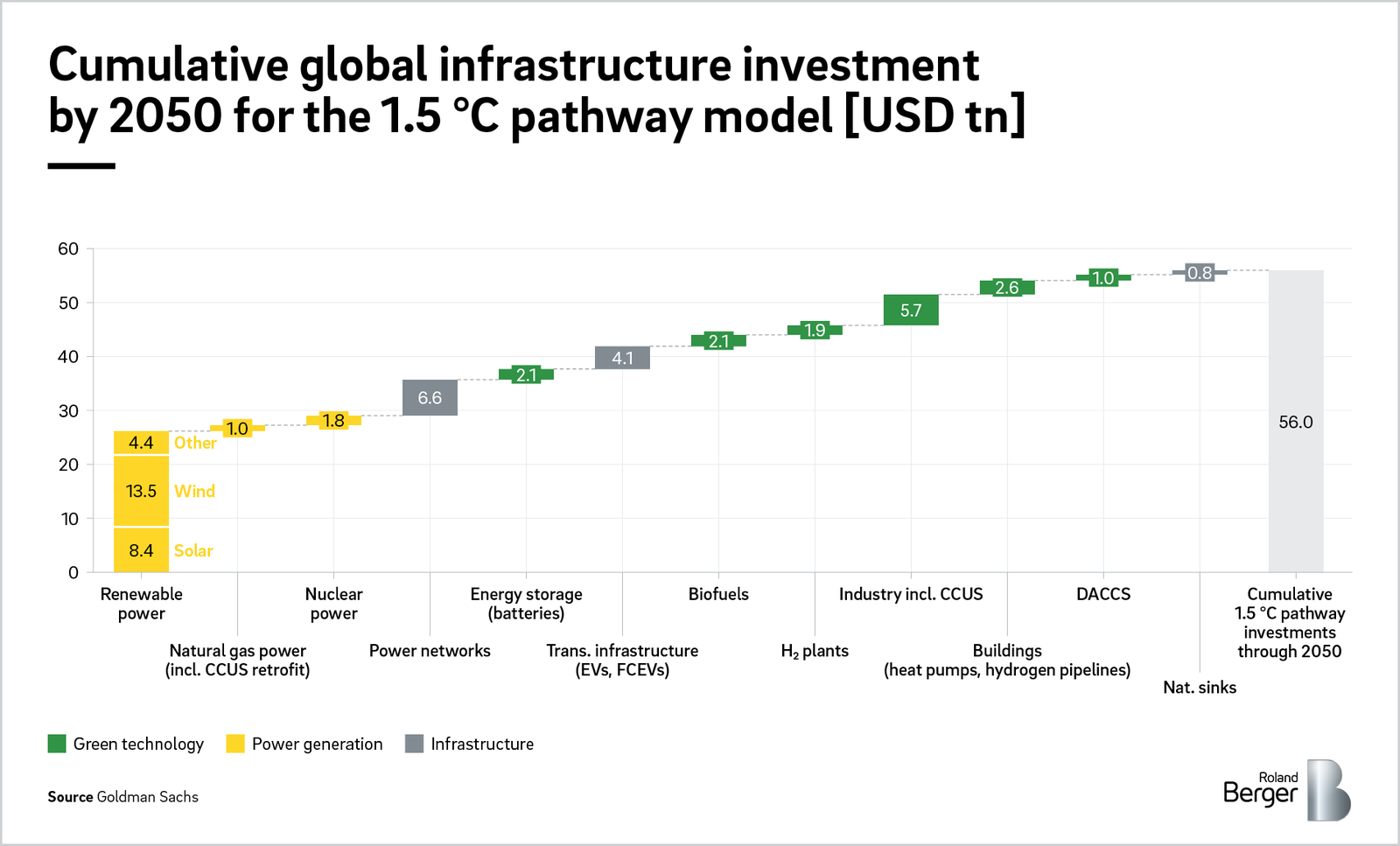
De-risking facilitates the timely adoption of early-stage technologies that require huge investment to achieve a significant emissions reduction impact
Given the financial support that is needed, companies need to find creative ways to mitigate the risk levels for such investments. Corporations can act before costs come down. The de-risking approach is designed to break this cycle by supporting private investments with contributions from the public sector until high-impact technologies and investment cases become bankable. De-risking requires the exploration and identification of support mechanisms from various sources, including subsidies, guaranteed purchases and investment alliances. Ultimately, combinations of these mechanisms can then be custom-tailored to deliver solutions for each project, subject to due consideration for specific technologies, regions, business cases and risks.
Building coalitions to find investments and jointly implement decarbonization technologies is a success factor in the de-risking process as it allows the participants to benefit from synergies and tackle challenges in a coordinated way. In 2021, COP26 in Glasgow was the scene of ancillary agreements and coalition-building efforts to foster decarbonization across all industries and regions. For example, the International Aviation Climate Ambition Coalition, an alliance of 23 governments, promotes the development and deployment of sustainable aviation fuels to limit emissions and thereby reach the 1.5 ºC target. Combining resources from various countries and companies in this way brings investment and expertise together from different sources, which inherently diversifies the risks associated with scaling production of sustainable aviation fuels. Another example is project financing, an alternative to corporate financing that enables ventures to be spun off as special purpose vehicle, thereby limiting the risk to the parent company. Project financing can rely on funding from the private or public sectors or a combination of both. Normally, most risks associated with the venture are transferred within the shareholder group to minimize the likelihood that risks will materialize and ensure that the venture is financially attractive to lenders. These cases are examples of how cooperation can help de-risk the leading-edge technologies needed to contain climate change. At this year’s
COP27,
new coalitions and topics are expected to be driven forward. Given the need to foster decarbonization and adopt new green technologies, companies should act quickly, for example by monitoring which alliances and subsidies are emerging, and by engaging with them when introducing new technologies. Find out more about how your company can de-risk technologies and help limit global warming in our recent paper “
Accelerating decarbonization
” and on our
product website.