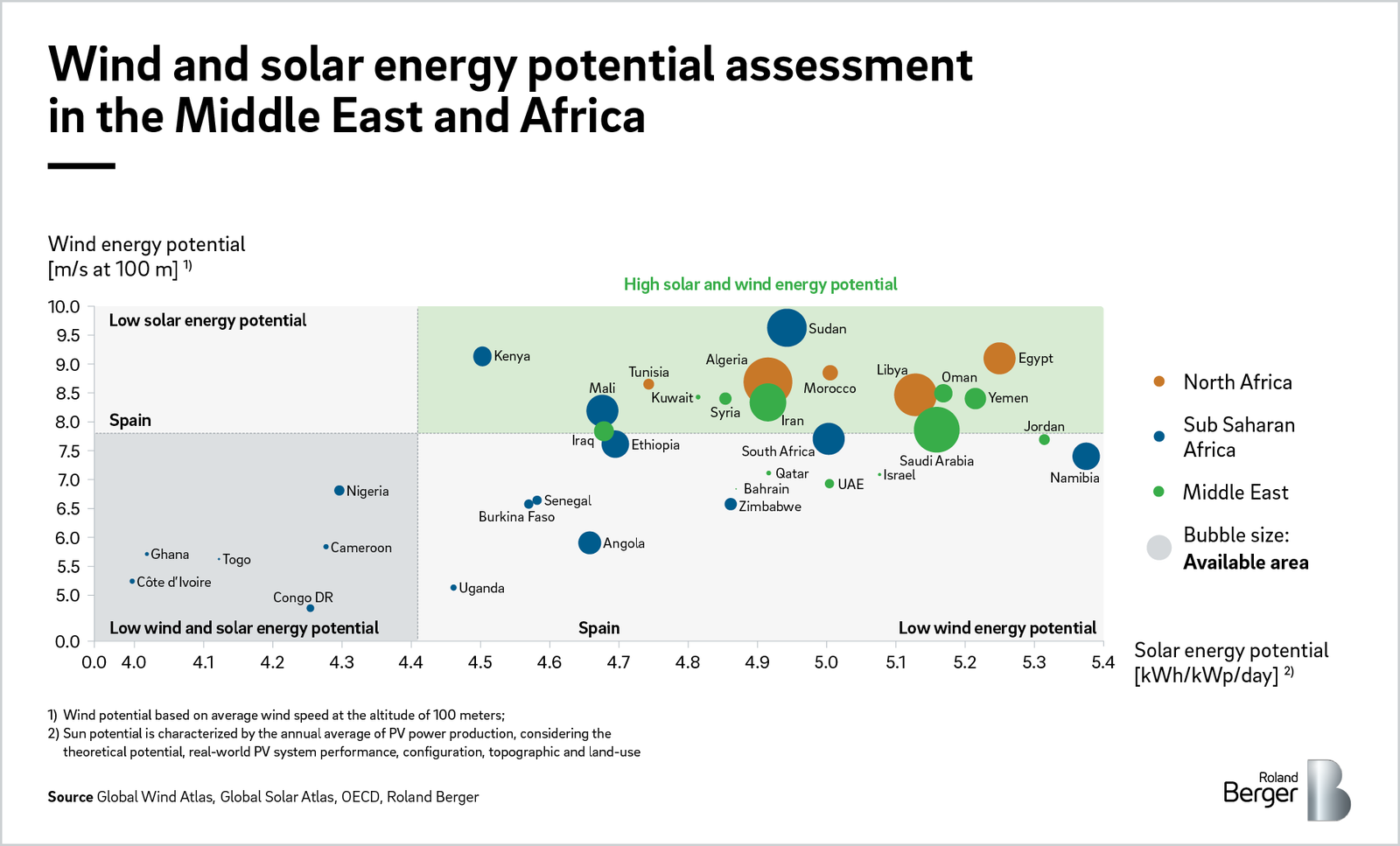
In many regions – especially remote regions where RE capacity is highest – the existing grid infrastructure is inadequate. Additionally, political uncertainty, a lack of governmental commitment to RE projects, and slow land acquisition and permit processes often hamper the expansion of RE. Also, in some countries subsidies for oil and gas consumption create additional constraints. Lastly, large RE projects require a vast amount of financial resources.
There has been some recent progress in this context, however, with Namibia announcing an estimated USD 9.4 billion green hydrogen project which includes large solar and wind power investments and is scheduled to go into production in 2026. Similarly, USD 8.5 billion was promised at COP26 to support South Africa’s low-emission development path. Kenya, Morocco and various countries in the Middle East are likewise putting forward plans to ramp up renewable energy production, partly to produce green hydrogen. In the Kingdom of Saudi Arabia, the Saudi Power Procurement Company recently announced five new renewable electricity projects with a total capacity of 3.3 GW. In line with Saudi plans for a net zero economy by 2050, the government has announced its intent to invest USD 100 billion in RE projects.
Though the challenges in Europe are different, large-scale access to RE remains problematic here too. Renewable energy’s share of the overall energy mix remains at about 20%, causing fierce competition to secure access to RE. To make matters worse, cumbersome approval procedures, long project cycles, limited grid infrastructure, and a steady decline in the availability of prime sites for investment projects further hinder the expansion of RE in Europe. Just recently, 1,320 megawatts of onshore wind were put out to tender in Germany. However, a total of only 87 projects with 772 megawatts were submitted. Although all of these can now be realized, they only account for just under 60 percent of the volume put out to tender, underlining that high raw material prices, long project cycles and approval processes hinder wind energy expansion in particular. Unsurprisingly, in a letter to Commission President Ursula von der Leyen the WindEurope CEO and the CEOs of five large European wind turbine manufacturers outline that, although that expansion of wind energy in Europe is high, lengthy permitting processes limit the demand for wind turbines resulting in strong price competition and factory closures.