Roland Berger Upside case: Regulatory rebound
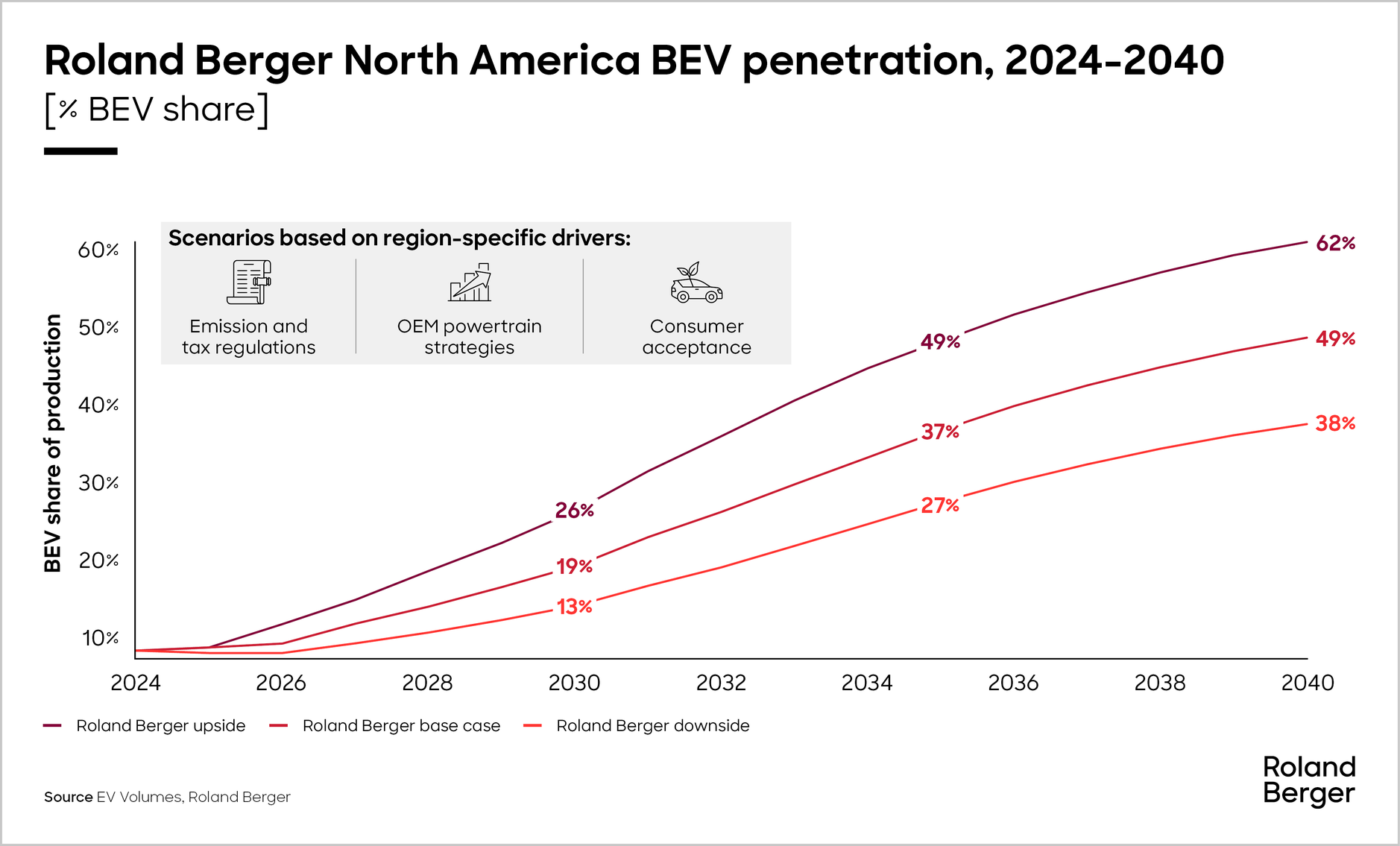
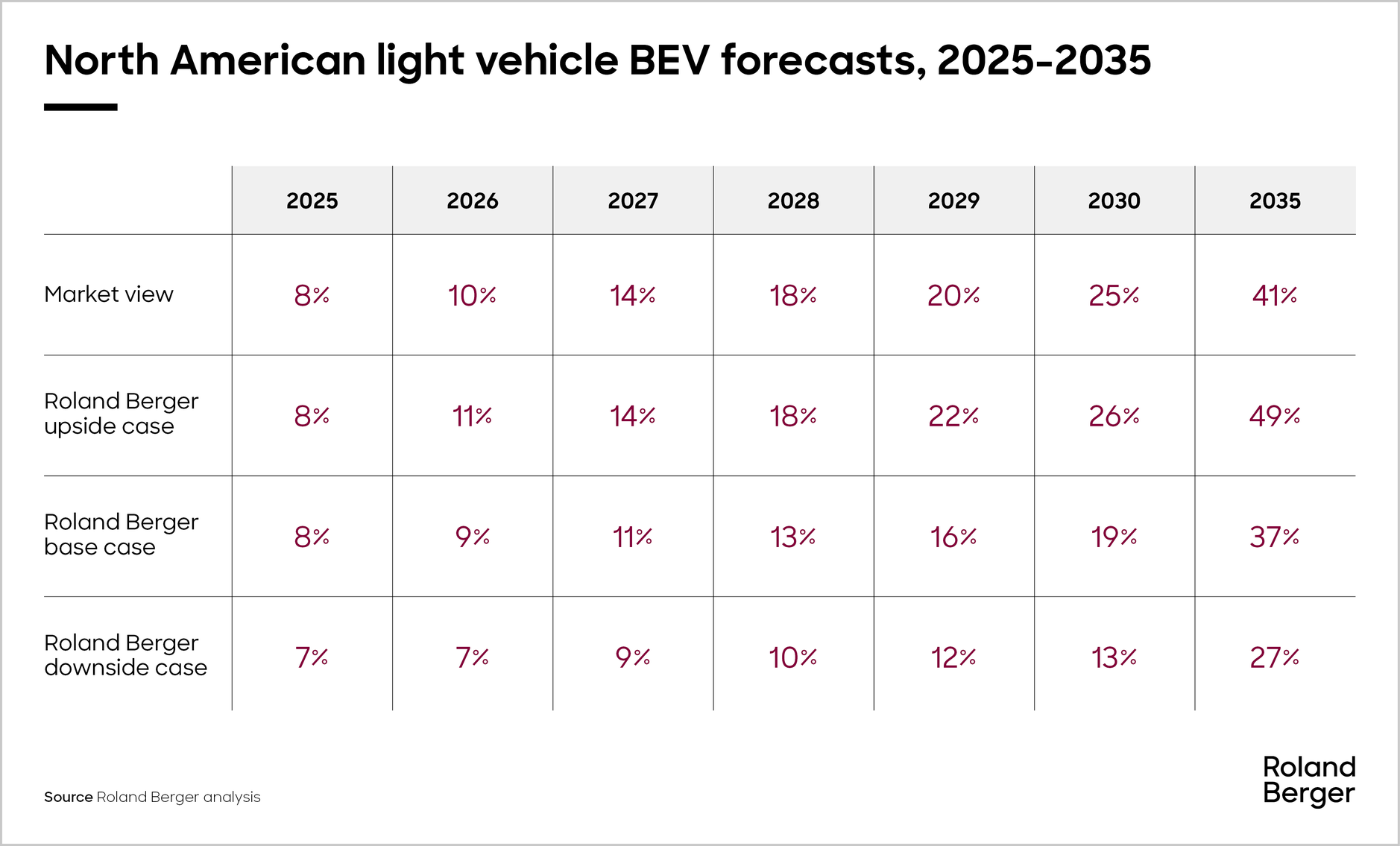
In the Roland Berger Upside scenario, OEMs continue to offer BEVs in the short term, anticipating ongoing emissions regulation, with regulatory levels returning to those similar to the Biden administration after the next presidential election. BEV adoption follows a consistent growth pattern across both high-regulation (such as CARB states and Canada) and low-regulation states.
Roland Berger Base case: Delayed normalization
In the Roland Berger Base scenario, near-term BEV adoption slows due to laxed emissions regulations and penalties through 2027. OEMs respond by increasing BEV model availability in anticipation of future regulatory measures, though at a slower pace, projected for 2028. It is assumed that consumer challenges regarding BEVs are gradually addressed through ongoing investment and innovation from global markets, which also affects North American consumers.
Roland Berger Downside case: Market-led stall
In the Roland Berger Downside scenario, BEV adoption declines in the near-term as OEMs focus on models with higher profitability. Emissions regulations are not expected to return significantly after Trump’s second mandate, resulting in BEV adoption stalling through 2030, primarily influenced by consumer preferences. Long-term
electrification
rates vary among US states due to structural differences in customer choices.
Key takeaways
The evolving regulatory landscape and market dynamics present distinct challenges and opportunities for automotive industry stakeholders. Understanding these implications is critical for navigating the near- and long-term electrification trajectory.
For OEMs:
Traditional manufacturers must manage a complex transition to a multi-powertrain strategy, balancing internal combustion engines, hybrids, and battery electric vehicles. While BEV programs remain critical for global competitiveness, the rise of hybrids to meet emissions targets and profitability goals will heighten xEV competition. BEV-only players will have to defend market share against hybrids offering a more compelling price-performance balance amid ongoing profitability pressures.
For suppliers:
Suppliers will encounter a more cautious market environment with lower near-term BEV volume expectations. This will drive a reassessment of electrification investments and make cost reduction, standardization, and automation critical for survival. Some smaller suppliers may exit the market due to scale and profitability challenges, while others will need to adapt by focusing on efficiency and strategic partnerships to remain competitive.
In conclusion, the North American
automotive
future remains electric, but without renewed regulatory support, that transition will be delayed. In the meantime, growth opportunities will emerge for players capitalizing on the expansion of hybrids and the extended runway of ICE vehicles, while those heavily invested in a BEV-only future will face a more challenging path ahead.