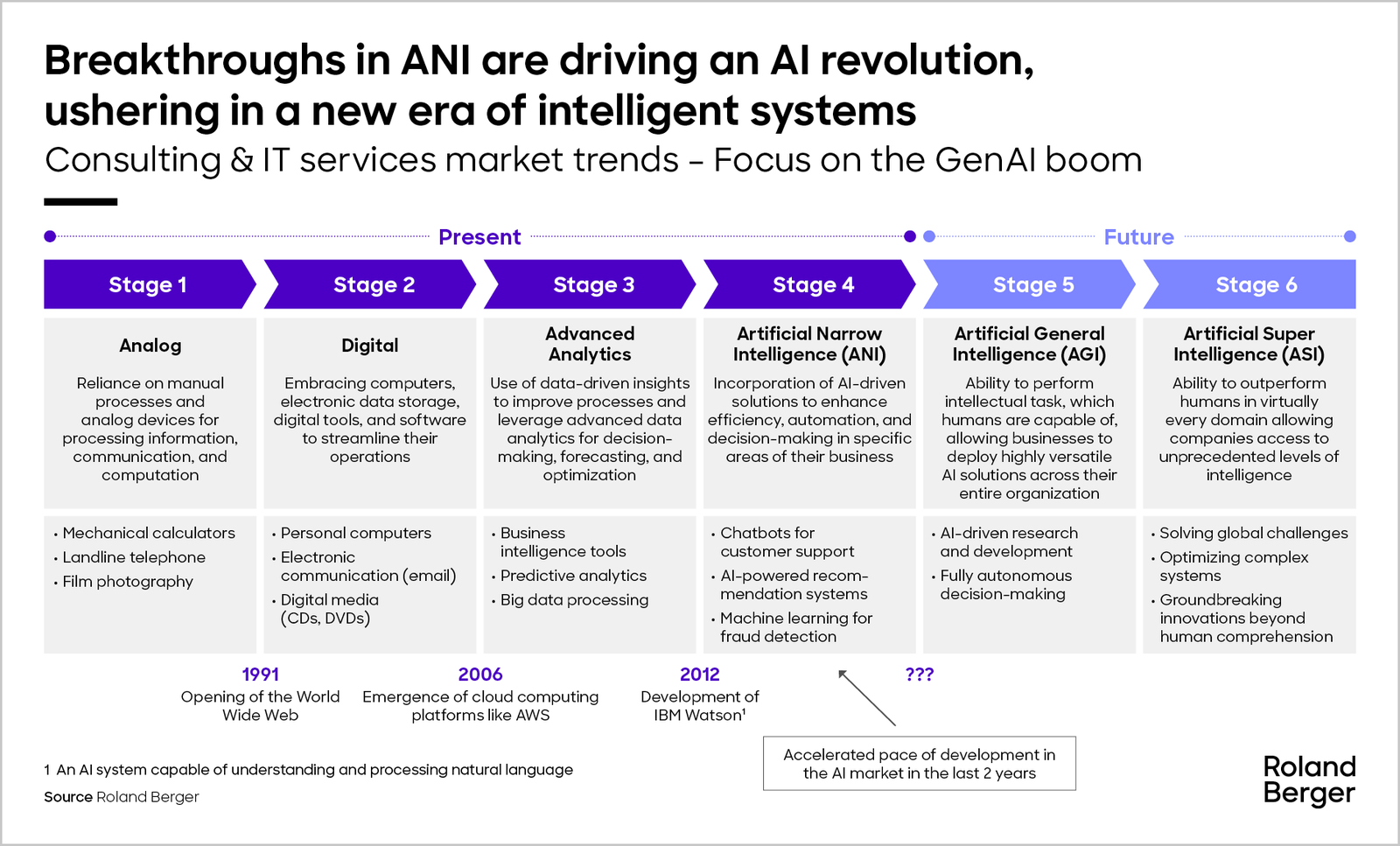
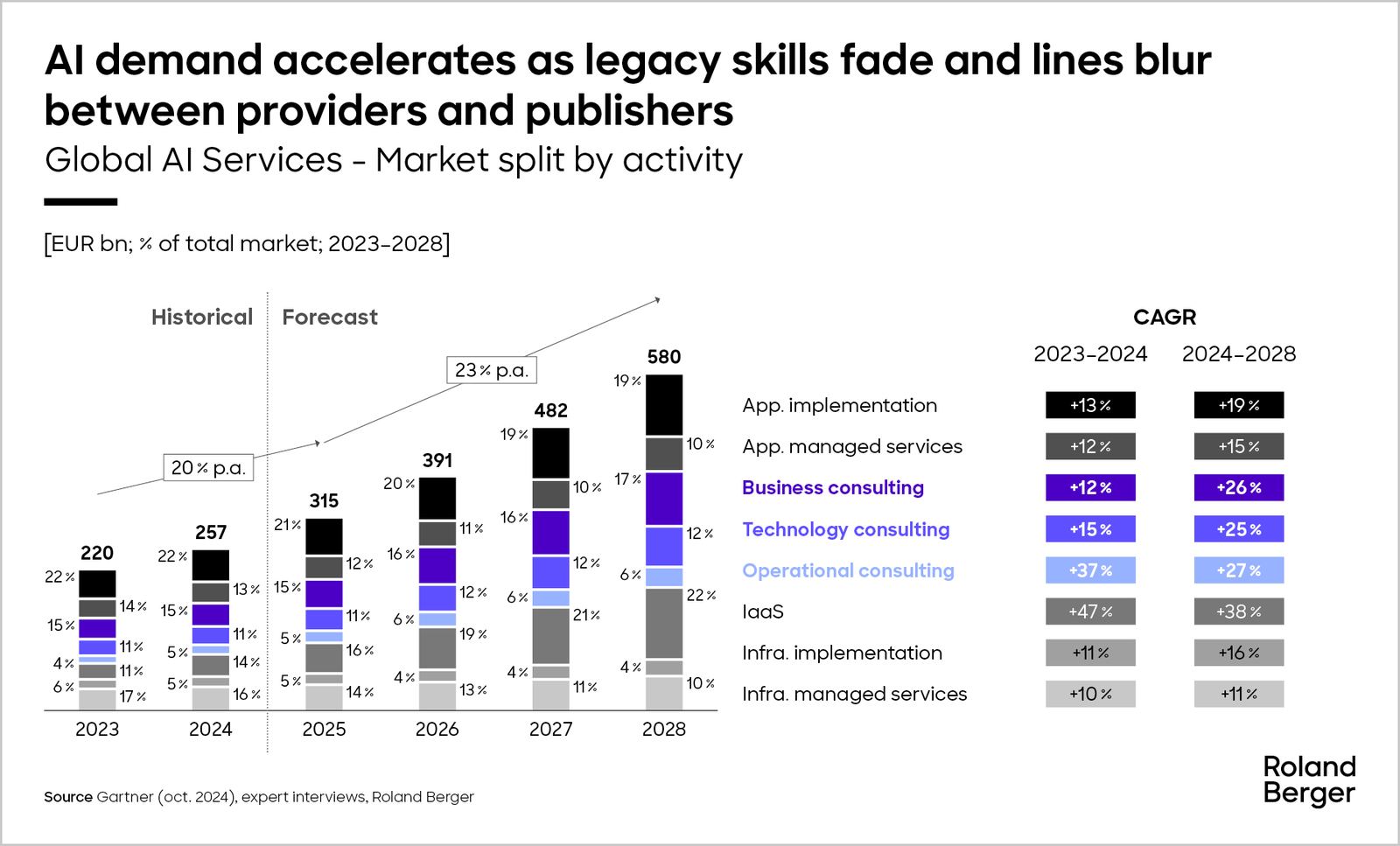
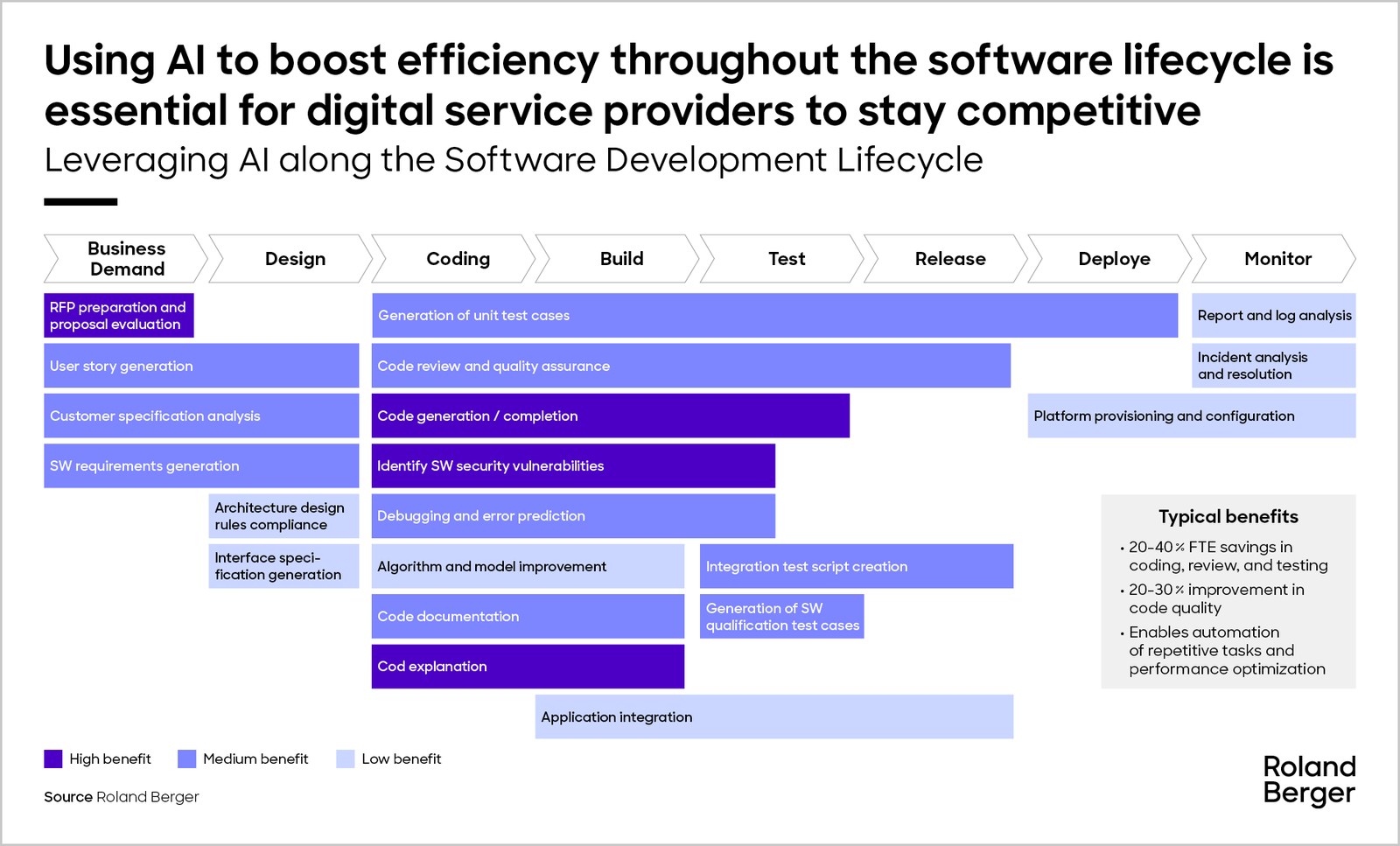
Yet the greater transformation lies in how organizations are structured. Hierarchies are flattening. Decision-making is being delegated to intelligent systems that can manage complex workflows in real time. The “pyramid” model of consulting and IT delivery is being replaced by agile, AI-orchestrated networks of human and machine expertise.
Human talent remains critical — but its focus shifts toward what AI cannot yet replicate: creative problem solving, relationship management, and ethical judgment. The workforce of the future will be smaller, more interdisciplinary, and more strategically deployed.
How leading players are responding
Industry leaders are already investing heavily in this transition. CGI’s ai360 program has expanded AI-based client projects by 140 percent in a year. Accenture has pledged USD 3 billion to AI transformation and expects half its revenue to come from AI-related work by 2028. Capgemini’s partnership with Microsoft to build the Quercus GenAI platform illustrates how consultancies and hyperscalers are merging expertise to accelerate industrial-scale AI deployment.
These moves mark the start of a new competitive era. AI investment is no longer optional — it is the foundation of future relevance. Firms that move early can shape industry standards; those that hesitate will find their legacy models increasingly unprofitable.
From agents to enterprise impace - early days of AI scaling
Across the digital services landscape, the trajectory of AI adoption shows strong momentum — yet a clear gap remains between experimentation and enterprise-level impact. Several patterns have become consistent over the past years:
1. AI adoption is now ubiquitous, but scaling remains the exception.
Most organizations have introduced AI into at least one business function, and many have achieved promising results in isolated domains. Yet broad, cross-functional scaling is still rare. AI often sits at the edges of operations rather than reshaping the enterprise core.
2. AI agents are gaining traction, though deployments are still narrow.
Agentic systems are being tested widely — in IT operations, support functions, analytics workflows, and software delivery. However, these deployments typically remain limited to single use cases. The transition from localized pilots to integrated, multi-process agentic architectures has only begun.
3. Value creation is strong at the use-case level, but enterprise impact is modest.
Where AI is applied with focus, organizations achieve meaningful gains: accelerated execution, cost-efficient delivery, and higher quality outputs. Yet many still struggle to convert these gains into material improvements in enterprise performance, signaling a need for more systemic integration.
4. Leading performers approach AI as a redesign challenge, not a tooling exercise.
A defining characteristic of early leaders is their willingness to re-architect workflows, clarify ownership, and embed AI into decision-making processes. Technology alone does not differentiate them; operating-model transformation does.
5. Organizational and process readiness are more decisive than technical capability.
The primary barriers to scaling are rarely model access or algorithmic constraints. Instead, challenges typically lie in fragmented data foundations, legacy workflows, unclear governance, and insufficient workforce readiness for human-AI teaming.
6. Domain-specific data ecosystems are emerging as the strongest source of advantage.
Differentiation increasingly depends on curating, protecting, and activating proprietary, industry-relevant datasets. Firms that control high-quality domain data are better positioned to deliver contextualized solutions — the step in the value chain least exposed to commoditization.
7. Digital service firms and software providers are advancing fastest — each from a different starting point.
IT services organizations have moved quickly due to early establishment of AI labs and strong incentives to improve operational efficiency. Software developers, by contrast, are unlocking scale by leveraging extensive proprietary datasets embedded in their products. Together, they are setting the pace for AI industrialization in the services economy.
Strategic recommendations
For leaders in consulting and digital services, the message is clear: adaptation must be structural, not superficial.
Four imperatives stand out.
First, redefine the business model.
Transition from capacity-based billing to value- and outcome-based pricing. As AI compresses delivery timelines and reduces manual input, traditional hourly billing will face margin compression. Develop new commercial frameworks that price intelligence and outcomes rather than effort, establishing clear metrics for AI-enabled value creation—from speed-to-market improvements to quality enhancements. Leading firms are pioneering hybrid models combining subscription-based platform access with success-based fees tied to specific business outcomes, capturing the full economic upside of intelligence-scaled operations rather than capping revenue at labor capacity.
Second, build proprietary data ecosystems.
Curate, protect, and leverage domain-specific data as the foundation for differentiation. As generic AI models become commoditized, the real competitive moat lies in owning exclusive, industry-specific datasets. Firms must evolve from "buyers" of off-the-shelf AI tools to "builders" of their own intelligence layers. Organizations with formal data governance demonstrate 35% higher ROI on data investments and achieve 4x faster speed-to-insights compared to those without.
When AI is combined with proprietary datasets and process redesign, organizations achieve cost reductions of up to 25%. This requires systematic investment in data infrastructure and treating proprietary data as a core strategic asset rather than an engagement byproduct.
Contextualization remains the least threatened step of the services value chain because it demands intimate industry understanding that only domain-specific data can provide. Firms with curated client-specific repositories can deploy AI agents that diagnose, predict, and recommend with precision generic models cannot match. In an era where generic intelligence is abundant but contextualized intelligence remains scarce, ownership of high-quality, industry-relevant data will determine who controls the next wave of AI-enabled services.
Third, redesign the operating model.
Automate systematically to fundamentally reconfigure workflows around AI-human collaboration. Treat intelligent systems as integral workforce components with clear accountability frameworks and governance mechanisms. Organizations report 20-40% reductions in manual workload as AI copilots handle documentation, testing, and quality assurance while human experts focus on architecture and judgment. This requires re-architecting end-to-end processes rather than simply deploying AI tools—clarifying ownership between human and machine capabilities and embedding AI into decision-making workflows. Create hybrid delivery models that orchestrate seamless collaboration, amplifying strategic judgment while automating execution at scale.
Fourth, rethink talent and culture.
Invest in AI literacy across all roles while restructuring workforce composition toward hybrid skill sets combining business design, technology fluency, and ethical judgment. Build continuous learning programs blending technical training with domain expertise, ensuring professionals can translate business context into AI-executable strategies. Foster a culture of experimentation and cross-functional collaboration, creating psychological safety for testing AI-enabled approaches. Focus human talent on creative problem solving, relationship management, and AI governance—the irreducible capabilities that define leadership in the intelligence-scaled era—as routine work diminishes and value shifts to orchestrating autonomous systems.
Looking ahead
The digital services industry stands at a defining inflection point. AI is not another technology wave — it is the foundation of a new industrial logic. It will amplify human creativity, accelerate delivery, and upend the relationship between scale and value.
The firms that succeed will not be those with the largest teams or the longest client lists, but those that learn to turn intelligence itself into an asset class. The age of intelligent services has begun — and in it, leadership will belong to those who can transform fastest, think boldly, and make machines an integral part of their strategic DNA.