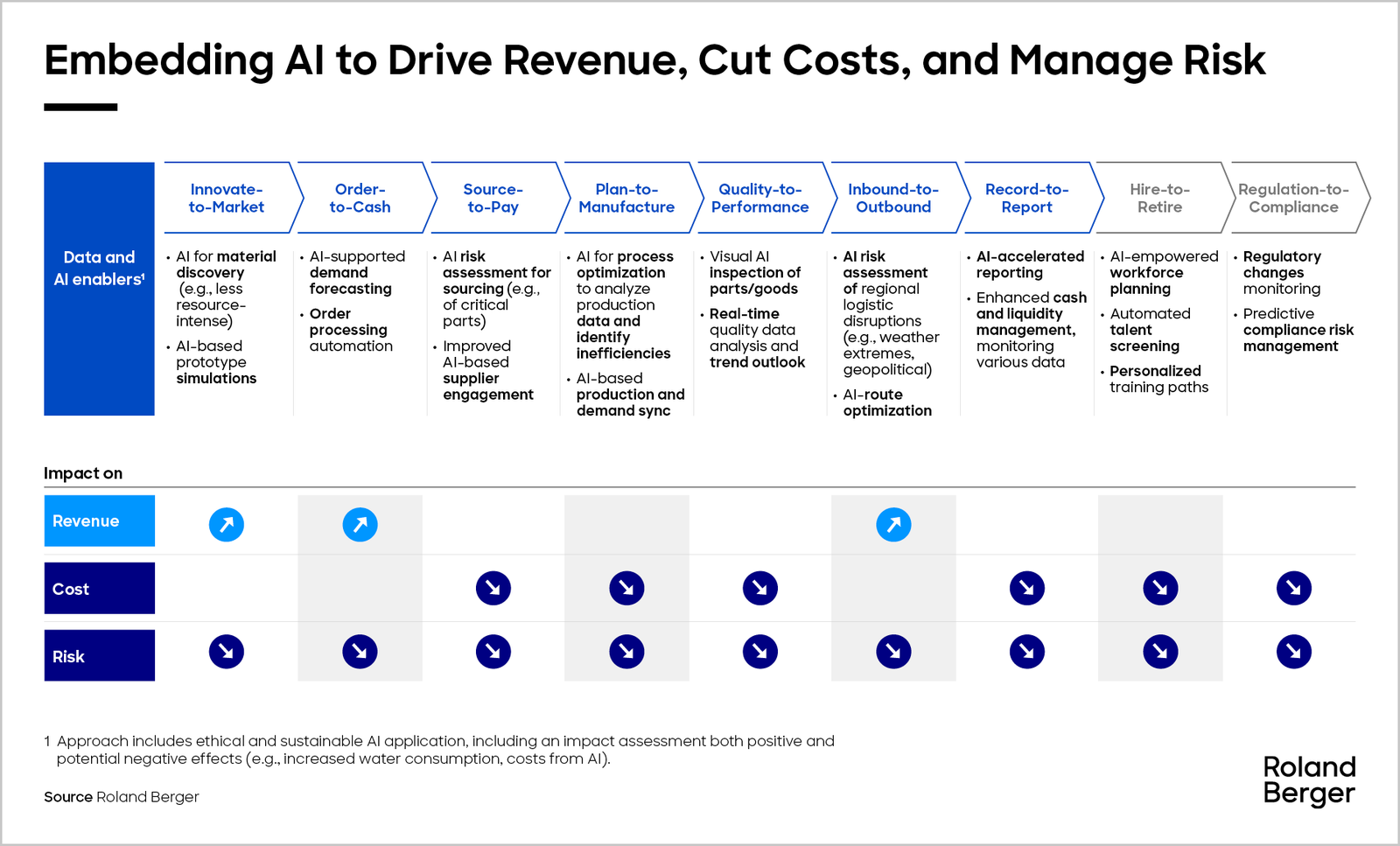
Standardization and harmonization in production present different challenges, but AI also moves beyond simple automation here. An inventory AI agent can analyze past sales, seasonality, and supply lead times to determine optimal safety stocks per item, thus optimizing working capital. AI can also be used for
predictive maintenance,
rerouting production to avoid costly downtimes. Furthermore, AI-supported forecasting processes can incorporate various data from sales, marketing, and distribution partners to enhance demand forecast accuracy.
In innovate-to-market, AI can boost simulation capabilities to predict performances of several product prototypes or variants, drastically reducing the need for costly and time-consuming physical testing. It could also help with the discovery of new, less resource-intense material combinations based on the latest research while considering internal specifications and quality standards.
Integrating AI into future end-to-end processes is a critical component of transformation, especially as processes may change depending on AI's capabilities. Anticipating further enhancements post-transformation is essential, leveraging AI agents to analyze process data for continuous improvement. ERP providers have already taken steps to include production-ready AI functionality in their product suites. To maximize AI's potential, they must facilitate workflows that combine human and AI input and facilitate contextualized data as a baseline for AI agents. Decisions taken in ERP transformations will impact a large share of company data and with that the foundation for agentic AI, including its cost and reliability.