Structural forces reshaping energy retail
Four drivers are converging to fundamentally change the economics of energy retail. Each is significant on its own, but together they create a step change in how customer service, operations, and technology can be organized. What was previously constrained by labor-intensive processes becomes increasingly software-driven. Four drivers are working in concert, from agentic AI to SaaS solutions, while a fifth factor explains why data quality, of all things, becomes the new bottleneck.
1. Agentic AI resolves cases instead of rerouting them
Digitalization to date has shifted contacts – from phone to portal, from letter to app. It has rarely resolved them. AI agents based on large language models now handle cases end-to-end for the first time: payment plan adjustments, relocations, invoice clarifications, tariff advisory – around the clock, multilingual, at marginal costs near zero. The relevant steering metric becomes the straight-through processing rate across the entire case, no longer handle time in the contact center.
2. Smart meters and market communication create the data foundation
The rollout of
smart metering systems,
the reduction of supplier switching to 24 hours, and the progressive standardization of market communication make processes machine-readable that previously lived on exceptions and manual clarification. What used to be the graveyard of exception cases in retail operations becomes automatable – provided the master data is correct.
3. Cloud-native platforms commoditize the billing stack
SaaS solutions make first-class billing and service processes available as a standard product. The scale advantage of large IT organizations erodes; fixed costs become variable. A municipal utility with 80,000 customers can operate at the same process level as a large group – process excellence itself is no longer a moat.
4. Software scales, headcount does not
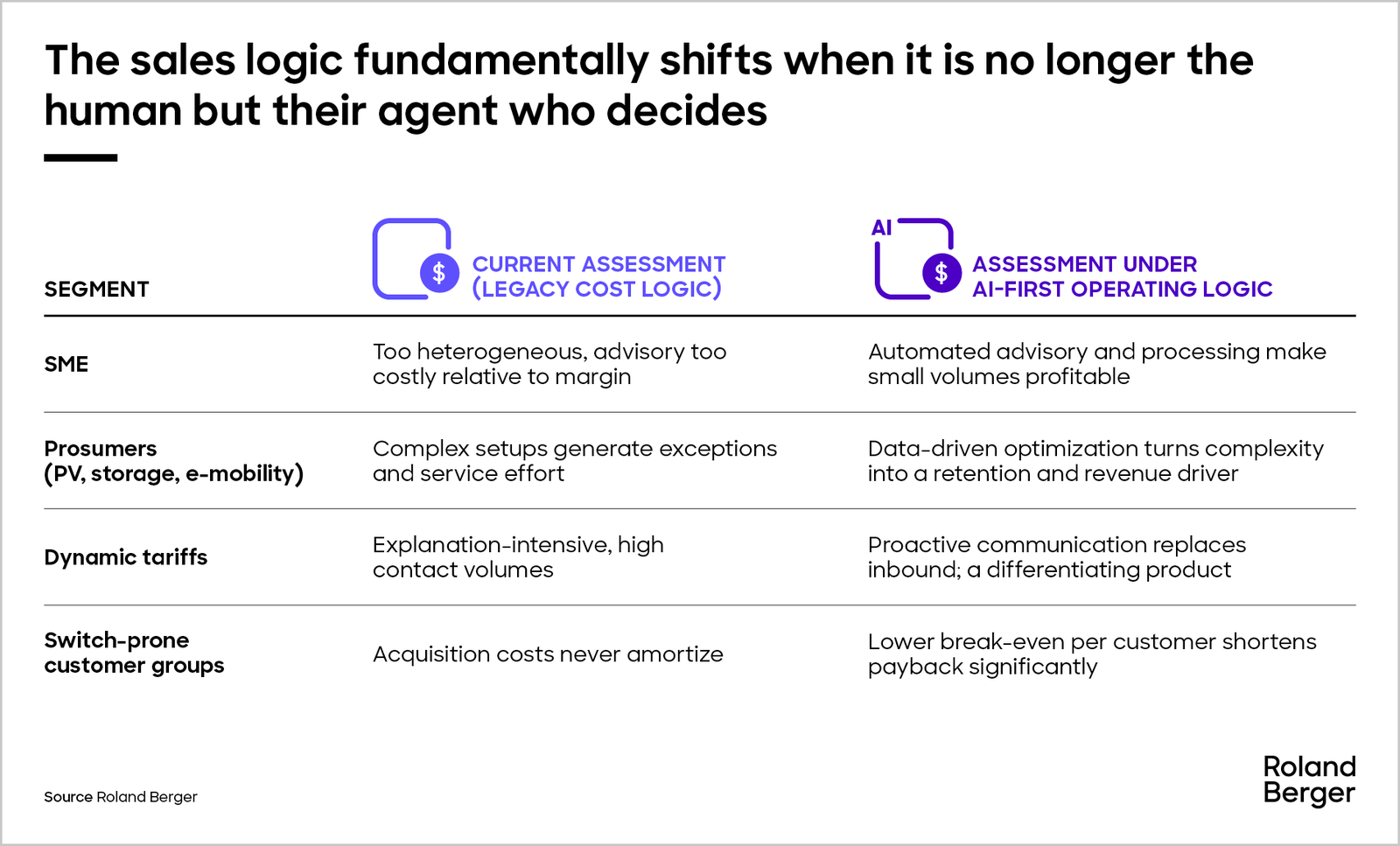
Until now, customer growth meant linear build-up of service capacity – the real reason low-margin segments were unattractive. In an AI-first operating logic, customer base and service costs decouple. Break-even per customer falls so far that the attractiveness map of segments has to be redrawn.