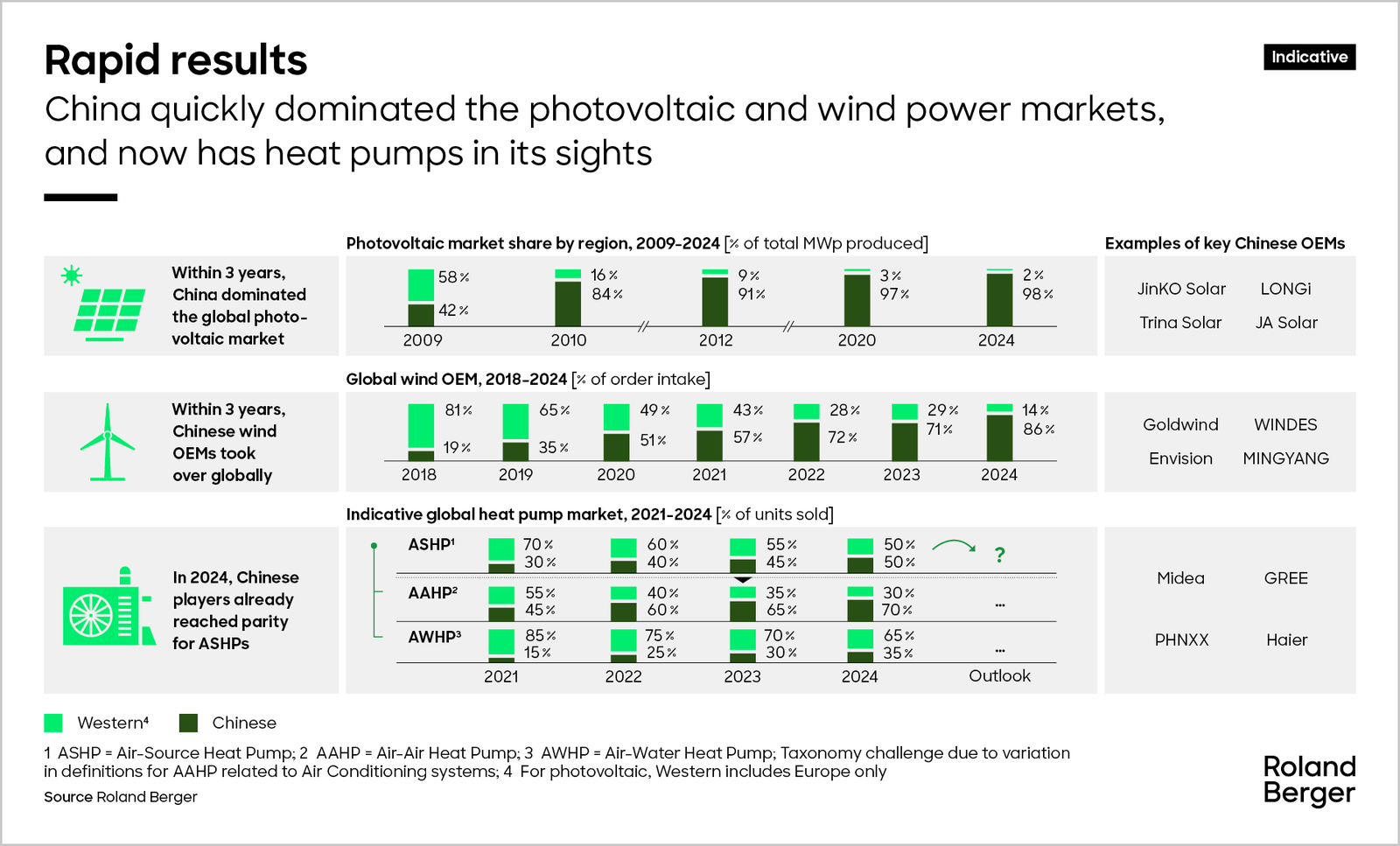
China’s shift into heat pumps is placing three simultaneous pressures on European OEMs, each reinforcing the others:
Margin erosion: Residential air-source heat pumps (ASHPs) are the key margin pressure point. European OEMs currently generate most of their volume in this segment, but Chinese competitors are entering with significantly lower cost structures. They must therefore decide whether to defend their market share at unsustainable margins or cede volume and move further upmarket.
Technology parity: European OEMs currently maintain their pricing power through a technology premium in areas such as low GWP (global warming potential) refrigerant systems, advanced system integration capabilities and high-temperature industrial applications. However, the 15th FYP specifically targets these areas, threatening not just rapid technological parity, but parity at a lower cost as Chinese OEMs combine R&D knowhow with stringent cost-out models.
Emerging market competition: European OEMs have viewed Eastern Europe, Southeast Asia and the Middle East and North Africa as key mid-term growth regions that compliment traditional European core markets, albeit paired with significant market volatility. Yet Chinese competitors are already securing positions in these markets through Belt and Road-linked HVAC infrastructure programs.
Compounding these threats to European OEMs are two key risks – a lack of European Union (EU) regulatory protection and supply chain dependency. With regards the former, regulations, such as anti-dumping measures, HFC quotas and energy labelling requirements, offer temporary relief but do not change the underlying competitive or structural cost dynamics. Chinese OEMs will further penetrate the European market with EU-compliant offerings, increasingly localized production footprints and strengthened distribution access, fundamentally changing the competitive landscape.
Regarding supply chain dependency, the FYP’s focus on manufacturing strength, technological self-reliance and supply-chain resilience increases the risk that Chinese suppliers will prioritize domestic customers when capacity is tight. This could mean higher continuity risk, less favourable terms and weaker influence over future product roadmaps for European OEMs that are sourcing items such as compressors or power electronics from China. Political factors, such as trade restrictions and potential escalation over Taiwan, increase the risk of disruption in globally concentrated supply chains.
Strategic responses
So, what can European OEMs do to mitigate the risks posed by Chinese rivals? A key response advocated in the full report is for European players to move resources away from commoditizing high-volume products, such as ASHPs, toward more defensible segments, such as low GWP refrigerant architectures and high-temperature retrofit solutions. The report also proposes
rationalizing product lines
and shifting toward life-cycle solutions.