Four value pockets drive success
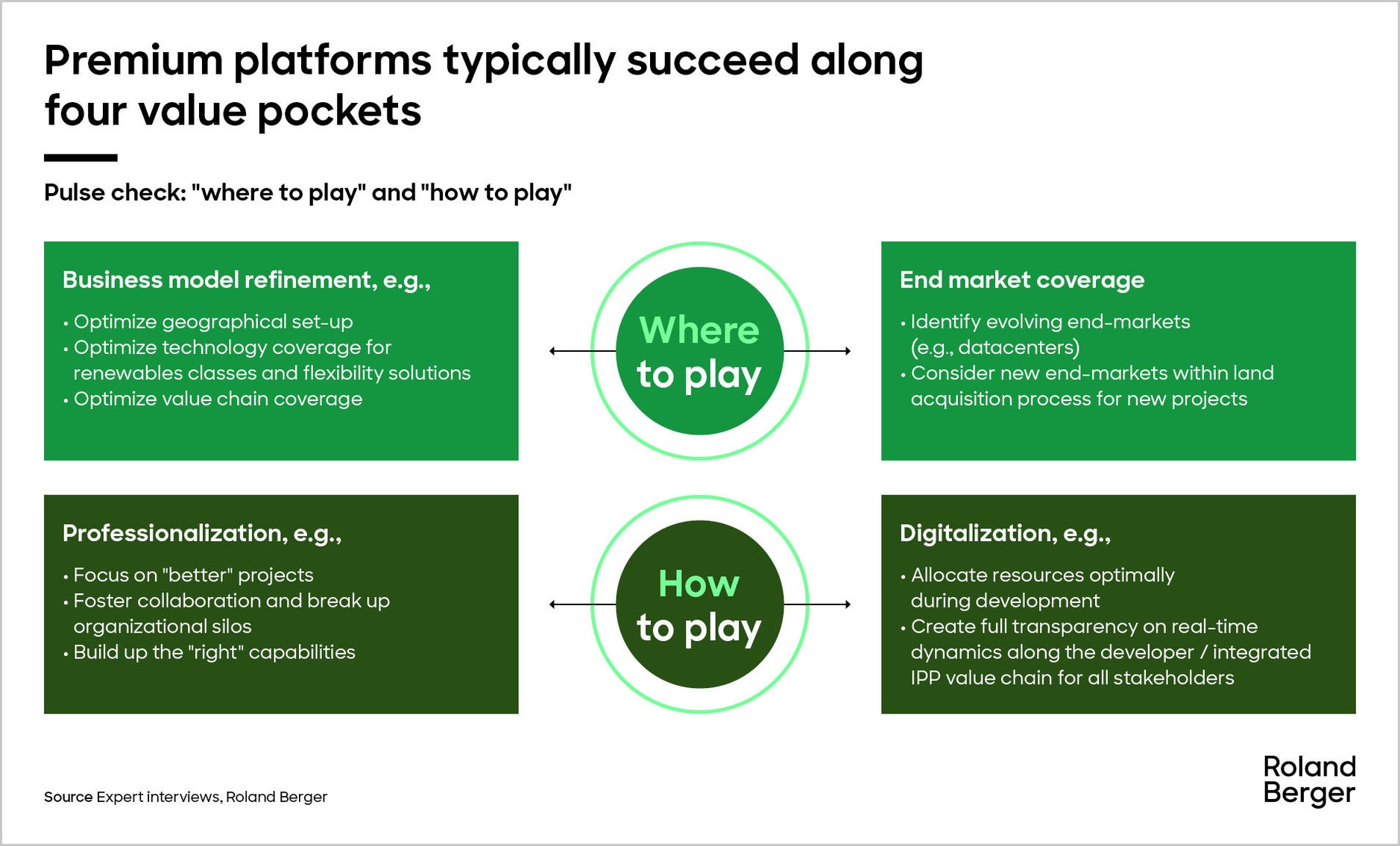
Our analysis identifies four interconnected areas where leading platforms outperform.
1. Business model refinement
Diversification across asset classes, geographies, and value chain steps reduces single-market exposure. Premium platforms may span solar PV, wind, and hydro as well as flexibility solutions like
battery energy
storage systems (BESS) across multiple countries. Critically, they optimize their value chain positioning dynamically, choosing develop-to-sell strategies more in mature, liquid markets where asset recycling preserves capital, and develop-to-own positions more in markets where long-term contracted revenues justify balance sheet commitment. This structural flexibility provides revenue stability when individual technologies or markets deteriorate.
2. End market coverage
Evolving offtake opportunities beyond traditional utilities offer premium pricing and contract certainty unavailable in wholesale markets. The European datacenter market alone is anticipated to add an estimated 15.2 GW of cumulative capacity by 2030, growing at 14% annually, driven by hyperscaler and AI infrastructure buildout. Developers incorporating datacenter offtake strategies into land acquisition and project design secure attractive long-term contracts insulated from spot price volatility.
3. Professionalization
Operational discipline separates premium platforms from struggling developers across four dimensions. First, defining clear project guardrails to allocate capital toward high-return opportunities rather than volume targets. Second, dismantling cross-functional silos to enable end-to-end process flows and faster decision making. Third, building specialized expert hubs for offtake structuring, grid engineering, and permitting – functions where execution quality determines project economics. Fourth, standardizing workflows through templates and approval processes to reduce errors and accelerate deployment at scale.
4. Digitalization
A unified digital asset deployment platform creates real-time transparency across the developer
value chain
. Integrating project managers, legal teams, technical analysts, regulatory teams, OEMs, and trading desks into a single system eliminates information gaps and coordination failures that compound in multi-country portfolios. This factory model for renewables development, replacing fragmented, project-by-project execution with standardized, repeatable processes, delivers measurable returns: Platforms that have implemented such systems report reductions in development lead times and development cost savings.