What is ZBR and how can it help?
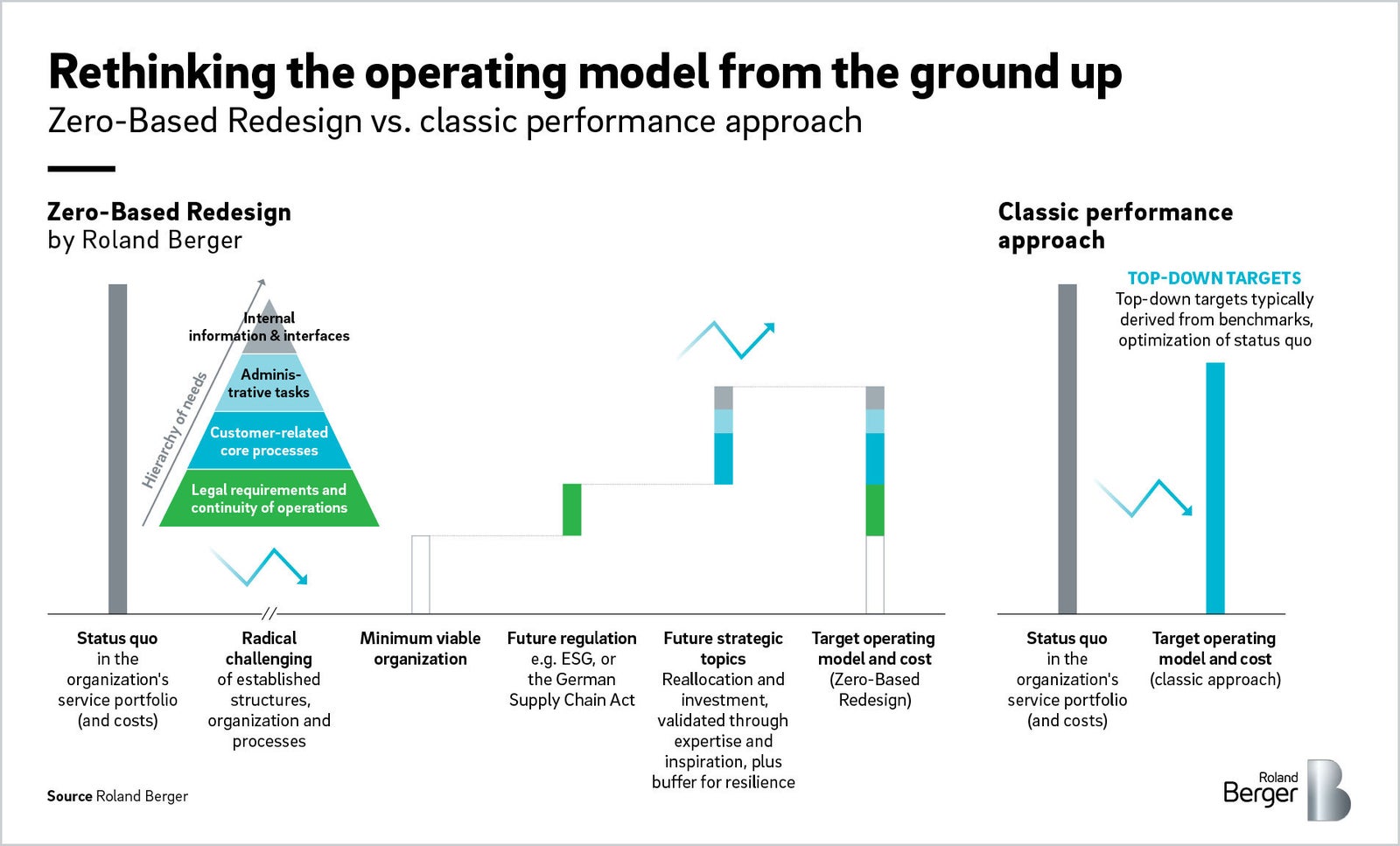
Transformation approaches differ in their extremity. At the lower end are attempts to maintain the status quo and classic performance improvement methods. These ask questions like “How can we do more with less?”, and “How can we be leaner?”. These help to cut costs and lower resource requirements but fail to address bigger picture issues such as market dynamics and company perception.
At the opposite, radical end of the transformation spectrum is the ultra-lean minimum viable organization. This focuses on bare necessities (value proposition, compliance) to minimize costs and improve agility. But the whittling down of resources can leave a company unable to monitor market dynamics or be proactive.
Zero-Based Redesign fits neatly between the two. It takes a pragmatic, future-oriented view on customer needs, market dynamics, regulatory requirements and resilience – and then redesigns the target operating model from the ground up. To do this, ZBR seeks to determine which parts of the existing operating model (activities, processes, organization etc.) justify their existence under the status quo, and what capabilities the organization needs to thrive in the new market dynamics. The process therefore goes beyond mere cost-cutting and instead ensures a more sustainable transformation and firm platform to enact culture change.
Another benefit is that ZBR suits a large variety of transformation situations. From entire companies to specific business functions (especially Finance, HR, Sales, R&D and Procurement) and individual processes, it can be applied at multiple organizational levels.