No doubt we are all familiar with the phenomenon: You want to book a trip, you go online – and you are immediately dazzled by the abundance of offers. You start to wonder, isn't there a flight at a more convenient time? Or maybe a cheaper deal on the hotel? Each additional option throws up new questions. Many people seem to feel so overwhelmed by it all that they end up not booking a trip at all: A Google survey found that more than one in every two people felt they were bombarded with too much information to be able to make a travel decision.
This example is symptomatic of our time – and of three trends that companies around the world are struggling with. First, markets are becoming increasingly volatile, with rising innovation rates, new technologies and falling barriers to market entry rocking the boat wherever you look. In the past, a company could go decades without a takeover bid or the urge to swallow another firm, but now
corporate acquisitions and mergers
are the order of the day.
Customers – and markets – are overwhelmed
The second global trend is the rise in what consumers expect in terms of service and prices. The greater the transparency and the more that's available on the market, the more important it becomes to offer a positive customer experience if you want to keep the customer coming back. Successfully mastering this seems like an almost impossible task, because consumers want more products and more service at the same time as more simplicity and more personalized choice. Just as in our travel analogy, you shouldn't simply present your entire portfolio and hope for the best. What you need to do is filter the information based on the customer's personal preferences and past behavior.
The third trend is the transition from value chains to value networks. The more the traditional boundaries between industries and rival firms disappear, the easier it is for new entrants to thrive, especially if they have direct access to customers. Digitalization plays a key role here, in that it changes corporate cost structures and brings down transaction costs dramatically – both within and between organizations.
Simplicity is a complex matter
These three developments offer great business opportunities. But they also involve risks. For example, if the entry barriers to mass markets fall, incumbent players can quickly lose access to customers. The complexity of large, amorphous networks is confusing to shareholders and suppliers, and customers are unsure who to turn to. Companies often find themselves in a tug-of-war between two strategic objectives: On the one hand, they are keen to make their offering as simple as possible by combining different products and services and acting as a one-stop shop. But this comes at the cost of considerable operational complexity. On the other hand, if they want to want to keep their operations as simple as possible, which means producing cheaply and getting new products to market quickly, they must focus. Yet the more they expand their product offering to serve the maximum number of customers, the more easily replaceable they become.
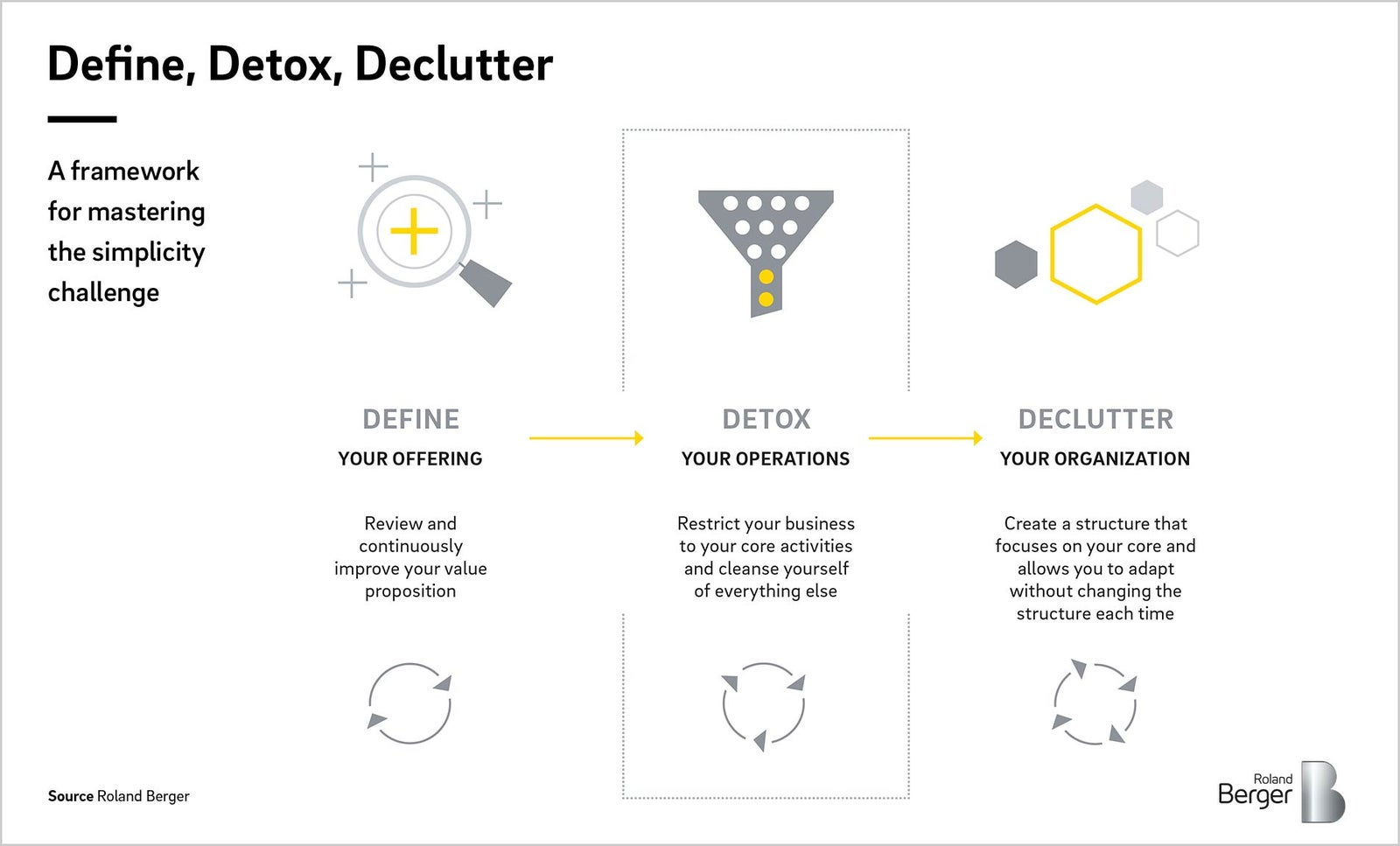
So the challenge lies in offering customers as much convenience as possible – through simplification – while also bringing down the level of complexity within the company. Adopting a new mindset doesn't go far enough, not on its own. Businesses need a concrete roadmap for simplification on all fronts.