Some of the remaining bits per second are processed unconsciously; thank your instincts for that. It’s a simple process: if (stimulus), then (response). But let’s think about this for a second – and yes, alongside all of the other data that is still flooding in. A huge proportion of all the incoming data doesn’t even reach a level requiring analysis. The brain knows what it does and what it doesn’t have to worry about. In short, it uses a technique akin to predicting the future. It works on the basis of expectation and acts accordingly, only making an intervention if something is not right.
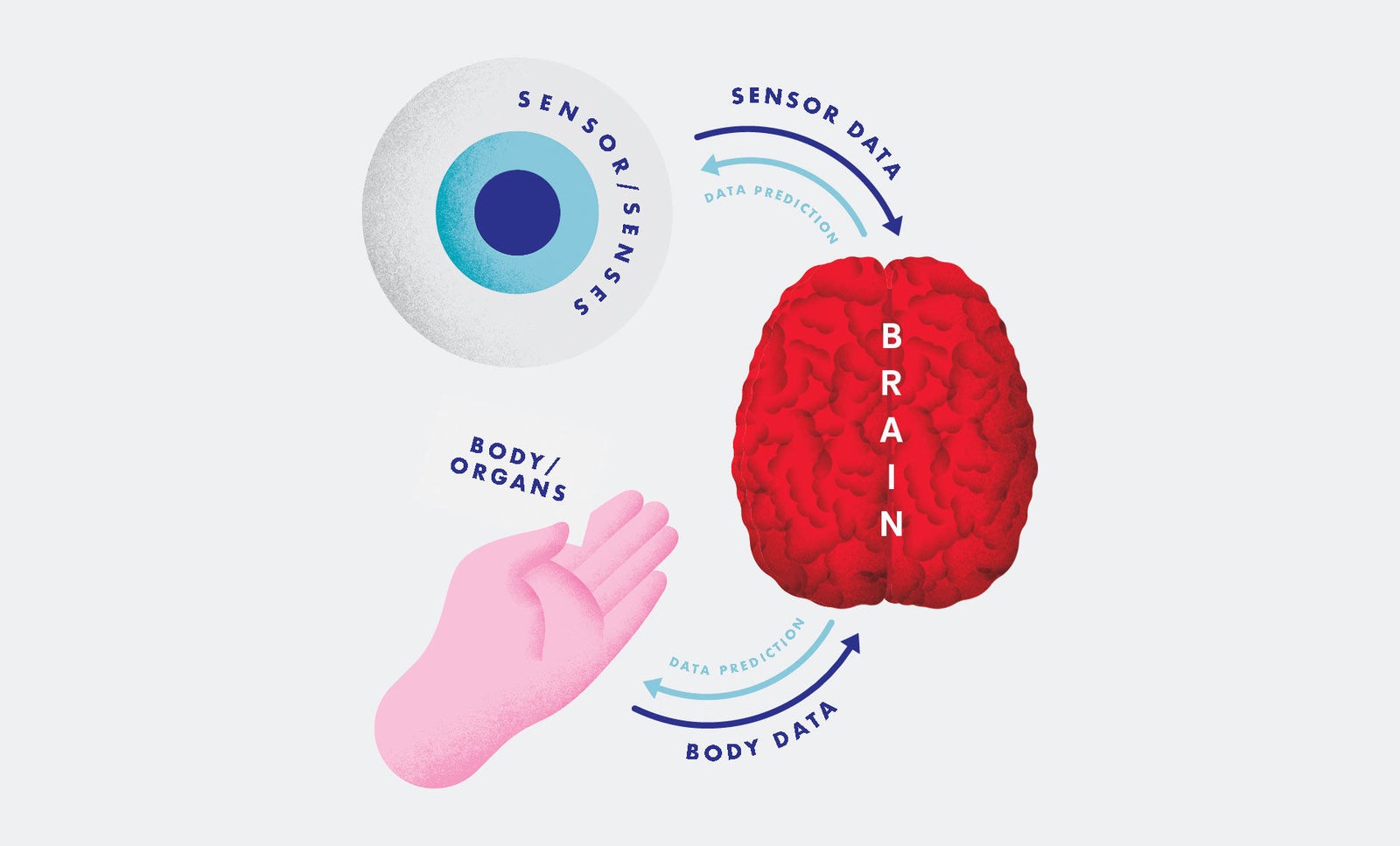
Lars Muckli, a neuropsychologist at the University of Glasgow, has put his finger on exactly that point. He has even gone so far as to call the brain a "prediction machine." The brain, he explains, does not only receive data from the sensors and organs, it also delivers continuous forecasts to them: What should your sense organ – eye, ear, or fingertip – be feeling the next moment? What performance task should you deliver right now? If the forecast and the result match, everything is fine and there’s no need to think about it. "Processing continues only for the unpredicted things, the surprises," says Muckli.
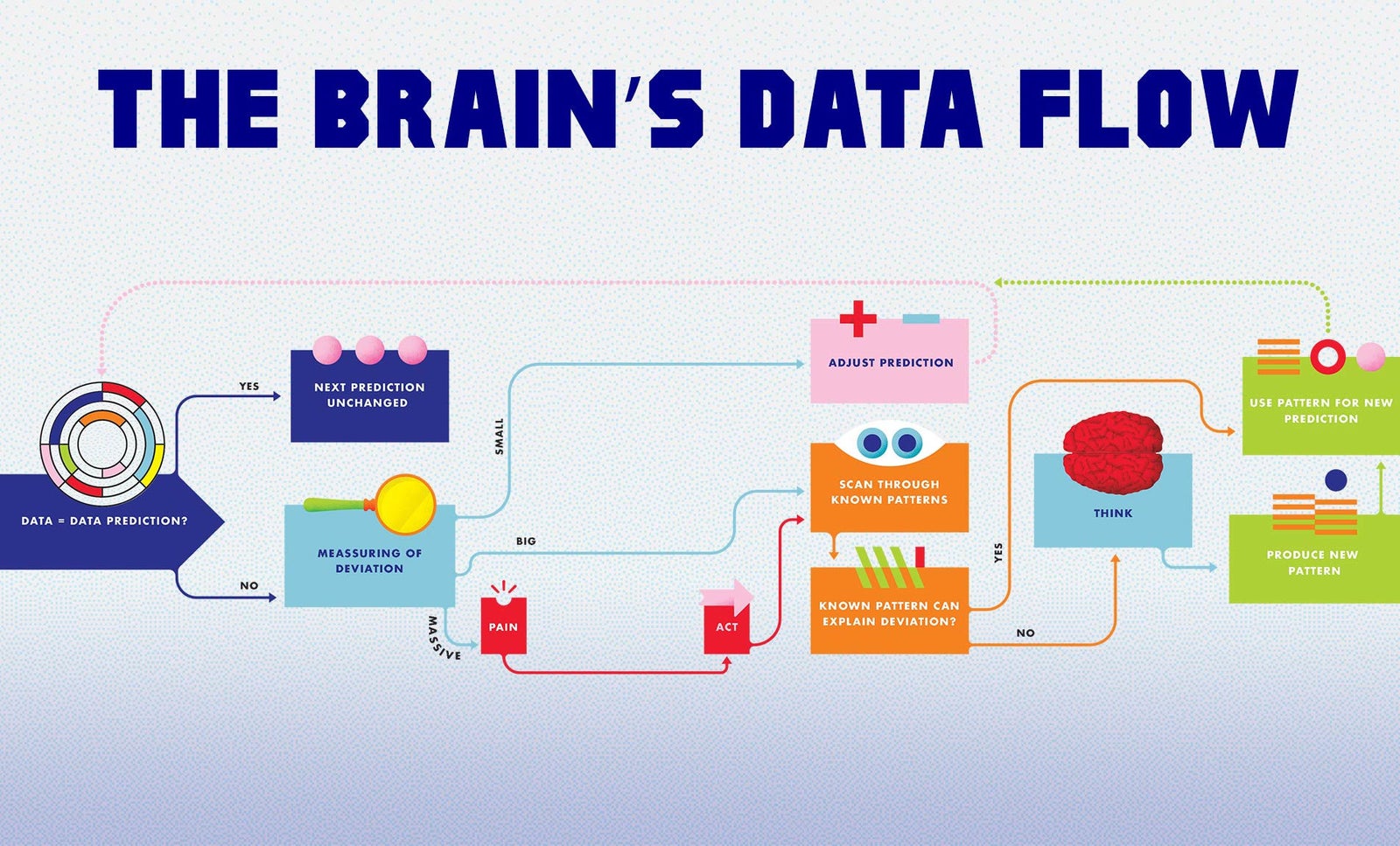
There are three different ways that the brain then continues with its processing functions, depending, of course, on the size of the "surprise."
- Small deviations are solved by small, mostly unconscious adjustments.
- Larger deviations or unsuccessful adjustments activate the memory to ask the question: Is there any pattern or reaction or procedure already known that might be a better fit for these results? If this is the case, this known pattern will be used for the next predictions. If not, the process we know as "thinking" starts. The brain produces a new pattern that fits best to the new reality and lets the body act accordingly.
- Huge deviations, or big surprises, often mean danger. Evolution has linked them with a strong signal: pain. And also with a special response: stress. Both will short-circuit the brain’s pattern prediction process and lead to immediate action – running, fighting, hiding or whatever seems to be the most appropriate response.
Renowned neuroscientist Moshe Bar, director of the Cognitive Neuroscience Lab at the Brain Research Center at Bar-Ilan University in Ramat Gan, Israel and an associate professor of psychiatry at Harvard Medical School, calls it a "feed-forward method for top-down predictions." His explanation highlights the difference between this method and the one usually attributed to the brain: a more computer-like way of decision-making. Instead of "interpreting our world merely by analyzing incoming information," he says the brain is using "top-down guesses that are based on rudimentary input information." This is part of a never-ending story that leads from analogies to associations to predictions to new analogies and so on.
The brain, it seems, is extremely successful with this "feed-forward" process. So it is perhaps interesting to observe that nothing else seems to have made use of its model – that is to say, no one has really tried to replicate its success. None of the objects, institutions or systems built by men mirror the way the brain works in this idiosyncratic way. The top-down channels in companies are not used to predict the outcome of departments, teams or individuals over the following seconds or minutes. Instead, they are accustomed to giving orders and/or setting targets with much longer timescales, such as for the next quarter or fiscal year. The military and bureaucratic roots of management are still abundantly clear in both theory and practice, but they are not very neuroscientific management methods. It could be said they are not using an intelligent model.