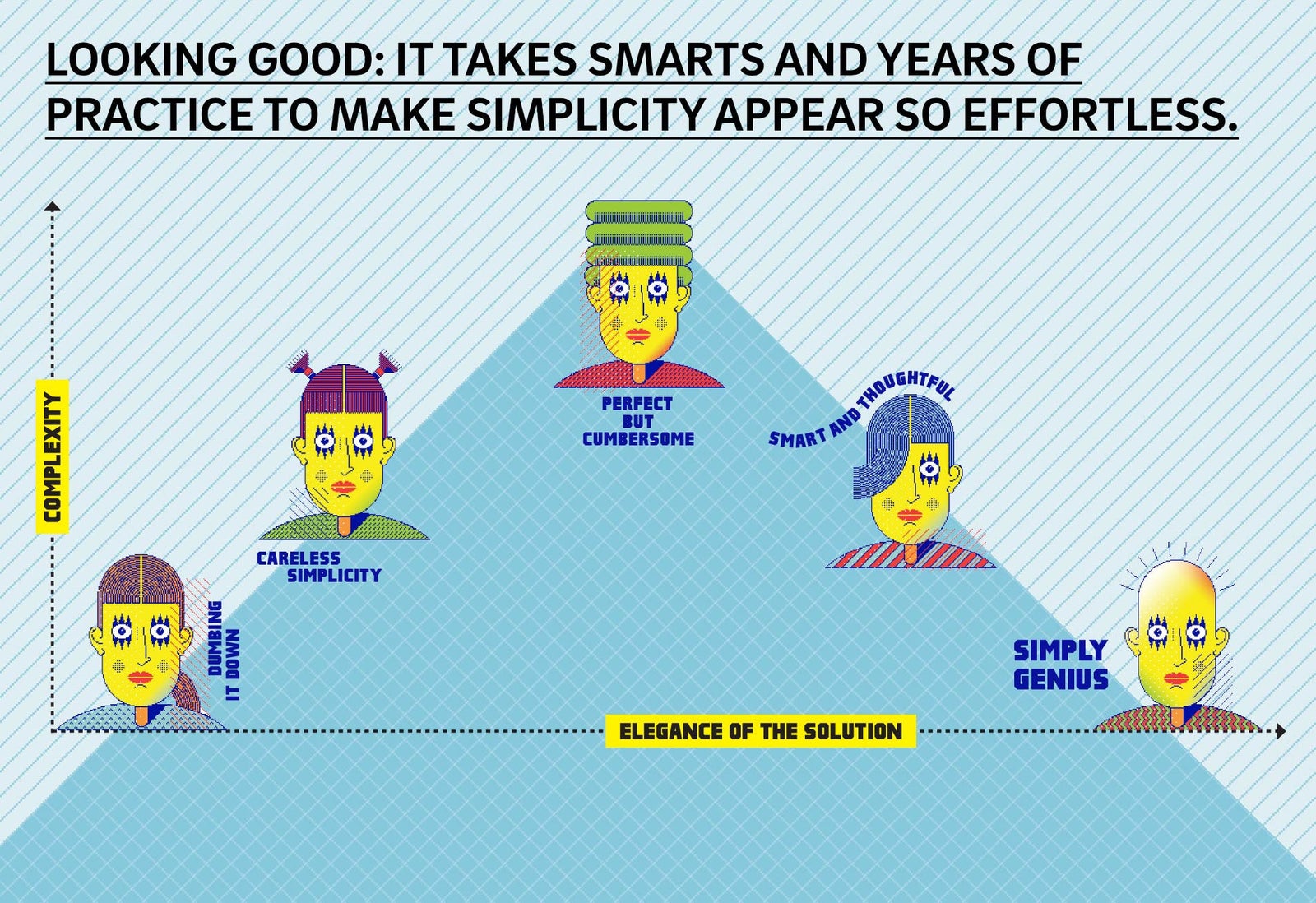
What's the magic formula? People look around to see where simple solutions have led to super success. To be sure, history does have a few examples and some simple things have sporadically succeeded in all the decades of nonsense. Companies like Aldi (logistics), Apple (aesthetics) or Google (customer value) are all, in their own ways models of simplicity. I would like to illustrate the drama of the naive hope for simplicity and the gullibility for pointless concepts, the underlying idea for which I found in the online article "How To Simplify Your Presentation Without Dumbing It Down" by Olivia Mitchell.
You can arrive at two types of simplicity: Either you can reduce the complex to a level of stupidity, or you can shape complexity into clear genius. Stupid simplification is more seductive than shaping simplicity into genius. It is stimulated by things like: "Let's do it fast, the boss insists." In contrast, genius simplicity can only come from hard work by those who are thinking and behaving holistically. There aren't that many people in the world who can do it. As I mentioned earlier, Aldi managed it. Steve Jobs and the founders of Google did, too. But their kind of genius can't be replicated quickly or cheaply. Even if a company did have a genius in its ranks, that person would probably end up sitting in meetings where everyone is searching feverishly for simple ways out. The people in the meeting aren't fools, but they do want to simplify the complexity of their own small environments and aren't thinking about the big picture. That's why they simplify the complex into what is, for them, the most manageable thing as it appears at that moment.
That's how careless simplicity – or even stupid simplicity – emerges. For example: "We need more IT experts! OK, we have too many sales people at the moment, so let's retrain them quickly." The "better to do something than nothing" philosophy mixed with time pressure turns people into fools. Almost every manager surely knows the KISS principle: "Keep it simple, stupid." But surely the last "S" should stand for something else, like this: "Keep it simple, smarty-pants."
We are often awestruck by nature's wonderful solutions, by how the brain works, the harmonious interaction of orchestral musicians, Olympic champions and the shining heroes of human history. The result appears to be either smart or genius – but never something that was created. Behind that seemingly effortless "genius," that "good design," lie years of practice and learning. Yet we don't work towards genius simplicity in the workplace, and rather fight amongst ourselves in meetings where simplicity could be developed.