This poses several challenges. The luxury watch industry must cope with the increasing scarcity of resources as well as the impact of climate change. Its complex global value chain complicates the traceability of raw materials and the transparency of the companies that operate along the chain.
In recent years, social and environmental sustainability have become key factors for luxury watch buyers, alongside traditional factors like aesthetics and craftsmanship. This is particularly true among millennial and Generation Z cohorts. A credible sustainability strategy is thus crucial to retaining customers and future-proofing a business. According to the Positive Luxury Trend Report, 46% of CEOs from the global luxury industry acknowledge that both resource scarcity and climate change will transform their business models.
Consumers are increasingly interested in the sustainability of the materials used to manufacture a final product. A luxury Swiss watch typically contains a vast number of raw materials such as gemstones and metals, which need to be extracted and refined before being imported to Switzerland for further manufacturing. Besides the responsible sourcing of raw materials, the watch industry's focus on climate aspects is an important lever to look at, with different scopes of direct and indirect emissions generated.
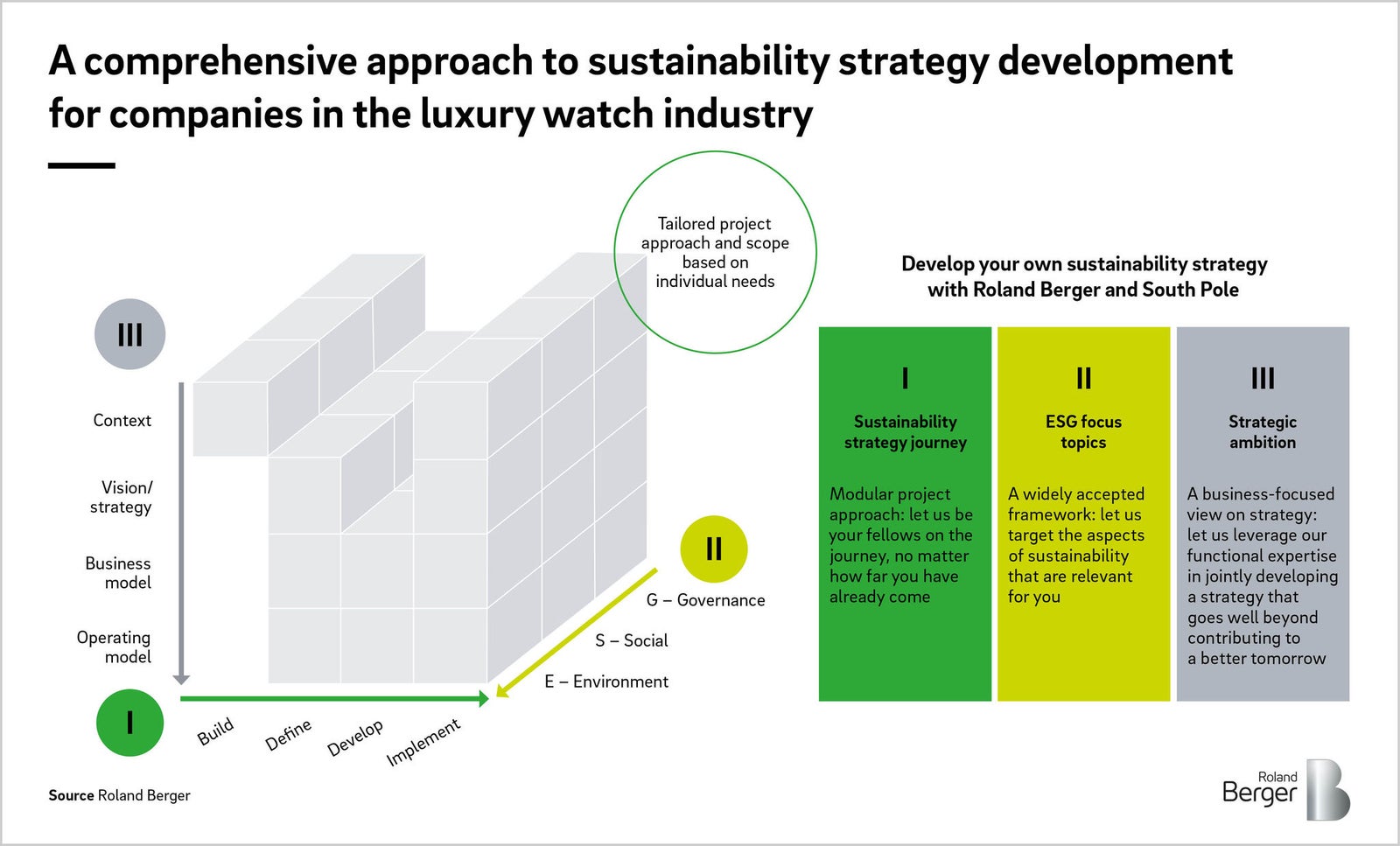
To successfully tackle these key challenges, businesses must take a holistic approach to sustainability and gain a clear picture of both their own activities and those of their suppliers. There is no one-size-fits-all solution, but by following certain guidelines a company can develop a sustainability strategy that works for them. In collaboration with
South Pole , a leading developer of climate action projects and sustainability solutions, Roland Berger has defined a comprehensive approach to sustainability strategy development for companies in the luxury watch industry. It is based on three dimensions: a sustainability strategy journey, ESG focus topics and strategic ambition.