In 2020 Tesla proved that electric vehicles could be offered profitably to a mass market. The launch of the Model Y as an affordable, no-compromise, long-range vehicle marked a turning point, changing industry perceptions of battery electric vehicles (BEVs) and effectively disrupting the market. Tesla achieved sustainable profitability through its differentiated engineering and production concepts, by accelerating its scaling of production in Shanghai and Berlin and by mass-marketing the software-defined vehicle. The capital markets took notice, rewarding Tesla for its potential to speed up the global transition to electric mobility. Against a backdrop of ever-tightening global emissions regulations, a hype cycle was born.
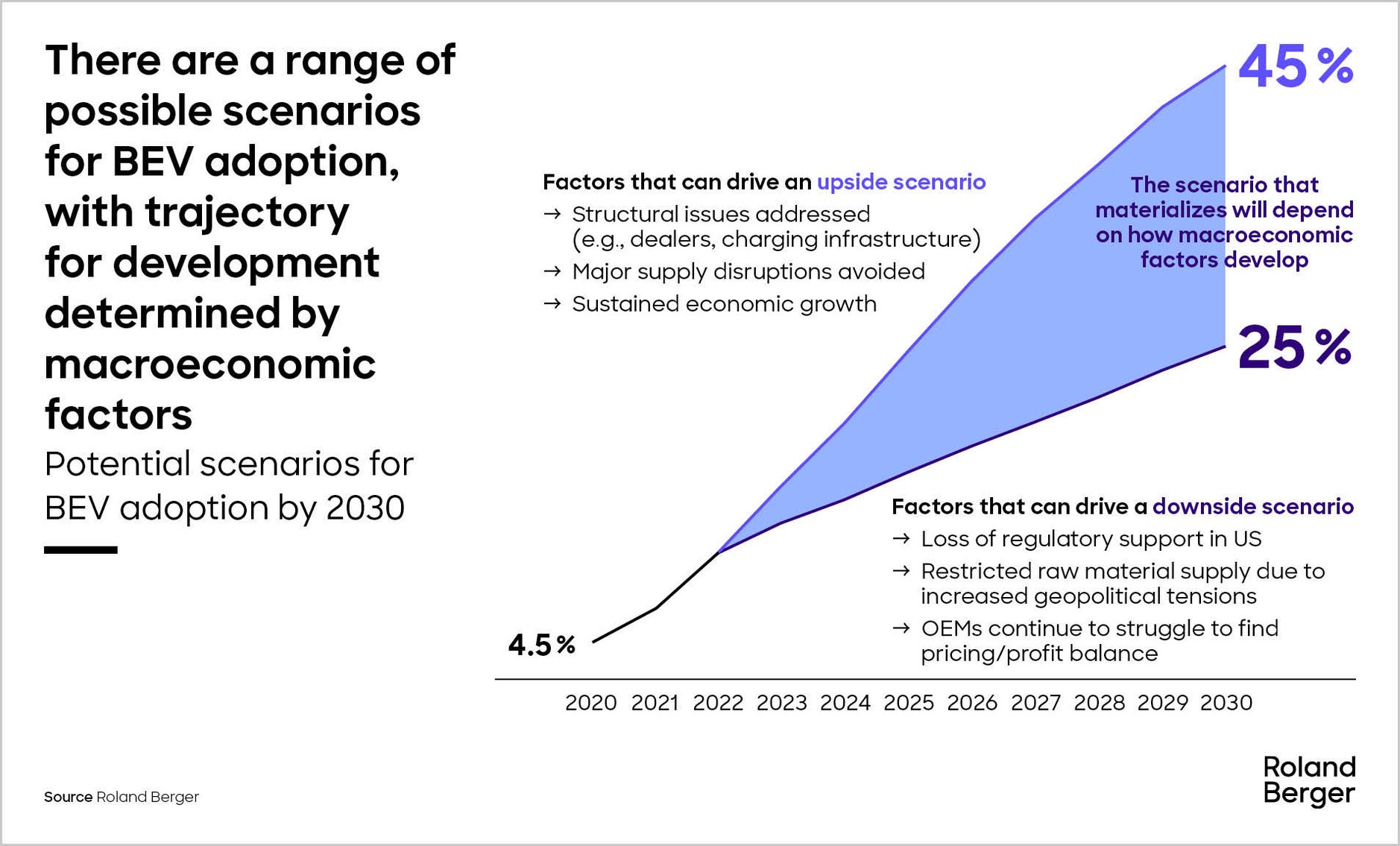
Seeing Tesla's success and feeling the growing government pressure, other automotive original equipment manufacturers (OEMs) started making their own commitments, promising to electrify between 50% and 100% of the production of such vehicles by 2030 or 2035. Their enthusiasm, combined with subsidies and legislation from policymakers, triggered a boom in the global production of BEVs and ever higher expectations for their adoption with market forecasts in late 2023 expecting ~45% BEV adoption globally by 2030.
Yet, recent developments - including delays in BEV program launches and major OEMs scaling back their BEV sales expectations - have called this forecast into question. At Roland Berger, we are regularly asked whether we think that BEVs will really make up half of all vehicles produced as early as 2030 - just six years from now. Will the supply chain for critical materials be able to sustain growth on this scale? Will enough charging stations have been built? Can customers even afford BEVs? Can our electricity grids support the required charging infrastructure?