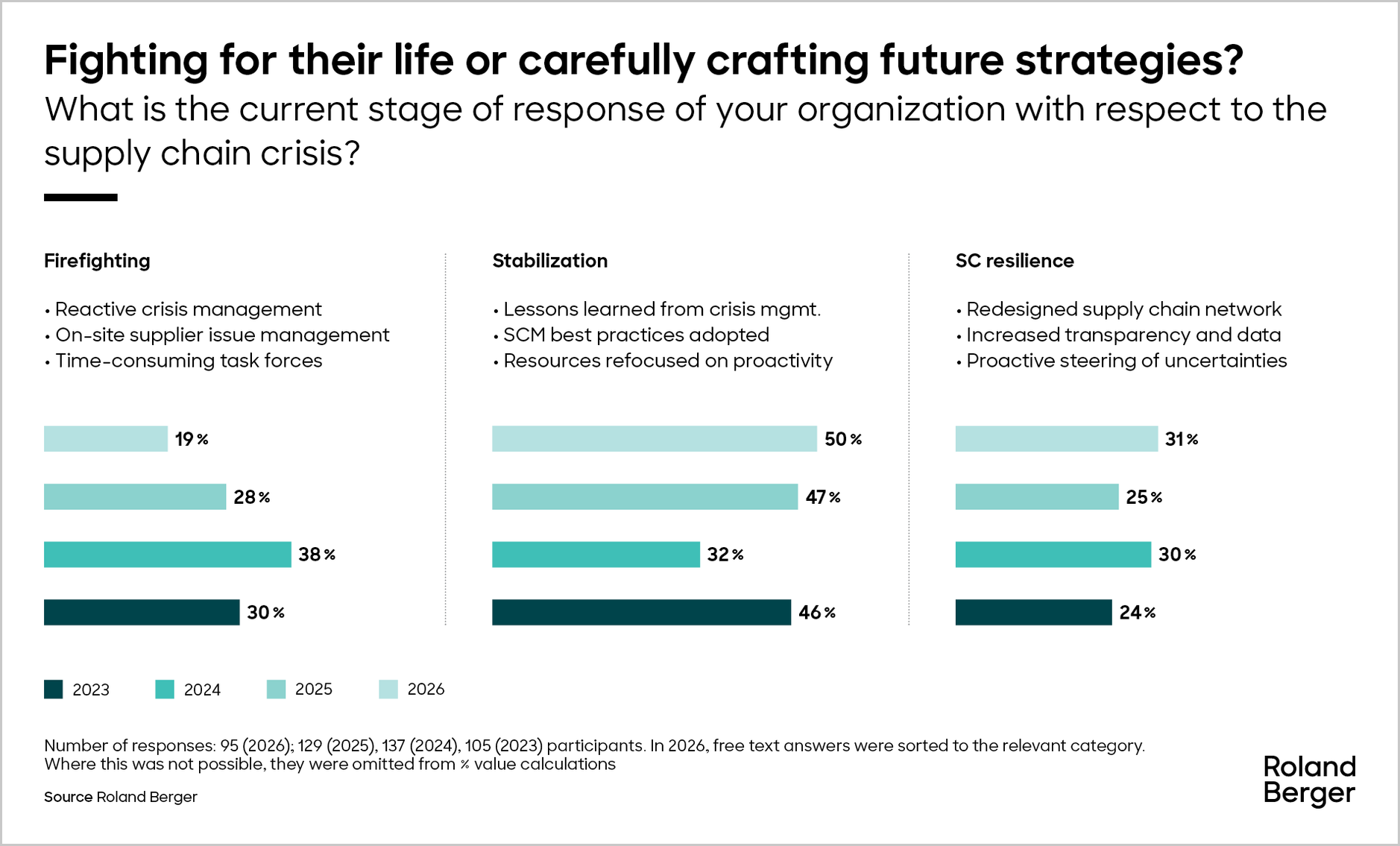
As the chart shows, more and more industry players are gradually emerging from full-blown crisis management. Many are now in a more considered process of stabilizing their operations, and over 30% have reached a level of
supply chain resilience
that lets them proactively prepare for future changes and developments.
That said, with more than half of respondents yet to resolve what can only be described as serious issues, the survey raises two important questions:
- Why do so many companies pay lip service to the benefits of programs such as Aero Excellence International but then fail to sign up and realize those benefits?
- Why do large numbers of players fail to adopt recognized best practices in everything from the design of their supply chain networks to the organization and quality of those supply chains?
In the past, overblown expectations have fueled perceptions that some best practices did not necessarily lead to hoped-for improvements. Be that as it may, the survey makes a strong case that suppliers and OEMs alike must be more consistent and realistic in making use of these valuable tools.
Expectation of material shortages – One of several key risks
Anticipating shortages of both raw materials and some semi-finished parts, many industry players have elected to diversify their supplier base. Others are actively boosting their inventories. The survey examines the reasons for these expectations and essentially acknowledges the sound logic behind these and other strategies. However, if the inventory build-up continues for too long, it can only add to the pressure on what, in many cases, are already razor-thin margins.
Above and beyond these very valid concerns, current geopolitical tensions have also prompted suppliers and OEMs to adopt timely countermeasures on a number of fronts. The survey explores how, in response, different companies are reorganizing their supply chain setup and even their internal production footprint.
Three scenarios
In light of all that is happening in and around the Middle East right now, the survey closes with a detailed look at the possible repercussions for the global aerospace supply chain. These repercussions hinge largely on how airlines – and hence production demand – are affected by the ongoing conflict. And this impact will be determined to a great extent by the duration of the current tense situation. Roland Berger thus spells out three crisis scenarios, each depicting a different timeline and varying levels of escalation. The survey then draws conclusions from each scenario for potential developments in the wider industry.