The
capital investment disadvantage
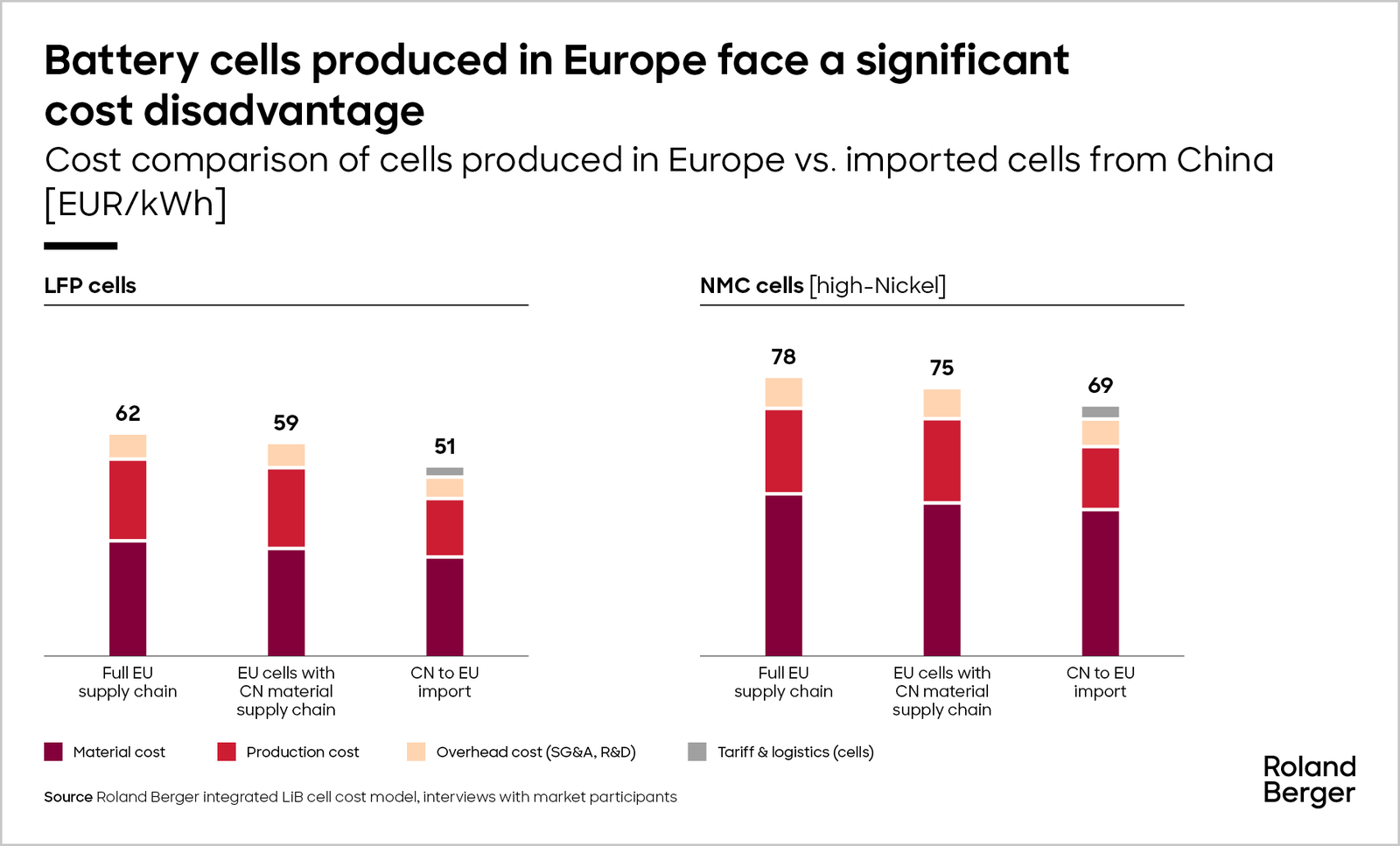
is estimated to be at least 50% to 100% higher for equipment and about 200% to 400% higher for building infrastructure, even for Asian manufacturers who largely replicate their facilities but must adapt them to local requirements. This results in additional investments of approximately €900 million to €1.1 billion for a 20 GWh facility. Operating cost disadvantages are mainly related to higher labor and energy costs. Ramp-up costs for new EU entrants are anticipated to add approximately €1.5 billion for a 20 GWh factory in Europe compared to new factories built by established Asian players.
Furthermore, significant overcapacity of cell production in China has intensified price competition, with prices approaching marginal costs. This situation presents considerable challenges for both emerging domestic manufacturers and established Asian companies operating in Europe.
Regulatory uncertainty and fragmented policy
Regulatory conditions in Europe threaten investment security, constrain rapid scaling, and increase costs. The core issue is a regulatory environment that is questioned repeatedly, and a lack of clear, long-term industrial strategy. Policy signals and detailed guidance that survive across election cycles are insufficient, unlike the more consistent, centrally coordinated approach seen in China.
The absence of a coherent, EU-wide battery industry strategy has led to fragmented regulation and planning uncertainty. Many measures, such as the Net Zero Industries Act (NZIA) and the Critical Raw Materials Act (CRMA), lack incentives for local content and binding requirements, offering limited leverage for true value chain localization. Current instruments are relevant, but their impact is diluted by slow rollout, non-binding requirements, and difficulties in accessing or allocating funds efficiently.
A central challenge is that current regulations are often not tailored to cell factories. Fire safety and building codes are major cost drivers, frequently prescribing detailed technical solutions rather than performance-based requirements. Hundreds of regulations, combined with the need to deal with a two-digit number of authorities to get the needed permits for a single plant significantly hinder project execution speed and increase costs. A “single point of contact”, responsible for facilitating and coordinating the entire permit-granting process”, while demanded within the NZIA, does typically not exist.