The global
aerospace and defense
supply chain has been under enormous pressure over the past few years. Crises ranging from the Covid pandemic to material shortages and high interest rates have caused unprecedented disruption, with planned deliveries of aircraft and engines severely reduced. Companies have been working hard to address the challenges, setting ambitious rate ramp-up targets to get the industry back on track as soon as possible. The question is, are they succeeding?
Since 2023, Roland Berger has conducted an
aerospace supply chain resilience report
to find out. Based on a survey of dozens of key industry players, it assesses the current health and future readiness of the supply chain, as well as outlining key priorities and identifying potential measures for improvement for OEMs and suppliers.
The 2025 report makes several notable findings. The most significant is that the industry may now be turning a corner – the supply chain crisis seems to have stabilized, with resilience increasing and disruption severity decreasing. To ensure progress is sustained, recommendations include optimizing the supply chain setup to improve resilience against future geopolitical disruption.
Key findings
The 2025 survey, which was again conducted in collaboration with the aerospace industry associations of the UK, Germany and France (ADS, BDLI and GIFAS), focused on three areas:
Ramp-up readiness
As in the 2024 survey, most aerospace companies still lack key resources to support the production ramp-up. At 65%, personnel shortages were the most commonly cited challenge, with little change compared to 2024. The number of respondents citing missing production capacity (34%) was also flat.
There was a significant increase in the perception of ramp-up readiness. Almost 70% of companies now believe they are either well-prepared or very well-prepared for the rate ramp-up, compared to half that figure in 2024. However, financing is emerging as a growing concern, with 49% of respondents now citing a lack of financial resources as a challenge, up from 41% in 2024. This highlights that, despite improved confidence in operational readiness, financial constraints could pose a risk to sustaining or accelerating the production ramp-up.
Overall, this indicates that the industry has now turned a corner, although it may take until 2026 before production rates improve.
Supply chain resilience
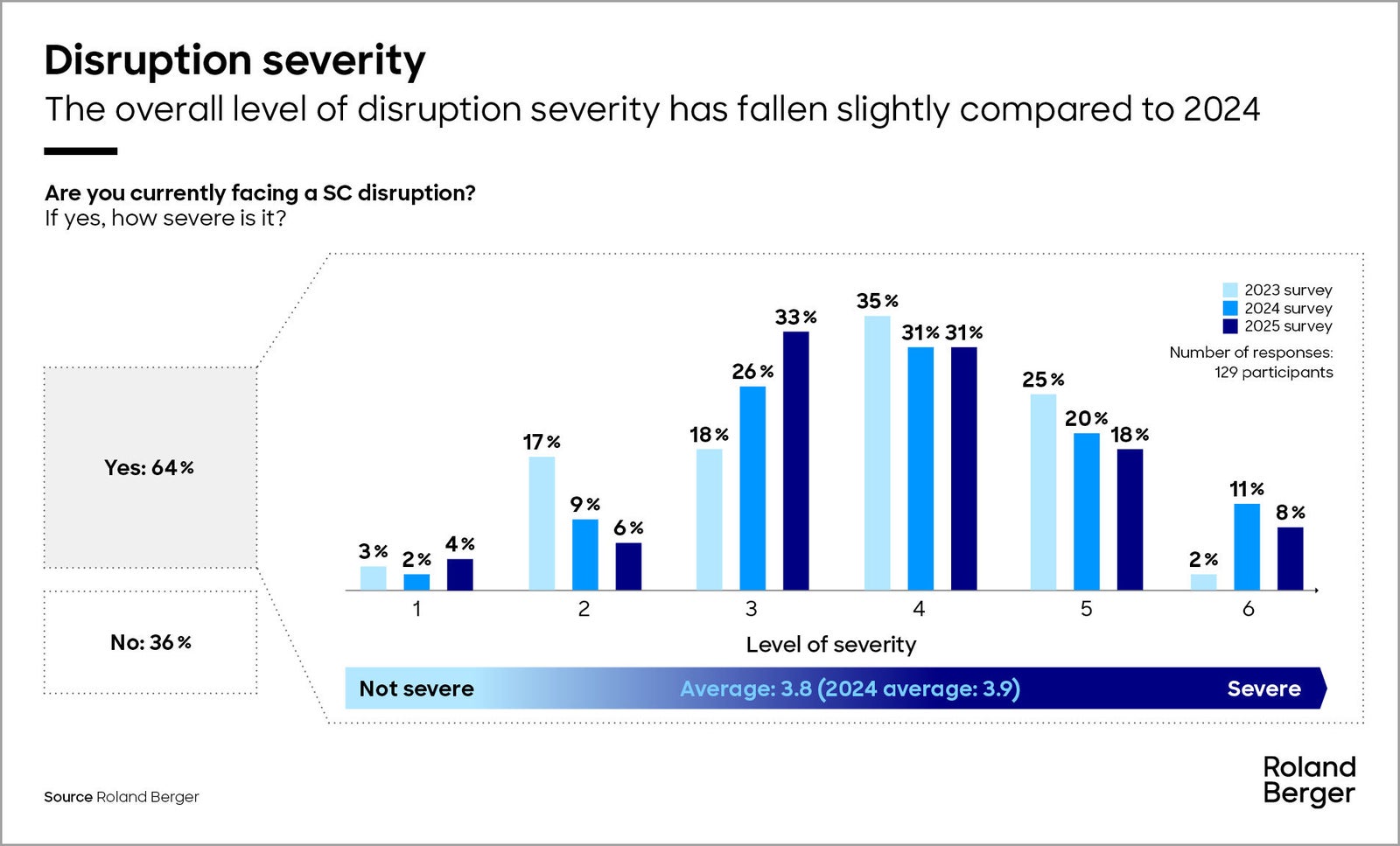
Almost two-thirds of companies (64%) are facing a supply chain disruption, only a two-percentage point improvement in 2024. The main reasons given for disruptions were largely unchanged – increased lead times and limited availability of raw material and semi-finished goods. Companies not affected by supply-chain disruptions gave reasons such as improved stock/inventory management, improved demand forecasts and good supplier relations. However, the level of very severe disruptions has fallen, with the most severe disruptions concentrated at Tier-1 and Tier-3+ levels.